
Exclusive:Scotland's Maternity Crisis: Nearly 40,000 midwifery shifts left unfilled across Scotland
Extent of crisis described as ‘staggering’ by senior health figure


Nearly 40,000 midwifery shifts were left unfilled across Scottish maternity and neonatal services over the past three years, with the staffing shortfalls more than doubling at some health boards.
An investigation by The Scotsman as part of its week-long series, Scotland’s Maternity Crisis, shows that at least 39,978 shifts went unfilled across the nation’s 14 health boards after being put out for agency or bank cover by health boards.
The overall number of unfilled shifts has risen sharply over the period, adding to the workload and strain of existing staff. The figure jumped from 12,647 in 2023/24 to 15,762 in the most recent financial year, the data shows.

However, the total number is likely to be higher given that some health boards were unable to provide the data for parts of the period in question. Others could only provide the data for calendar years instead of financial years.
Jaki Lambert, the director of the Royal College of Midwives in Scotland, described the scale of unfilled shifts detailed by The Scotsman as “staggering,” and warned that they exacted a “huge toll” on midwifery staff who were being asked to “fill the gaps.”
Read more here: Scotland's Maternity Crisis: A week-long series exposing nationwide problems and giving voice to families
However, the Scottish government said that ministers have been clear on the need to improve maternity services, adding that the number of midwives in Scotland has increased in the past decade, with health boards having a clear statutory duty to ensure appropriately qualified staff are available.
The stark figures come amidst growing concerns about staffing shortages. The most recent NHS Scotland statistics show that there were around 2,710 whole time equivalent nursing and midwifery vacancies as of 31 March this year. In the 12 months to that date, some £391 million was spent on bank staff - up 11 per cent year-on-year - with a further £34.5m going towards agency staff.

Out of Scotland’s 14 regional boards, NHS Greater Glasgow and Clyde reported the highest number of unfilled bank and agency shifts (10,111) over the three year period. Scotland’s biggest health board made 30,691 midwifery shift requests over the period, meaning that almost a third ended up going unfilled.
Staffing issues have been flagged at the board in recent months. In June, a Healthcare Improvement Scotland (HIS) inspection report found that staff at the Queen Elizabeth University Hospital in Glasgow told inspectors that staff raised concerns regarding the midwifery “skill mix” and its impact on the provision of safe care and patient safety.
Inspectors were also told by many staff members that they were unable to take a break due to work pressures and acuity, with the problem of staff not taking breaks viewed as “an accepted practice.”
NHS Grampian also reported high numbers of unfilled bank and agency shifts between 2023/24 and 2025/26, with a total of 7,307. The number shot up from 2,294 in 2023/24 to 2,779 in 2025/26.
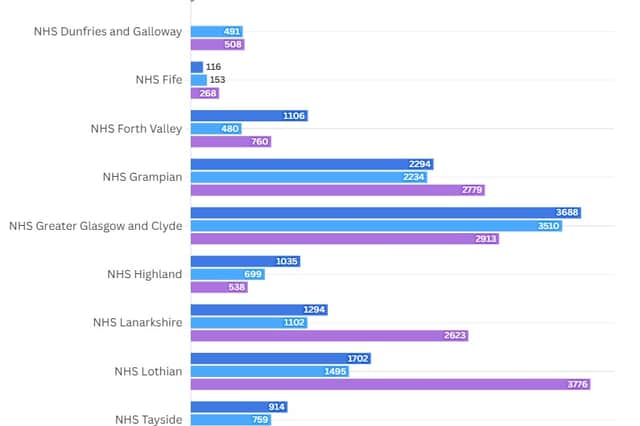
A report prepared earlier this year for NHS Grampian’s board said that workforce capacity remained the most significant risk across its maternity and neonatal services. It pointed out that high workloads and rising acuity required a review of staffing models and funded establishments, with the service facing challenges when it comes to achieving compliance in mandatory training, supervision and audit activity.
NHS Lothian has had to deal with 6,973 unfilled shifts across its maternity and neonatal services over the three year timeframe, with the number more than doubling from 1,702 in 2023/24 to 3,776 in 2025/26. The majority of the unfilled shifts (4,179) at Scotland’s second largest health board were at the Royal Infirmary of Edinburgh.
Last October, an inspection of maternity care at the hospital found that staffing shortages and a “culture of mistrust” had led to delays and patients being harmed at its maternity unit. The inspection of maternity care also said that some women waiting for labour to be induced had experienced delays of upwards of 24 hours, with some staff raising concerns about being overwhelmed and unsupported.
Elsewhere, NHS Lanarkshire has also seen a significant number of agency and bank midwifery shifts go unfilled. The health board only provided a breakdown of numbers by calendar year, but they show that there were 1,294 such empty shifts in 2023, 1,102 in 2024, and 2,626 over 2025. Between 1 January and 30 June this year, there were 1,390 unfilled shifts.

The data, obtained via freedom of information legislation, also shows that NHS Tayside had 2,707 unfilled shifts, the vast majority of which were at Ninewells Hospital in Dundee. It has seen a more modest rise in the number of shifts that were not staffed over the period, up from 914 in 2023/24 to 1,034 in 2025/26.
There were 2,346 unfilled bank and agency midwifery shifts at NHS Forth Valley and 2,272 at NHS Highland, although they were among a handful of health boards where the number had fallen over the timeframe.
At NHS Ayrshire & Arran, NHS Dumfries and Galloway, NHS Fife, and NHS Borders, there were 1,560, 999, 537, and 147 unfilled shifts respectively. However, NHS Dumfries and Galloway’s figure excludes 2023/24, for which no data was available.
The health boards in Shetland, Orkney and the Western Isles did not report any unfilled bank or agency shifts over the period.
Ms Lambert said: “These figures further confirm what our members have been telling us for years - that maternity services in Scotland are being held together by staff going above and beyond, shift after shift, to fill the gaps.
Read more here: Scotland's Maternity Crisis: Why safe maternity staffing levels are desperately needed
“We know that bank shifts may be recorded differently across health boards but almost 40,000 unfilled shifts in three years is a staggering figure. The fact that it's risen so sharply shows this problem is getting worse, not better. That’s despite a real crackdown on the use of bank midwives in health boards. At the same time, we know that the workforce plans, asking for permanent staff to fill these gaps, are not being approved. The maths simply doesn’t add up.”
She added: "An unfilled shift doesn't mean the work disappears. It means the midwives and maternity care assistants who are there end up covering more with less time and support to give each woman the care she needs. It takes a huge toll on midwifery staff and it's exactly the kind of pressure that pushes them to the point of leaving the profession altogether.”
A Scottish government spokesperson said: “Ministers have been clear that maternity services across Scotland must be improved. That is why we commissioned inspections of every acute maternity unit via HIS and why we announced a new independent review to be led by Professor Christine McCourt.
“We also established the maternity and neonatal taskforce to promote improvements in maternity and neonatal care, pregnancy and birth. Ministers are now considering how the taskforce will work alongside the independent review.
“The number of midwives in Scotland has increased in the past decade and health boards have a clear statutory duty to ensure appropriately qualified staff are available in numbers that safeguard patient and staff wellbeing.”
Comments
Want to join the conversation? Please or to comment on this article.