
Rare gold dental bridge uncovered at medieval Scots site
Researchers highlight ‘social importance’ of gold wire


It is a modern fashion trend popularised by the hip-hop scene, but researchers have pinpointed an example of so-called dental ‘bling’ in Scotland stretching back half a millennium.
Archeologists have discovered a man who lived in Aberdeen around 500 years ago had been fitted with a gold dental bridge.
While the 20 carat ligature would have been needed to stabilise a tooth or replace a lost one, experts from the University of Aberdeen said it was likely the implement was also used for cosmetic purposes.
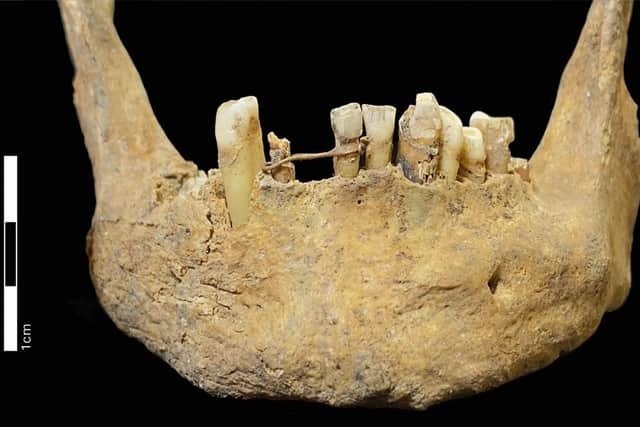
In what is the earliest known case of restorative dentistry ever found in Scotland, the ligature was formed out of 20 carat gold, silver, and copper alloy, indicating that a goldsmith or a jeweller was sought out to craft, and possibly even fit it.
The discovery was made among the skeletons excavated during archeological work at the east kirk of Aberdeen's St Nicholas Church, one of the oldest places of worship in Scotland. Known locally as the Mither Kirk, records indicate a church was present on the site as far back as 1151.
The researchers said the middle aged man, who was buried sometime between 1460 and 1670, was likely to have been a “relatively wealthy” member of the north east community.
They pointed out that during the late medieval and early modern period, an individual’s physical appearance was believed to be indicative of their character, meaning that a pleasant smile was a valuable social currency. “The reasons for undergoing this procedure extended beyond retaining masticatory abilities and oral function,” they explained.

“The appearance of a person and their perceived health was linked to one's sins. As such, the social importance of an individual's smile encouraged those who were able to afford such treatments to seek them out.”
The earliest accepted examples of dental ligatures can be found in Egypt, where gold and silver wires were used. However, few examples of dental ligatures have been found at archaeological sites in Europe that predate the 17th century.
The researchers added that it was unclear whether the Aberdeen man was fitted with the fine gold wire ligature locally, or if it was fitted elsewhere. But they pointed out that records indicated that at least 22 goldsmiths were known to have been operating in the region during the late medieval and early modern period.
Their findings, published in the British Dentistry Journal, also sheds light on the history of practice of dentistry, long before the first dental qualification was introduced in the mid 19th century.
Up until then, treatment was provided by a range of practitioners, some of whom had only rudimentary skills. Barbers, craftsmen, and healers were often relied on, while so-called travelling carnival performers known as ‘tooth drawers’ were also favoured - at least until their promises of painless extractions were shown to be empty.
In some communities, a series of curious bespoke remedies were also used for oral health as late as the 20th century. In Skye, toothache was treated with turf that had been heated with embers, while in parts of Aberdeen, accounts indicate that one treatment for abscesses involved a cow dung poultice.
Comments
Want to join the conversation? Please or to comment on this article.