
Could this be the face of an ordinary Pict? Aberdeen University student makes 'special' Fife discovery
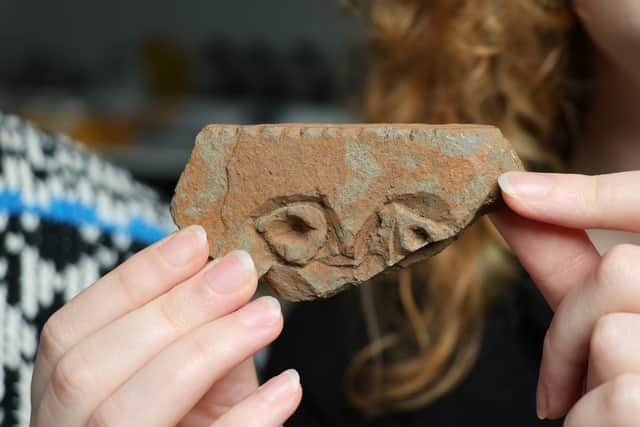
With its two eyes, nose and hairline, the carving alludes to the people of East Lomond in Fife around 1,500 years ago.
An incredibly rare, carved depiction of what may be a human face has been unearthed at a Pictish hillfort in Fife.
The carving was unearthed at East Lomond near Falkland by an archaeology student at Aberdeen University during a recent excavation.

East Lomond, with its panoramic views across Fife, was an important site during the late Iron Age and is believed to have then formed the southernmost part of Pictland, which ruled a large part of what is now Scotland through a series of kingdoms, between the 3rd and 9th century.
Professor Gordon Noble, head of archaeology at the university and leading authority on the Picts, said East Lomond had proved to be an “amazing” site given the quality of finds made there. These finds include the fragment of carving that he suggested could depict an ordinary Pict in contrast to the more regal figures recorded on larger symbol stones.
“This is an early schematic carving with two eyes, a nose and what appears to be a hairline at the top,” he said. “We need to get this fully analysed, but it appears to be a carving of a face, and resembles some of the human faces you see in early medieval manuscripts.
“It is incredibly rare to have a representation of a human face in this time period. We’ll have to look at all the parallels, but if it really is a human face it’s nice to think it could be a rudimentary portrait of a local Picts who lived at East Lomond.”
The carving was found in the remnants of a building dating to between the 5th and 7th century.
Prof Noble said: The discovery could offer new insights into how Picts understood themselves and represented their own identities through crafting and stone carving.
“The face suggests that Pictish people here were making more expedient carvings, perhaps something for family members living at the site rather than public display like the more famous Pictish symbol stones.”
The archaeologists will now work to make sense of the face through radiocarbon dating of the floor layers and settlement deposits associated with the building. The search is on for parallels in art history, which could help in understanding more about the character and context of the small carved stone object.
Professor Noble said: “East Lomond is turning out to be such an amazing site. In addition to the face, we found a complete mattock head [and] an iron tool from the floor of a building right next to the building with the carving.”

The carving was found by Jodie Allan, a third-year archaeology student who volunteered on the dig run in conjunction with Falkland Stewardship Trust, which has long investigated the site.
Ms Allan said: “I had no idea I was holding anything significant. But I took a closer look because of its size and because the colour – a sort of oxidised coppery green – caught my eye.
“I showed it to Professor Noble who took one look at the stone and his reaction told me it was something special – with what appears to be a carved face on it.”
Previous work has unearthed Roman imports such as Oxfordshire Ware pottery.
Comments
Want to join the conversation? Please or to comment on this article.