
'A profound threat': How Scottish politicians view the prospect of another Donald Trump US presidency

Donald Trump is currently the favourite in the race for the White House
Scotland is bracing itself for another Donald Trump presidency, with warnings the re-election of the former US leader represented a “profound threat” as the Republican inched ahead in the polls just a week-and-a-half out from the vote.
Politicians north of the Border have expressed widespread concern to The Scotsman about Mr Trump’s potential return to the White House, as he is pitted against Kamala Harris in the looming US presidential election on November 5.


Mr Trump's odds of beating vice-president Harris, the Democratic candidate, have recently edged higher on betting websites, though opinion polls show the race is a dead heat.
While the Scottish Greens and Liberal Democrats lamented Mr Trump’s character, some in Labour suggested the real power lay in the US Congress and the Senate.
Most concerned was Scottish Green co-leader Patrick Harvie, who called the Republican leader “far-right”.
He said: “It’s a profound threat, a threat in terms of direct impact on policy, areas like climate policy, a threat geopolitically to potentially embolden and empower some of the most dangerous forces in the world, but also a threat to democracy itself.
“Win or lose, it looks like it's going to be a very close election and it is going to demonstrate that a campaign that is not only a bit dishonest, but one that is fundamentally built on lies and conspiracy theories, is capable of engaging half of the electorate of a very powerful developed economy.
“That's a profound threat at a time when we see similar far-right populist parties on the rise in Europe, and the manipulation of misinformation and the very clear direct corrupt abuse of money.”
Despite this, Mr Harvie insisted a Trump presidency could be bypassed by working with others in America.
He said: “When he [Mr Trump] formed his first administration, we made the case that the relationship with America is still profoundly important, and there's an opportunity to refocus it from the US Government itself that will never cease to be a relevant relationship. But actually to focus on a relationship with those parts of the U.S, that do respect democracy, that do respect human rights, that are taking climate action, and very often that's at state and city level that we’ll find the allies who will actually share a common vision.”

Scottish Liberal Democrat leader Alex Cole-Hamilton, who has been in the US campaigning for the Democrats, insisted a win for Mr Trump would not mean politicians could not criticise the Republican’s conduct.
He said: “Our special relationship isn't very special if we can’t be a critical friend of the worst excesses of the political extremes. In terms of politics, you can call people out in a robust, but respectful way. But you still call them out. You can’t just pretend like something isn’t happening.
“We all survived one Trump presidency, we can survive another one. I just worry about the degradation of women’s rights, and the degradation of democracy.
“Some of the things he’s been coming out with about what he’d do to his opponents, using the judiciary etc. I would never be disrespectful about him publicly, but I will always call out the excesses and the worst of his personality quite freely.”
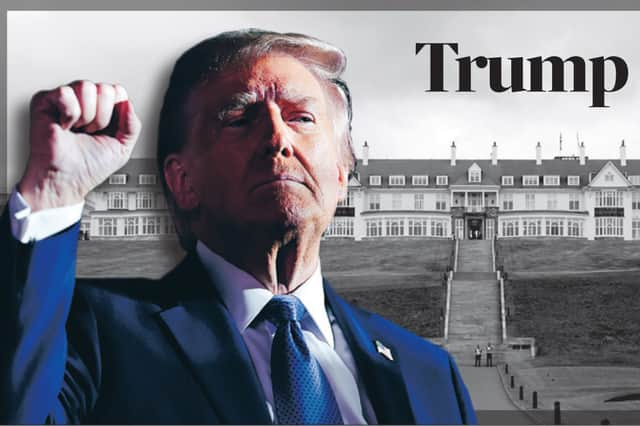
The fears are shared by Christine Jardine MP, who also referenced Mr Trump’s controversial golf course in Aberdeenshire. Built in 2012, the original proposal included approval for a 450-room hotel, 950 holiday apartments, 36 'golf villas' and 500 houses for sale, but none of these have been built so far.
She said: “It [his re-election] would fill me with dread. I am not a fan of his policies, when I can decipher what they actually are. He is not the sort of politician I admire. All the publicity that has surrounded his court cases give me the impression his attitude towards women is not very refreshing.
“All of his public pronouncements, all of his public actions reinforce the negative impression I’ve had over the years. The thought he might have another term of office does not fill me with excitement.
“I spent a lot of my life in Aberdeenshire, and I remember the direct consequences of what sounded like a simple plan of building a golf course, and the promises that were made. Maybe I am biased, but he is not someone I put a great deal of faith in.
“I would find it very difficult to support a state visit if it was offered, but I would have to respect the fact that if the American public vote to elect Donald Trump, he is their head of state.”
Labour MP Dr Zubir Ahmed downplayed the idea the identity of the president was the most important factor, insisting there was still work to be done between administrations.
Referencing his own experiences visiting the US as a candidate, Dr Ahmed said: “I think so much of what is going on transatlantic transcends the individual. So much of American political debate over the last 30, 40 years has been over what the Senate or Congress thinks, especially on big international issues such as security and economic growth.
“For individual parliamentarians, that’s what we need to think about, how we place ourselves with the US. They are a long-term partner, and we are one of a few countries that support the international law order.
“I would talk less about Trump, and more talk about there being work needed to be done between legislatures. I actually went there last year with a few parliamentary candidates, and we met with senators and congressmen and women, and that was really enlightening to me.
“The strength of the relationship is not based on the Prime Minister or the President, but the layer below that, and we need to strengthen it.”
Labour MSP Paul Sweeney focused more on the impact another Trump term would have on Ukraine and international conflict.
He said: “The looming question is, what happens in Ukraine, where does that lead in terms of escalation with Russia, does it embolden China to move on Taiwan?
“That’s the challenge. How do you get to the point in the Ukraine conflict where you are able to find a solution?
“Trump is prone to isolationism. The worry would be that it could give a signal that China could invade Taiwan or embolden Russia to open a new front and annex more of Ukraine.
“It raises the question - are European countries capable of developing defence capability to offset an American withdrawal? Even Britain, Europe's leading military power and Nato member, has seen its defence spending reduce from around 4 per cent in 1990 to just over 2 per cent this year and I doubt there is a political will to go back to that Cold War scale of defence expenditure anytime soon."
Comments
Want to join the conversation? Please or to comment on this article.