
From golden eagles to local jobs, these seven Angus estates do a lot of good – Iona McGregor
Politicians need to recognise the work that estates do in terms of habitat management, wildfire prevention, investment in rural skills, and more

People often speak about the five glens of Angus as a landscape. It is easy to understand why: these hills, rivers and moors form one of Scotland’s most breathtaking places. But for those of us who know Clova, Esk, Isla, Lethnot and Prosen, they are not simply scenery. They are home.
When I look across the glens, I see families raising children, tradespeople travelling to work and men and women caring for the land in all weathers. I see businesses and communities fighting to retain the people, services and connections that keep them alive.
That human story is why a new report on the economic, environmental and social impact of moorland and grouse management matters so much. Produced by the Angus Glens Moorland Group and Scottish Land & Estates, it examines seven estates managing 54,715 hectares – around 60 per cent of the Angus Glens.

Estates worth millions to local economy
As another grouse season approaches, bringing visitors from Scotland, elsewhere in the UK and overseas, this first comprehensive account of activity across the estates challenges the idea that they are single-purpose operations whose contribution begins and ends with country sports.
During 2025, the estates supported 86.5 full-time equivalent jobs, engaged 768 seasonal workers and invested £3.66 million in employment.
‘Employment costs’ can sound cold. In reality, that money represents wages brought home to families. It helps pay mortgages, energy bills and the weekly shop, while allowing people to build careers where they grew up or find flexible seasonal work.
The estates also provide 68 homes, including 23 occupied by families with school-age children. Those families stayed in my mind because, in a rural community, every family counts. They help sustain school rolls, shops, clubs and services, ensuring the glens remain living communities rather than places people visit but cannot call home.
A further £2.94m was spent on contractors, goods and services, with 82.5 per cent – more than £2.4m – going to local businesses. That spending supports garages, plumbers, groundworkers, fencing contractors, agricultural suppliers, butchers and hotels. For them, an estate is not an abstract concept – it is a customer providing regular work, supporting skilled jobs and keeping money circulating locally.
When one part of this network is weakened, the effects do not stop at an estate boundary. They travel through the workshop, the shop, the school and the family home.
READ MORE: 'We are losing the identity of Scotland' – new charter launched to protect the open moors
Grouse shooting matters
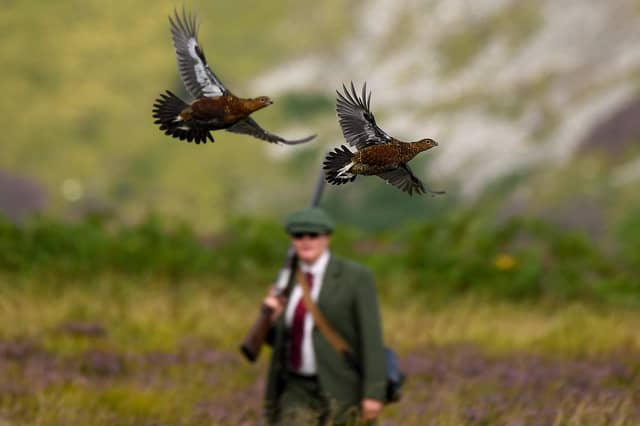
Grouse shooting is part of this picture, and we should not shy away from saying so. Across the estates, 84 grouse shooting days took place in 2025. Each shoot day required an average of 54 seasonal staff on the estate concerned.
Public discussion often focuses only on those participating in the sport, overlooking local workers and the businesses supplying food, equipment, vehicles and services. These days matter economically, but they also bring generations of the community together.
Some critics will dismiss this contribution as modest or easily replaced. That is easy to say from a distance. It is harder to say to a family whose income depends on the work, a contractor relying on the business or a community that knows how quickly jobs can disappear.
Eagles and kites, curlew and skylarks
Nor should we accept that rural employment and environmental protection are competing interests. Detailed monitoring on one estate recorded 102 bird species, 145 species of butterfly and moth, 19 mammal species and 146 plant species.
Across all seven estates, 16 species of raptor and owl were identified. White-tailed eagles, golden eagles, red kites, peregrine falcons, buzzards and kestrels were recorded on every estate. The glens also support curlew, lapwing, black grouse, skylark and other upland birds facing serious pressures elsewhere in Britain.
This does not mean every environmental challenge has been solved or that land management is beyond scrutiny. It shows why debate must be grounded in evidence and why active management should be recognised as part of the solution.
‘Getting harder and harder’
The Angus Glens are also shared landscapes. Schools, walking groups, mountain rescue teams, universities and environmental organisations all use the land. More than £114,000 was invested in track maintenance in 2025, supporting recreation, emergency access, research and land management.
Our partnership with Strathmore Rugby Club offers another example: over two seasons, 1,519 game meals from the estates were served to players and hospitality guests. The estates’ contribution can be found in a family home, a local garage, a university project, a mountain rescue operation or a meal shared after a match.
I am proud of what this report demonstrates, but I am also concerned about what could be lost. Those working on the land are being asked to deliver more for biodiversity, climate resilience, public access and rural employment while facing greater regulatory complexity and economic pressure. As one contributor to the report put it, “it’s getting harder and harder”.
Seeing the big picture
Policy decisions made far from the glens can have intensely personal consequences here. If a job disappears, a family may leave. A local business loses a customer, a school loses pupils and another thread holding the community together begins to fray. Those jobs, skills and relationships are difficult to recreate.
We are not asking decision-makers to exempt moorland management from scrutiny. We are asking them to look at the full picture.
We need clear, stable and workable regulation; recognition of practical habitat management and wildfire prevention; investment in rural skills; and support for the integrated land uses that sustain people and nature.
The Angus Glens are not a museum, an empty space on a map or merely a subject for political argument. They are a home, a workplace and a community. The people whose lives are woven into this landscape deserve to have their contribution seen, understood and valued.
Iona McGregor is regional co-ordinator of the Angus Glens Moorland Group
Comments
Want to join the conversation? Please or to comment on this article.