
'We are losing the identity of Scotland' - New charter launched to protect the open moors


Warning that conservation has been largely overlooked in land use discussions
It is a landscape that has inspired generations of Scottish writers, from Sir Walter Scott to John Buchan, supports some of the country’s richest biodiversity and has helped shape Scotland’s national identity.
Yet the experts behind a newly launched charter have warned that the protection of heather moorland and open hill ground has been largely overlooked in Scottish government discussions about land use.
As ministers pursue net zero ambitions through woodland expansion, commercial forestry, natural capital projects and renewable energy developments, Scotland’s moors are undergoing significant change. Campaigners argue that, despite the habitat’s importance for carbon storage, biodiversity and rural employment, there is currently no formal policy framework specifically designed to promote it in the face of significant landscape changes.
The newly launched Charter for the Open Hill aims to address this, calling for greater protection of Scotland’s open landscapes from what its authors describe as continued fragmentation and loss.
“We are losing the identity of Scotland,” said Dr James Fenton, a peat expert and one of the co-authors of the document.

“Its landscapes are disappearing. It is being planted and managed, which is what everywhere else in Europe is like. The highlands had managed to escape that, but now we are losing that feel of our wild places Scotland-wide.
“We want the government to do something to conserve what is the essence of the upland landscape of Scotland because there’s nothing to protect that at the moment.”
The independent charter highlights the international significance and rarity of Scotland’s moorland and open hill ground, as well as its contribution to tourism and employment through land management, deer stalking, gamekeeping and sheep farming. Its authors warn that these landscapes, that support species from waders to red deer to raptors, are increasingly under pressure from the combined impacts of tree planting and infrastructure developments, including wind farms, vehicle tracks, reservoirs and power lines.
Dr Fenton said the paper will be presented to Scottish ministers with a demand for a strategy identifying areas of open moorland and hill that should be shielded from such landscape changes.
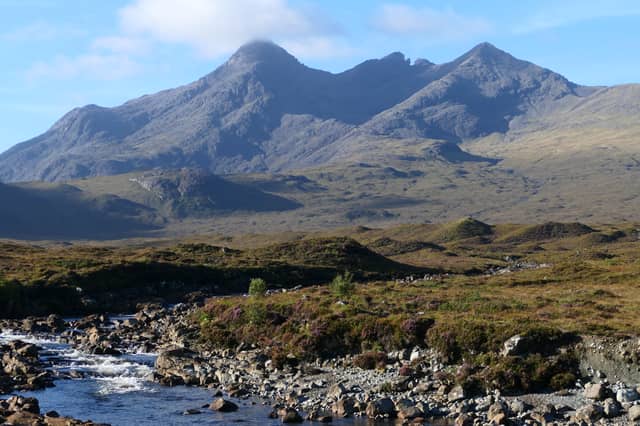
“The view across the Sligachan from the Cuillin, for example, or the view from Buachaille Etive Mòr to Rannoch Moor, everyone would agree that we don’t want to destroy that view,” he said.

“Where else do we want protected? Which key areas of large, unfractured moorland do we want to keep as open hill?”
The ecologist said the charter had also emerged from frustration among some rural communities who feel they have little influence over decisions affecting the land around them.
“The people of Scotland have no say in how their land is managed and how the landscape is being changed by large organisations, be it forestry, woodland or large developments. Formal consultations are a bit of a sham; they don’t really change anything, they just treat the edges of whatever the land was bought for.
“A lot of rural people are upset about what’s happening. Even if the charter at least starts a debate and gets the government thinking, that’s something.
“We want the charter to be seen as everybody’s charter.”
Scotland’s relatively treeless landscape has long been the subject of debate among conservationists and ecologists. Some argue that tree planting and natural regeneration are essential to restoring lost habitats, including the Caledonian Forest, while helping address biodiversity loss and habitat decline.
Woodland Trust Scotland’s policy manager, Simon Ritchie, argues that Scotland needs more woodland, pointing out that the country has about 19 per cent tree cover compared with a European average of 37 per cent.
Others, including Dr Fenton, argue that Scotland cannot be compared like-for-like with other countries and that its landscape has naturally evolved into open hill and moorland.
Rather than opposing tree planting outright, however, Dr Fenton said the charter was launched to highlight and promote the value of Scotland's open hills.
“It is not valued right now because it is common in Scotland,” he said.
“But internationally, if you stand back, moorland is rare and woodland is common. We need a more international perspective. Once moorland is rare, people will value it and say we need to stop trees. We don’t want it to get to that point.”
Mr Ritchie said the debate should not be framed as a choice between one habitat and another.
“We can and will have both,” he said. “This country is big enough to have expansive, connected and ecologically healthy native woodlands, thriving for nature and people, as well as restored peatland, open hillside, bare rocky crags, species-rich grassland, lush farmland and a full mosaic of habitats.”
Supporters of the charter, however, argue that Scotland's moorlands still lack comparable recognition. While the Scottish Government has Forestry and Land Scotland and Scottish Forestry to oversee and promote the country's woodlands, they say there is no equivalent body dedicated to championing the contribution of moorland landscapes. They also point to a lack of action at government level over self-seeding non-native Sitka spruce from commercial forestry across carbon-rich soils, which is damaging moor habitats.
“There is no counter to this huge policy pushing towards covering moorland with trees,” Dr Fenton said.
“The people who do [represent moorland interests] — the landowners, the grouse shooters and deer stalkers — are not flavour of the month among politicians, so they don’t have any credibility.
“There are lots of discussions around moorland management, such as muirburn and deer. But what the charter is saying is more fundamental. It’s not associated with any particular organisation or politics, it’s just about keeping moorland as open hill in the first place.”
Co-author Bill Cowie, who managed the Isle of Rona for decades and now lives on Skye, said the charter was a response to what he described as years of change imposed on Scotland’s uplands.

“After decades of insidious infringement of the vast open moors and hills of Scotland by organisations seeking their own interpretation of ‘wilderness’, which has no cultural empathy with our landscape, it is now time for the communities who live and work in such places to say enough is enough,” he said.
“Many conservation bodies prioritise their own agendas, which negatively impact rural economies, over the lived — often for generations — knowledge and experience of those who call the rural landscape home.
“It is an unhealthy power balance, with the former imposing biased changes on local communities who feel powerless to overcome grant-funding-driven conservationists.
“To move forward we must consider all facets of knowledge and experience available, with one not being of detriment to the other: we must work together to see the bigger picture.”
The Scottish Government was approached for comment.
Comments
Want to join the conversation? Please or to comment on this article.