
Tennent’s: How Scotland’s 140-year-old lager brand is taking on the Germans
“It can be traced back to Hugh Tennent who spent a lot of time in Bavaria perfecting the Tennent’s product” – Roger White, C&C Group CEO
Tennent’s is continuing to gain market share helped by the launch of the first new products in several years and as price-sensitive drinkers switch to “better value” longer pours at the expense of wines and spirits.
Releasing its first-half results, parent company C&C Group said Tennent’s - already Scotland’s best-selling beer - had outperformed total lager sales in the on-trade market, increasing market share by a further 0.6 percentage points in the latest 28-week period.
Tennent’s net revenues were up by 1.4 per cent in the first half, with higher pricing offsetting a volume decline of 2.8 per cent. Overall beer consumption in Scotland experienced a 2.7 per cent drop in volume over the period.


A new marketing campaign dubbed “Braving the Summer since 1885” saw the iconic Glasgow-based brewer celebrate its 140th anniversary. It also pushed further into the “no and low” alcohol space with the launch of a reformulated Tennent’s Zero product and a re-launch of its lower-strength Tennent’s Light.
Most recently, the firm has marked the first innovation for the brand for some time with the introduction of Tennent’s Bavarian Pilsner, the first in a range of limited edition products.
Dublin-headquartered C&C Group is led by Scots-born Roger White, who took the helm as chief executive towards the end of January, having led AG Barr, the Cumbernauld-headquartered maker of Irn-Bru, for 22 years until May last year.
White, who was one of Scotland’s longest-serving chief executives before he stepped down at the famous soft drinks maker, said the new German-inspired pilsner, which is being produced at Tennent’s historic Wellpark Brewery in Glasgow, was being rolled out to “most good stores” and a few on-trade outlets.
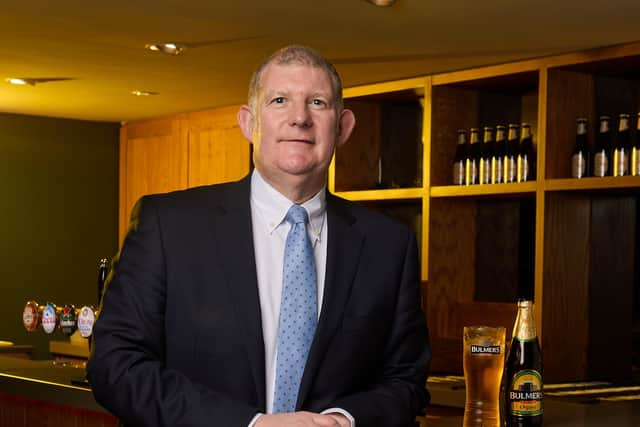
“It is moving through the retail supply chain right now,” he told The Scotsman. “It’s got a little bit more of a bite, at 4.7 per cent ABV. Germany is where the best beer comes from. It’s an original Bavarian recipe. It can be traced back to [founder] Hugh Tennent who spent a lot of time in Bavaria perfecting the Tennent’s product and this is, if you like, an offshoot of that.”
He said the new pilsner would be the first in a run of limited edition products from Tennent’s.
C&C Group said 2025 had been “another year of turbulence” for the UK hospitality industry, marked by changing fiscal and economic conditions, shifting consumer trends and “varied levels of consumer confidence”. The group added that shorter opening hours and variable footfall had driven “volume challenges” across some hospitality channels. Drink-led venues were said to have proved more resilient.
C&C noted that minimum unit pricing (MUP) in Scotland continued to require “careful navigation for all brands”.
White said the firm had “adjusted its way through” the more recent changes to MUP.
Make sure you keep up to date with breaking news from across Scotland by signing up to our free newsletter here.
In the UK on-trade sector, the shift in mix towards beer and cider continued during the year, the group added, as consumers increased spending on both categories due to a “notable preference towards lower tempo occasions as well as the prioritisation of longer serves that represent greater value for money”. This growth in beer has been at the expense of wines and spirits, both of which have seen value share losses in the year.
C&C, whose other brands include Bulmers, Magners, Menabrea and Orchard Pig, reported a 4 per cent rise in operating profit to €41.9 million (£36.7m) for the six months to the end of August, compared with the same period a year earlier. That came despite a 4 per cent year-on-year decline in net revenue to €825.7m. The drop in sales was primarily due to the transfer of Budweiser Brewing Group volume in Ireland.
Operating margin improved by 0.4 percentage points to 5.1 per cent as the group maintained tight cost controls and exited low-margin contract business.
The FTSE 250 group said it expected to see continued solid trading in the second half, with “strong plans” in place for the key festive trading period.
On the potential for acquisitions, White said: “We are on a self-help journey trying to improve what we’ve got, but the balance sheet is strong and our debt capacity is strong so if the right thing came along that made the right amount of sense then it’s possible.”
Clive Black, an analyst at brokerage Shore Capital, said: “C&C has reported first-half results that are well within our expectations and with the board seeing current trading in-line with plan it is not adjusting its anticipated outcome. Hence, we would not expect to be notably adjusting our forecasts or for consensus to change on this update.
“C&C’s wise and highly capable CEO, Roger White, speaks to a challenging market, a ‘solid’ first half but still work to do around simplification and cost improvement from which, we believe, shareholder benefit can ensure. Hence, while the shares may tread water for a little while on this update, we continue to like the ongoing story.”
Analysts at Davy Research noted: “With the mid-September trading update capturing key headlines, today’s update contained little by way of surprise. The business continues to execute to plan against a challenging market backdrop.
“The statements note the requirement for business model adaptation to harness scale while de-complexing and driving efficiencies which will take 12-18 months to effect. We envisage no material change to our forecasts.”
The half-year numbers follow May’s full-year results.
Comments
Want to join the conversation? Please or to comment on this article.