


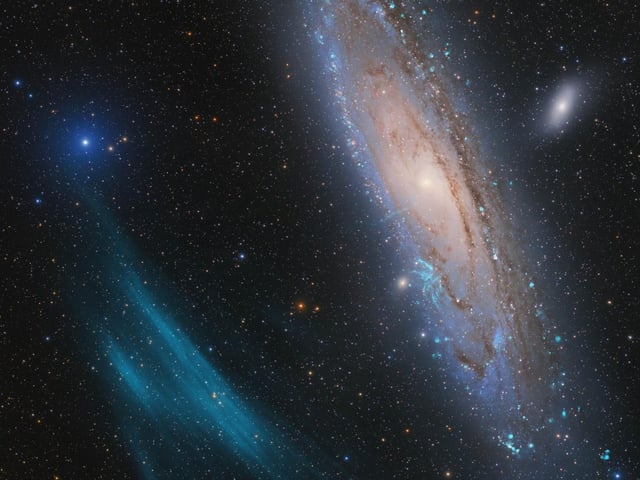
The overall winners of the Royal Observatory Greenwich’s Astronomy Photographer of the Year 15 are Marcel Drechsler, Xavier Strottner and Yann Sainty for their photograph Andromeda, Unexpected that captures a surprising discovery – a huge plasma arc next to the Andromeda Galaxy (M31). Scientists are now investigating the giant object in a transnational collaboration. It could be the largest such structure nearest to us in the Universe. The image will be on display alongside the winners of the other categories in the accompanying exhibition, opening at the National Maritime Museum on Saturday 16 September 2023.
1. Royal Observatory Greenwich Astronomy Photographer of the Year 15
Winner and Overall Winner Andromeda, Unexpected A team of amateur astronomers led by Marcel Drechsler, Xavier Strottner and Yann Sainty made a surprising discovery a huge plasma arc next to the Andromeda Galaxy. Scientists are now investigating the newly discovered giant in a transnational collaboration. It could be the largest such structure in the nearby environment in the Universe. The Andromeda Galaxy is the closest spiral galaxy to the Milky Way. It is undoubtedly one of the most photographed deep-sky objects ever. The new discovery of such a large structure in the immediate vicinity of the galaxy was all the more surprising. ‘What does a discovery image look like? It is mostly a blurry black and white image that depicts an almost invisible faint dot or a spectrum that is incomprehensible to us. However, that was not the case this time. This astrophoto is as spectacular as it is valuable. It not only presents Andromeda in a new way, but also raises the quality of astrophotography to a new level.’ – László Francsics Taken with a Takahashi FSQ-106EDX4 telescope, Sky-Watcher EQ6 Pro mount, ZWO ASI2600MM Pro camera, 382 mm f/3.6, multiple exposures between 1 and 600 seconds, 111 hours total exposure Location: Near Nancy, France Photo: Marcel Drechsler, Xavier Strottner and Yann Sainty
2. Royal Observatory Greenwich Astronomy Photographer of the Year 15
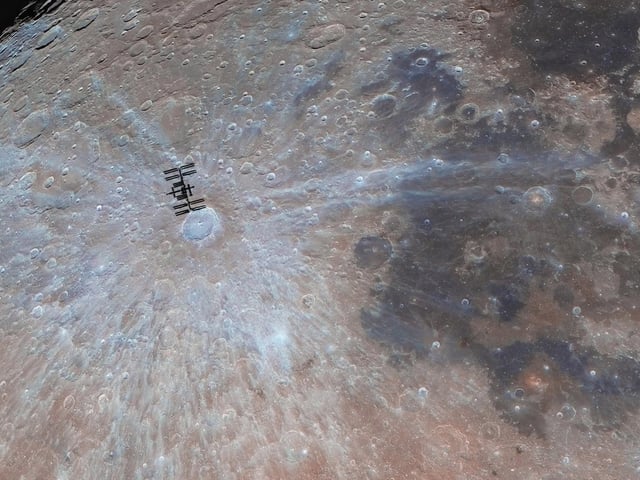
Runner-Up A Visit to Tycho © Andrew McCarthy In this photo, the International Space Station (ISS) has been captured in alignment with the Tycho Crater. While actually 1,000 times closer to Earth than the Moon, this perspective makes it seem like the ISS is in fact orbiting our natural satellite. McCarthy travelled to the Sonoran Desert in Arizona, USA, to find the perfect position. ‘Two cameras, two telescopes, a close eye on telemetry and a remote drive into the wilderness. To say this photographer has gone out of their way to create this spectacular image is an understatement. The ISS is often photographed as it passes over the lunar disc (from our perspective), yet few can capture it like this. The Station itself is sharp and detailed. The lunar surface below is not only thoughtfully positioned but perfectly resolved and processed. All this would make it a staggering achievement but when you also notice the brown and blue mineral colours that have been reproduced in all their subtle glory you have one of the finest ISS transit images ever made.’ - Steve Marsh Taken with a Celestron C11 and Sky-Watcher 14" GoTo Dobsonian telescopes, Astronomik UV/IR cut filter, 2.5x Powermate lens, Hobym Traveller mount, ZWO ASI174MM and Sony A7II cameras, 4,125 mm and 2,000 mm f/10, ISO 300 and 50, 2,000 x 0.2-millisecond and 25 x 1/200-second exposures Location: Florence, Arizona, USA Photo: Andrew McCarthy
3. ROYAL OBSERVATORY GREENWICH ANNOUNCES THE WINNER OF ASTRONOMY PHOTOGRAPHER OF THE YEAR 15 Runner-Up Celestial Equator Above First World War Trench Memorial © Louis Leroux-Gere Star trails above the preserved First World War trenches in Canadian National Vimy Memorial Park, Northern France. Taken over five hours, the camera captured the rotation of the sky, revealing the colourful stars. ‘In April 1917, Canadian and German troops fought and died on this ridge near Vimy in northern France. The Canadian Government later preserved the cratered battlefield as a war memorial. This haunting image contrasts the conflict-scarred landscape with the ethereal beauty of the stars. A line of trees divides the composition into two distinct halves. Above, pastel-coloured star trails trace smooth arcs across the sky. Below, a trench carves a twisted fissure through the dull green grassland. The result is a potent reminder of how human wars have disfigured the surface of our planet.’ – Katherine Gazzard Taken with a Canon EOS 6D (Astro modified), Samyang XP 14 mm f/2.4 lens, 14 mm f/3.2, ISO 1000, 577 x 30-second exposures Location: Vimy, Pas-de-Calais, Hauts de France, France
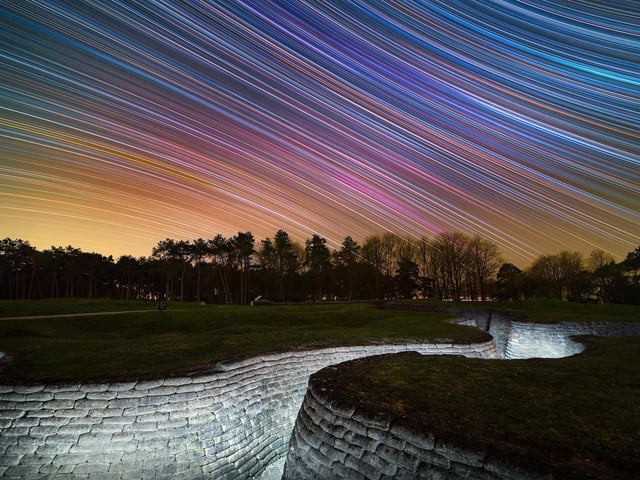
Runner-Up Celestial Equator Above First World War Trench Memorial © Louis Leroux-Gere Star trails above the preserved First World War trenches in Canadian National Vimy Memorial Park, Northern France. Taken over five hours, the camera captured the rotation of the sky, revealing the colourful stars. ‘In April 1917, Canadian and German troops fought and died on this ridge near Vimy in northern France. The Canadian Government later preserved the cratered battlefield as a war memorial. This haunting image contrasts the conflict-scarred landscape with the ethereal beauty of the stars. A line of trees divides the composition into two distinct halves. Above, pastel-coloured star trails trace smooth arcs across the sky. Below, a trench carves a twisted fissure through the dull green grassland. The result is a potent reminder of how human wars have disfigured the surface of our planet.’ – Katherine Gazzard Taken with a Canon EOS 6D (Astro modified), Samyang XP 14 mm f/2.4 lens, 14 mm f/3.2, ISO 1000, 577 x 30-second exposures Location: Vimy, Pas-de-Calais, Hauts de France, France Photo: Louis Leroux-Gere
4. Royal Observatory Greenwich Astronomy Photographer of the Year 15
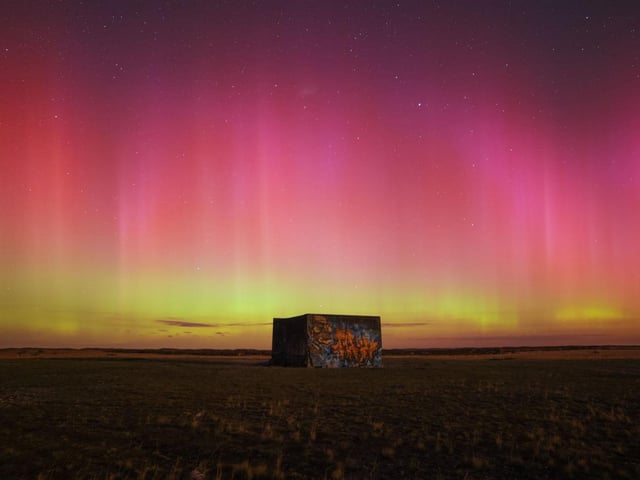
New Zealand regularly has aurora but due to its distance from the magnetic pole they are often not particularly vibrant for observers. Due to the increased solar activity the region saw this year, the photographer was able to capture a highly colourful aurora over Birdlings Flat, New Zealand. ‘A strong aurora image does not always need to display chaotic structures. Sometimes the best way to convey how it feels to witness the spectacle is to capture the serenity and peace of a celestial light display. This image fits the bill perfectly, with the strong pink and red hue over the more common green elevating it to a whole new level. Absolutely stunning!’ - Steve Marsh Taken with a Rokinon 14mm f/2.8 telescope, Nikon Z6 (Astro modified) camera, 14 mm f/1.8, ISO 1600, 15-second exposure Location: Birdlings Flat, Canterbury, New Zealand Photo: Chester Hall-Fernandez