


The overall winners of the Royal Observatory Greenwich’s Astronomy Photographer of the Year 15 are Marcel Drechsler, Xavier Strottner and Yann Sainty for their photograph Andromeda, Unexpected that captures a surprising discovery – a huge plasma arc next to the Andromeda Galaxy (M31). Scientists are now investigating the giant object in a transnational collaboration. It could be the largest such structure nearest to us in the Universe. The image will be on display alongside the winners of the other categories in the accompanying exhibition, opening at the National Maritime Museum on Saturday 16 September 2023.
13. Royal Observatory Greenwich Astronomy Photographer of the Year 15
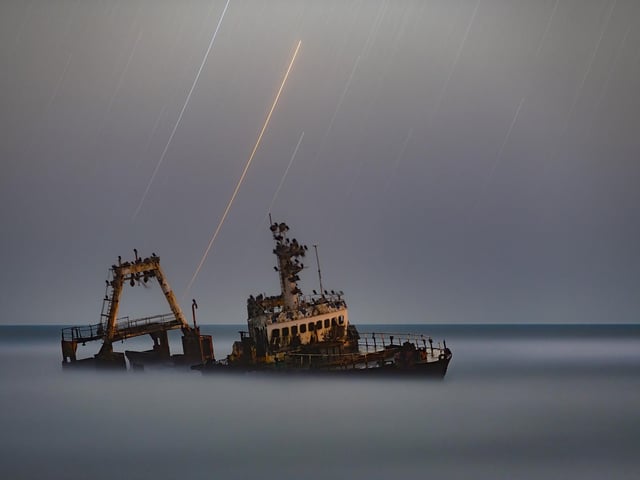
Winner Zeila © Vikas Chander The most northerly part of Namibia’s Atlantic facing coast is one of the most treacherous coastlines in the world and has gained the name the Skeleton Coast. The ship in this photo, Zeila, was stranded on 25 August 2008 and is still in a well-preserved state. The image shows the delicate colours of different star types. ‘I really love how the star trails poking through the grey sky provide a stunning backdrop for this stranded ship. It looks as though it’s floating on a sea of fog. It is a hauntingly beautiful image that would be the perfect setting for a ghost story and is one of my favourites from this year’s competition.’ - Melissa Brobby Taken with a Nikon D850 camera, 135 mm f/2.8, ISO 200, 30-minute exposure Location: Heintesbaai (Henties Bay), Erongo Region, Namibia Photo: Vikas Chander
14. Royal Observatory Greenwich Astronomy Photographer of the Year 15
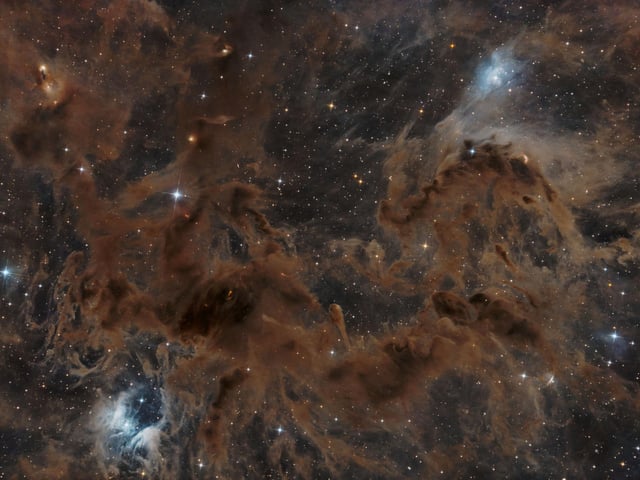
Runner-Up LDN 1448 et al. © Anthony Quintile A photograph of LDN 1448, which is close to the more spectacular and more often photographed NGC 1333. Quintile chose to photograph the lesser-known molecular cloud to explore the fascinating dust in this part of the sky. ‘This is a very impressive deep image of LDN 1448 molecular cloud – a region of the interstellar medium where gas and dust are concentrated, leading to the formation of new stars. The image captures all the beauty of the dust’s filamentary structures as well as colourful reflection nebulae. LDN 1448 is a subject of scientific study due to its role in the process of star formation. Capturing photos of such objects allows astrophotographers to contribute to scientific research by providing high-resolution images that can be used for scientific analysis.’ - Yuri Beletsky Taken with a Sky-Watcher Quattro 250P telescope, Losmandy G11 Gemini 2 mount, ZWO ASI2600MC Pro camera, Starizona Nexus 0.75 x reducer/corrector, 750 mm f/3, Gain 100, 1,022 x 120-second exposures Location: Flagstaff, Arizona, USA Photo: Anthony Quintile