
The Scotland World Cup tactics available to quell Brazil as Steve Clarke battles risk v reward
How the Scots can get a historic result in Miami
Stop the World Cup, Scotland want to get on. Maybe. Possibly. For a wee bit, anyway.
In the days since this tournament kicked off, it has occasionally felt as if we’ve been watching two concurrent competitions play out. One is all joy, laughter, flair and, yes, soaring ambition taking flight in the most unlikely of places. The other is … well, you know.
Amid the demands for Steve Clarke to “take the handbrake off” and let his collection of high-performing players demonstrate their ability to do something other than sweat, grind and battle in a solid defensive shape while on national service, however, few articulate the argument beyond expressing an obvious - and natural - desire to be entertained and inspired. It’s all very well wishing for Clarke to kick against a lifetime of coaching practice by hitting the gamble button. How he does that is a question of devilish detail.
If we assume that Scotland will not be lining up in a 4-3-3 that goes man-for-man against Brazil in Miami on Wednesday night, what are the options available to the coaching brains trust assembled by Clarke? Is there some magic formation that will bring the best out of our finest attacking threats without exposing obvious vulnerabilities? And will we see Kieran Tierney on the left wing again?


Shape of things to come
There are dozens of different ways to play in any given formation. And it’s important to remember that, whether you go for a back three, false 9 or double pivot, footballers need to play from – as opposed to in – a position.
That said, Clarke would appear to face a straight choice heading into this final Group C fixture. Reinforce the backline by switching to a back three/five, or rely on blocking up the passing lanes in midfield to disrupt Brazil’s rhythm.

Some variation on the 4-2-3-1 (see Photo 1) is very in vogue at the moment, with coaches recognising its inherent flexibility and adaptability. Without the ball, you drop into a 4-5-1, which provides a lot of bodies doing a lot of short, sharp running to close gaps and track runners; that’s firmly in Scotland’s wheelhouse.
It can occasionally look like a 4-1-4-1. And it does allow room for man marking, as Tierney’s role against Morocco demonstrated. Don’t expect to see that again.
They key is getting players beyond the loan striker in attack. And pushing someone out of midfield to press, on occasion, in a 4-4-2. The danger is in the centre forward getting isolated, leaving your team without threat when/if the ball is won.
Change the rules on roles
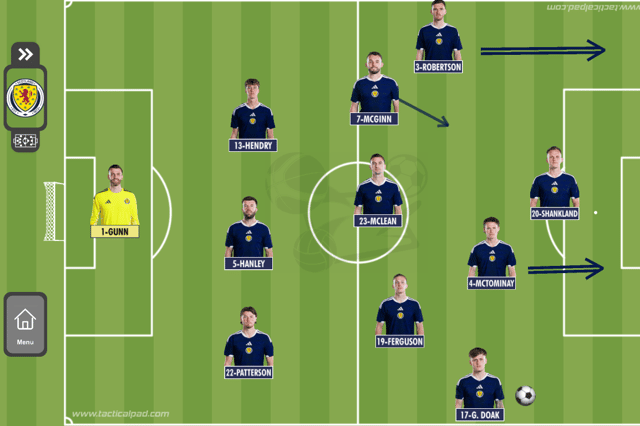
As Photo 2 shows, however, you don’t have to stick to any hard and fast rules on individual roles. For Scotland, sticking Ben Gannon-Doak on the right touchline opens up opportunities for, say, John McGinn to tuck in as a supporting attacker – and leave that entire left flank for Andy Robertson to go flying forward.
And, of course, you’re looking for Scott McTominay to go barrelling into the penalty box and do his thing. Get this shape right and you can play with real width, achieving the much-discussed five-lane attack that so many coaching gurus preach with such fervour.
Loading the back line

Clarke was once a real devotee of the 3-4-2-1 formation (see Photo 3) that was so popular for quite a while, with coaches at the very top end of the game going all-in on a shape that gives you a midfield ‘box’ and multiple options. It would certainly fulfil a lot of requirements for Scotland in this instance.
Much will depend, again, on the fitness of key players. But slipping Tierney or Scott McKenna into the back three obviously gives you another body to deal with Brazil’s front three, as Scotland drop into a 5-4-1 without the ball.

As with the 4-2-3-1, meanwhile, nobody says you have to stick to very prescriptive guidelines for players with the ball. There’s no reason why Gannon-Doak can’t drift out to his favourite place on the touchline (see Photo 4), encouraging McTominay and McGinn to support the loan striker … and again leaving Robertson room to drive into space on the left.
If your right-back tucks in and a holding midfielder takes up a good rest defence position, you end up with a back four protected by a screen, but still have width across the attack. It’s an option.
Intent, ambition, hope
You can’t just sit deep and hang on for 100 minutes. Well, actually, you can. Plenty of teams have done it. Trophies have been won by playing anti-football; it’s one of the reasons the game is so endlessly fascinating.
The question of whether Scotland should prioritise stifling Brazil above all is, well, that’s a different matter. But what it if it works … and then Clarke lets everyone off the leash in the first knock-out game in this proud footballing nation’s long history of tournament play? What if he tilts the balance too far towards attack, and we suffer precisely the sort of heavy defeat that kills off our only chance of qualification?
So far, the vibes emanating from within the camp hint at a balanced approach. How Brazil play will impact on that.
The one guarantee? Clarke will have a plan. Hopefully one that delivers at least a flicker of hope – Robertson on the overlap, Gannon-Doak spinning his man, McTominay crashing into the penalty area – in a campaign posing a lot of questions about Scotland’s approach to playing on the world’s grandest stage.
John Greechan has a UEFA B Licence in coaching and a Certificate in Advanced Tactical Analysis from Barca Innovation Hub Universitas.
Comments
Want to join the conversation? Please or to comment on this article.