
In search of Pele at 2026 World Cup as Scottish biographer tells story of complicated Brazil icon

New book to chronicle the ‘many lives’ of three-time World Cup winner
At this World Cup, Pele is everywhere and yet he is nowhere. His name was evoked only on Sunday, in the way it often is – in relation to goal scoring records.
Lamine Yamal, the brilliant teenage Spain forward, scored against Saudi Arabia. Of course it was a Pele record he was equalling by becoming the first player since the Brazilian to score the opening goal of a World Cup match aged 18 – his current age – or under.
Pele was just 17 when he struck v Wales in 1958, so he remains The King. So much so that a street in Queens, New York has been renamed after him for the duration of the World Cup. An intersection in the area is now known as Pele Way, in recognition of his influence in initially triggering interest in the game in the States by signing for New York Cosmos.


Although present in people’s minds as always at World Cup time, Pele is also a ghost. This is the first tournament that has taken place since he died aged 82, just 11 days after the final of the last tournament in Qatar. He had been admitted to hospital during the tournament after testing positive for Covid-19. He also had a lung infection, which spread to his one good kidney – the other one had been “quietly removed” in an operation more than 20 years previously.
“Under attack on several fronts, his organs were gradually shutting down,” writes Andrew Downie in a forthcoming new book about the legend, due to be published in the Autumn.
Pele never left Sao Paulo’s Albert Einstein hospital. He watched World Cup matches from bed, despairing as the Selecao were eliminated on penalties at the quarter-final stage by Croatia. Argentina’s victory was hardly likely to revive the ailing Pele. However, in a conversation with The Scotsman, the Edinburgh-raised Downie recounts a story told to him by Flavia, the legend’s daughter. It offers the comfort that he died knowing his place back in Brazilians' affections was secure.
“His daughter said he could hear all the Brazil fans below singing his name,” Downie says. “Because the Argentina fans had a song basically bigging up Maradona and slagging off Pele. The Brazilian fans did one in response. It became this big song Brazil fans sang for many years. She said he was in the room and could hear this song drifting up from below, all the Brazil fans singing his name which was quite nice.”
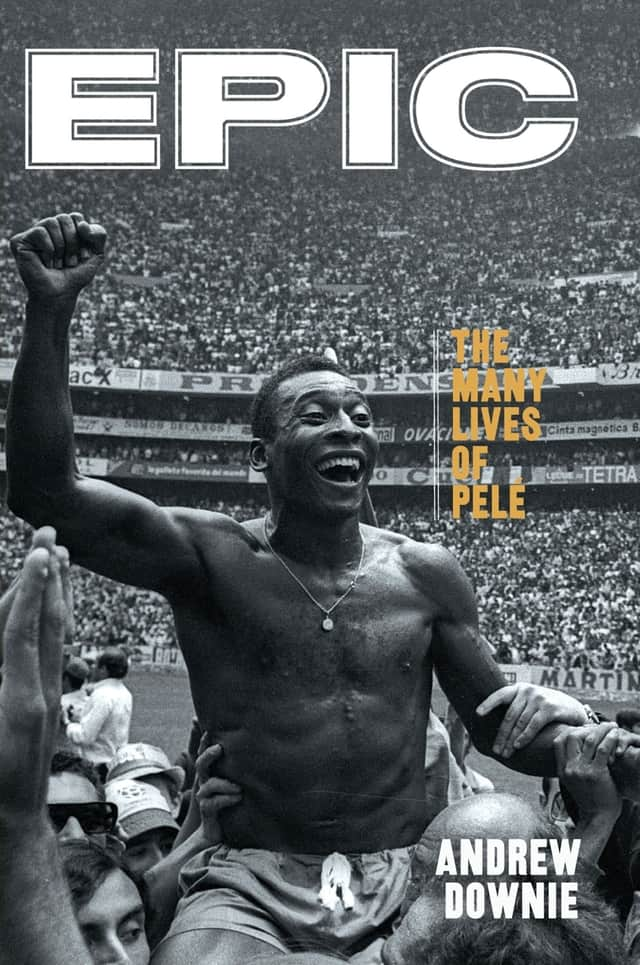
Pele’s death provided a full stop in the book the currently Madrid-based Downie had been working on for around the last eight years. Epic: The Many Lives of Pele is due out later this year and is set to be very much the last word on a football icon, although the modest Downie is riled slightly by the suggestion it is definitive. What he does accept is that such a staggering amount of research, which involved over 250 fresh interviews, is the least Pele deserves.
“It was always my belief that Pele was one of the most consequential figures of the 20th century, in terms of entertainment,” says Downie. “Everyone talks about Muhammad Ali but in terms of sport, no one came close to Pele and Ali for being such global icons. There were so many books written about Ali. It was always my belief that he deserved a biography as big and as complete and detailed as those given to Ali. Also Marlon Brando and Gabriel Garzia Marquez, Frida Kahlo, and Picasso, all these great cultural figures of the 20th century.”
Without Pele, a World Cup in America might never have happened
It’s no exaggeration to say that Pele put Brazil on the map. He is not the only reason why we immediately associate the country with the beautiful game, but he is the principal one. Indeed, Pele claimed responsibility for coining the phrase ‘the beautiful game’ – or o jogo bonito in Portuguese – while at the Cosmos. He was seeking to explain to American reporters the difference between their football and the seductive sport played by the rest of the world.
It’s not stretching things to connect his arrival in the States in 1975 with what is happening now. Without Pele, a first World Cup in America in 1994 might not have been possible, never mind a second, albeit co-hosted, in 2026.
“As I say in the introduction, Pele is the best-known Brazilian,” says Downie. “Before 1958, people did not know where Brazil was. And after 1970, it was the country of football. Everyone knew where Brazil was. Everyone knew what Brazil stood for. His face was known the whole world over. He was who Brazilians wanted to see themselves as.”
It wouldn’t always be thus. Epic is very good on the shifting attitudes towards Pele, not least when it was discovered he had an illegitimate daughter, whom he barely acknowledged throughout her life. This was even after a DNA test determined his status. “That was a turning point in his relationship with Brazil,” notes Downie. “Up until then he had been very much beloved and the national hero but after that, especially among women, that was a real turning point.” Sandra died in 2006 aged 42 from cancer. Her mother had met Pele in 1963, when he had already won two World Cups and was an international superstar. Paternity was not established until 1991.
Pele led an undoubtedly complicated life. His messy business affairs spoke of someone whose head for figures was restricted to counting the goals that he scored, although even this total remains a slightly vexed question. He definitely exceeded 1000 goals.
“With his mouth shut, Pele is a poet,” Romario once said after being insulted by advice from his former hero that he should retire as the striker homed in on the 1000-goal mark, which meant emulating Pele - the only other player known to have reached and surpassed this prodigious total. The final tally is still under review, it seems.
Tartan Army may visit Pele store in Miami
Pele himself put it at 1283 although there was never a consensus, with the debate continuing even after his death. The Brazilian Football Confederation initially agreed but on the first anniversary of his death, they reduced the tally to 1282.
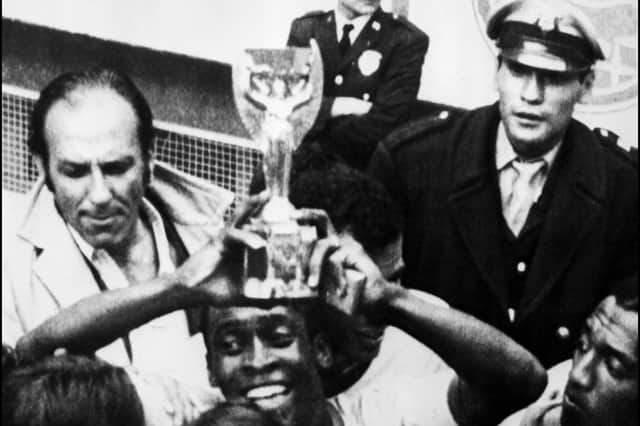
Rather than obsessing about the mystery of the missing goal, it’s surely better to salute the liquid joints, the spring-like heels, and the fact Pele scored all sorts of goals with his head and left and right foot. When one considers the place Pele still occupies in popular culture, it’s possible to wonder if he is even dead. Or has he sold us his greatest ever dummy, like the one that left Uruguay ‘keeper Ladisao Mazurklewicz completely flummoxed in the semi-final of the 1970 World Cup.
With Scotland fans already flooding Miami ahead of Wednesday night’s final group game against Brazil, many will end up at the Pele Soccer Store on Miami beach. The first European store opened last month in Paris. The Pele industry grinds on. But genius isn’t something that can be measured on the stock markets. Amid the current mania for identifying GOATs, where does he rank among the likes of Diego Maradona, Lionel Messi and Ronaldo?
“You just look at the number of goals he scored, the number of titles he won, his longevity,” says Downie. “He was the first to do it all, essentially. Everyone else is standing on the shoulders of that giant, and I will leave it at that.”
A 59-year-old former reporter with Reuters, Downie is of an age to be in thrall to Pele. He also lived in Brazil for 20 years and is quietly distinguishing himself as one of the finest chroniclers of the game in the country.
His 2017 biography of Socrates is already a classic. Not bad for someone who remembers running about with a ball as a kid in Granton’s Pilton Park. “I’d ask my friends: do you know who Edson Arantes do Nascimento is?” Downie recalls. “Of course nobody knew. I had remembered Pele’s whole name. I have no idea why I remember that.”
EPIC: The Many Lives of Pelé by Andrew Downie is published by Viking on 5 November 2026, £25. Pre-orders: https://www.penguin.co.uk/books/458302/epic-by-downie-andrew/9780241754795
Comments
Want to join the conversation? Please or to comment on this article.