
UK Budget: New electric car pay-per-mile charge is 'thin end of the wedge' for all vehicles

Chancellor also signals petrol and diesel duty will rise in 2026 for first time in 16 years
The 3p per mile charge for electric cars confirmed in the UK Budget is “the wrong decision for motorists, the climate and for Scotland” because it will unfairly hit rural drivers, the Scottish Government has said.
It came as a motoring group said other drivers would “breathe a sigh of relief” after the fuel duty freeze was extended again until September next year.
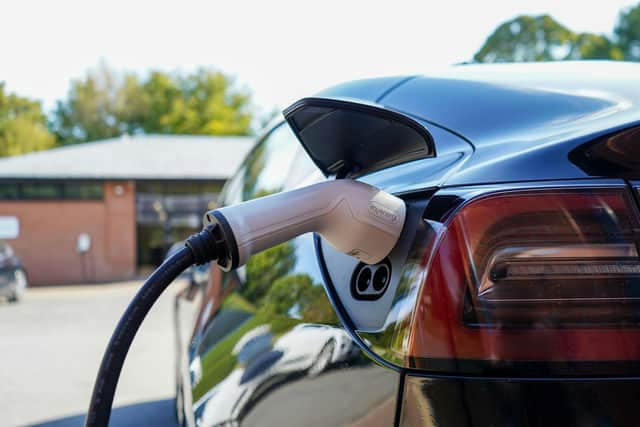

Chancellor Rachel Reeves justified the new electric vehicle (EV) tax by saying all car drivers should help pay for their impact on the roads, regardless of how they were powered, hinting that per-mile charges could be extended to all vehicles.
However, she also said commuting to work was “still too expensive” and postponed an increase in the 52.95p per litre fuel duty on petrol and diesel for six months from April to September next year.
The new electric vehicle charge will be introduced in April 2028 , at 3p per mile for battery cars and 1.5p per mile for plug-in hybrids - costing 10,000 miles-a-year drivers an extra £150-£300. The lower charge for hybrids was criticised by some campaigners as “outrageous”.
Ms Reeves said the charges would help double road maintenance funding in England, but how Scotland would benefit is yet to be seen.
The Office for Budget Responsibility predicted it would cut EV sales by about 440,000 and the Social Market Foundation said it risked collapsing the market.
Ms Reeves said: “Because all cars contribute to the wear and tear on our roads, I will ensure that drivers are taxed according to how much they drive and not just by the type of car they own.”
But Scotland’s Finance Secretary Shona Robison criticised the move as “the wrong decision for motorists, the climate and for Scotland given its disproportionate impact on rural drivers”.
She said: “Instead of the piecemeal approach we see today, which simply aims to balance the UK Budget on the back of motorists, we need a sensible four-nations conversation about motor taxation.
“Freezing fuel duty for a few more months and then increasing it, alongside arbitrary taxation of EVs, doesn’t give Scotland a sensible, coherent policy designed to help hard-pressed motorists, nor does it help tackle climate change.”
The announcement came as Scottish Government figures published on Wednesday showed interest in buying electric cars at its lowest for at least eight years.
Transport Scotland said 56 per cent of drivers asked last year said they wouldn’t consider one - the highest proportion since the question was first included in the official annual survey in 2016. Charging availability, vehicle cost and battery range were given as the main reasons.
Howard Cox, founder of campaigners Fair Fuel UK, said: “Rachel Reeves's 3p pay per mile on EVs is I fear the thin end of the wedge to make all vehicles, whatever their type of fuel, pay tax as they drive.
“Whilst fuel duty and VAT continues to deliver billions to the Exchequer, both types of taxation cannot work alongside each other.”
Richard Sallnow, a transport expert at PA Consulting, said the new charge was an “inevitable step” because of the looming multi-billion pound black hole from a reduction in fuel duty revenue as drivers switched from petrol and diesel.
Anna Krajinska, UK director of campaigners at T&E, formerly Transport and Environment, said: “It’s outrageous that the government has chosen to hand plug-in hybrids (PHEVs) yet another tax break as part of its new scheme.
“Evidence shows PHEVs are fast becoming another dieselgate-style scandal - they deliver little emission savings compared to petrol or diesel cars and already benefit from generous vehicle excise duty discounts.”
The OBR said the fuel duty freeze, introduced 16 years ago, would be "reversed through a staggered approach". It was cut by 5p by the previous Conservative government in 2022.
Ms Reeves said fuel forecourts would be required to supply live information about price rises through a new “fuel finder” expected to save households an average of £40 a year.
She told MPs: “Under current plans, the temporary 5p cut to fuel duty that was introduced during the pandemic will come to an end in April and fuel duty will be uprated in line with inflation.
“But I know the cost of travelling to and from work is still too expensive and so I am extending the 5p cut until September 2026.
“And because I know changes in wholesale prices are not always passed on to motorists, I am bringing in new rules to mandate petrol forecourts to share real time price rises through a new fuel finder, empowering drivers to find the cheapest fuel, calling out rip-offs and strengthening competition, saving the average household £40 a year.”
Ms Reeves also announced that search and rescue vehicles would be exempt from vehicle excise duty, which had been urged by Western Isles Labour MP Torcuil Crichton.
Nicholas Lyes, director of policy for motoring group IAM RoadSmart, said: “Drivers and operators of conventional vehicles will breathe a sigh of relief that the Chancellor has kept the fuel duty freeze in place until at least September 2026.”
AA president Edmund King said maintaining the 5p cut in the short-term is "much welcomed and helps everyone". But he warned "drivers will brace themselves for duty hikes from next September".
RAC head of policy Simon Williams said the "relief" felt by drivers will be "very short-lived".
Comments
Want to join the conversation? Please or to comment on this article.