
New North Coast 500 chief's frank admission about impact of route on Highlands - and the road ahead
Clare Winskill discusses challenges of the driving route through the north and west Highlands ahead of major report on project’s impact and future

The new boss of the North Coast 500 phenomenon which is loved and reviled in equal measure has signalled a new frankness about its impact ahead of a major report on its future.
Clare Winskill, a former lawyer and intensive care nurse who runs a hotel in Skye, has been appointed as executive chair of North Coast 500 Ltd, the company established a decade ago to market the area’s existing roads as a driving route.
“I will be leaning in to honesty - I am not going to be disagreeing with the challenges that some communities have faced along the route,” she said.
It comes amid an uncertain start to the summer tourist season, with the spectre of prolonged high fuel prices driven by the war in the Middle East threatening to deter some motorists from making the 516-mile trip round the top of the mainland.


Ms Winskill said the route had brought significant economic benefits, but acknowledged problems such as camper vans using unsuitable parts of the route and visitors leaving toilet waste and litter behind.
Bad behaviour by some visitors has prompted NC500 Ltd to include being “courteous and patient when interacting with locals” in the responsible tourism “pledge” which it encourages people to sign.
Ms Winskill said: “It is 50:50. There are businesses on the route which would not exist without it. It has brought economic development.
“Tourism repopulates, and it’s the number one driver of employment across the Highlands.”

She said creating such jobs enabled local young people to stay in their communities and go on to use the skills gained in other career.
Ms Winskill said: “The other 50 I’m hoping I’m going to convince. I’m in the realm of trying to change hearts and minds, and I’m an optimist. I think that can be done, that’s not to say I don’t recognise the challenges involved.”
Asked if NC500 Ltd should be franker about the negative as well as positive effects of the route, Ms Winskill said: “100 per cent - I totally agree”.
She said that would be addressed in a new impact study commissioned from economic consultants “to shape the route’s next chapter”, which is due to be published by the end of May.
It is also expected to include how visitors could be diverted from hotspots on the route to other locations, such as by providing “immersive” experiences like crofters showing tourists farming activities such as lambing as well as providing holiday accommodation.
Ms Winterskill would also like to see more promotion of the route’s food and drink, copying initiatives such as Food Coast Donegal and the Wild Atlantic Way in Ireland.
She also hopes to encourage the development of more parking for camper vans close to towns on the route.

She said: “It will enable people to walk into the town and spend money but not cause issues by taking their vehicles into a place that can’t cope.”
One of these new parking locations is already in operation, which she declined to name to prevent it becoming overwhelmed.
Ms Winskill, who is also co-chair of the Institute of Directors for the islands, said such facilities, offering waste disposal and access to water, must be in place before any motorhome levy is introduced.
However, more immediately, she is discussing with Highland Council the potential for stronger messaging on warning signs on the Bealach na Ba section of the route on the Applecross peninsula to more more effectively deter large camper vans from the mountain pass.
She said: “At the moment it’s advisory and I think visitors need a clearer steer. It needs to be stronger.

“There should be a limit on the size of vehicle going up there, but there are delivery vehicles so I don’t think the council can put a complete ban on it because that would stop the supply chain to Applecross.
“Some visitors brought a large camper van towing a car which simply shouldn’t happen. It causes huge frustration and could also potentially block the route.”
But Ms Winskill stressed that the image of the NC500 as a “heaving racetrack” was no longer true and the infamous supercar rallies were a thing of the past.
She said: “Overwhelmingly, most of the visitors are behaving well. Unfortunately, as with everything in life, the few who don’t, generate more of a response.
“If you’re being impacted on a daily basis by that sort of behaviour, you can see why communities and residents become resentful.
“But part of that is that if the infrastructure isn’t there - people turn up in camper vans and there are no facilities available, or too few - it’s more difficult for visitors to behave well.”
However, she said some of the extremes of poor behaviour which she said had occurred across rural Scotland after the Covid lockdowns were lifted, such as abandoned tents, may now be be in the past.
Ms Winskill said: “Hopefully with the movement towards global tourism and behaving better wherever you go, that might be something the NC500 can capitalise on.”
She said the overall impact of the route had been “hugely positive” and had made the development of tourist businesses far more attractive because of increased visitor numbers.
Ms Winskill, who fondly remembers family holidays at Nedd, near Lochinver, which is now on the route, had wanted to open a hotel in the area in 2009 but said it would not have been viable back then, so she chose Skye instead.
She said the NC500 had transformed the fortunes of such areas, with a study eight years ago assessing that the route had generated an additional £13.5 million in sales for businesses on or near it and created nearly 180 full time equivalent jobs in the north of Scotland.
However, while next month’s study may show far greater gains since then, uncertainty hangs over the prospects for this summer because of the knock on effects of the war in the Middle East on top of ongoing consumer cost pressures.
Ms Winskill said Easter at her hotel, Coruisk House, had been the quietest in her 15 years there with bookings much later than normal, which she attributed to the continuing cost of living crisis.
She said: “With the cost of fuel, people might find that it’s more difficult to travel to this part of the world.”
She said it was too early to say whether that would have a significant impact on visitor numbers on the NC500, as some might choose to come anyway for the “wellness” experience.
But she said electric vehicles were not a realistic option because chargers remained too few and far between, and could not be relied on to be working.
The RAC motoring group reported on Friday that UK average petrol and diesel prices had increased every day for 40 days, with petrol now £1.58 a litre.
However, petrol in Bettyhill on the north coast section of the NC500 was £1.79, according to the Fuel Finder website. While diesel now averages £1.91 across the UK, it was £2.29 in Bettyhill.
Traffic Scotland counters on the A9 south of Thurso have recorded a diminishing number of vehicles since the beginning of March, with the total falling below last year’s levels since the end of the month.
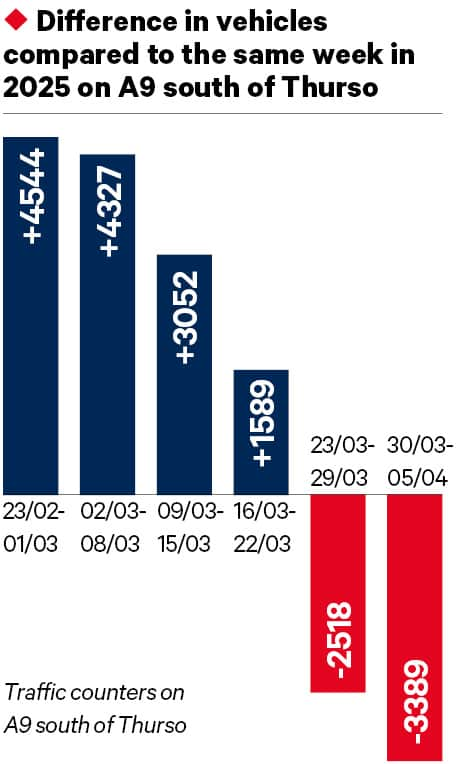
Christopher Greenwood, a senior research fellow at the Moffat Centre for Travel and Tourism Business Development at Glasgow Caledonian University, said the reduction appeared to be have coincided with the fuel price increases.
He said: “If there is a prolonged period of higher fuel prices, this may influence travellers to stay more local to reduce their travel costs.
“But if they come down and there is a belief that some stability will return, there should be a return to some normality.”
Mr Greenwood said prior to the Middle East, the outlook for the NC500 had been “favourable”.
He said: “While there were growing concerns over cost-of-living pressures affecting domestic household spend, travel and tourism, particularly for the NC500, remained robust.”
He said the BBC series The Traitors, filmed at Ardross Castle, off the A9 section of the route north of Dingwall, had increased interest, while new draws included the start of whisky production at Badachro Distillery near Gairloch on the west coast.
Mr Greenwood said further additional visitors could come from those travelling to the Commonwealth Games in Glasgow in July.
However, sceptics of the route said most people in the area still did not benefit.
Margaret Meek, co-founder of the NC500 The Land Weeps campaign group, said: “Many residents on the NC500 have hospitality or tourism-related businesses, but as many as 85 per cent of the population either make no income from tourism or it is extra to their full time employment.
“The NC500 will bring in business and people will welcome that.
“But many are not happy with the road trip mentality - people just completing a bucket list and numbers overwhelming villages.”
Comments
Want to join the conversation? Please or to comment on this article.