
Families of Stonehaven rail crash victims say lives were 'ripped apart'

Experts criticise installation of drainage system on the line
The families of three men who died in the Stonehaven train crash said their lives have been “ripped apart” by the disaster as tributes were paid to those killed in the derailment.
A Fatal Accident Inquiry into the deaths of train driver Brett McCullough, conductor Donald Dinnie and passenger Chris Stuchbury began on Monday in Aberdeen and heard that their families had been left “devastated” by their deaths.
The Aberdeen to Glasgow train came off the rails after hitting debris from a landslide caused by extreme rainfall on August 12, 2020 close to Carmont near Stonehaven in Aberdeenshire. Network Rail was later fined £6.7 million for a series of failings.
The downpour experienced in the hours leading up to the crash was of a rate only expected once a century, the inquiry heard.
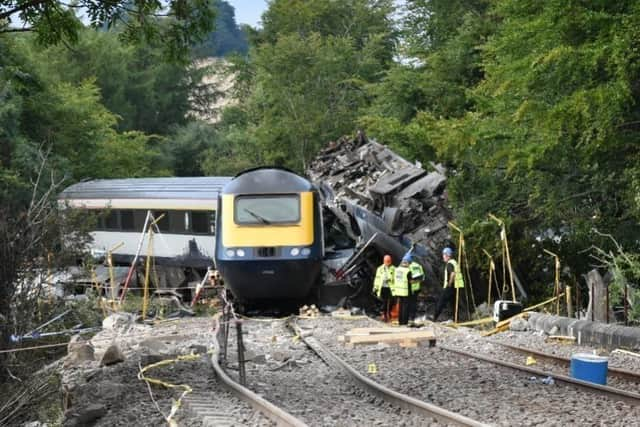

The inquiry was told all three men suffered “non-survivable” head injuries and probably died immediately. It was also told that Mr Stuchbury’s body was found on an embankment after being “thrown clear” of the train.
The inquiry heard there was an “unusually low” number of passengers on the train at the time due to the coronavirus pandemic and there would “almost certainly” had been more casualties had the service been busier.
Alex Prentice KC, Crown counsel for the inquiry, began proceedings by reading out statements from the families of the three men who died.
He said: “Chris Stuchbury’s wife says every day with Chris was a gift.
“He was the most loving, kind, lovely man you could ever meet.
“August 12 used to be a special day for us, the day we were married - but on this day our lives were ripped apart.
“I had no chance to hold his hand or take care of him. He was killed in an accident that should never have happened.
“He had one more trip before retirement and we have been robbed of a future together.”
Mr Prentice added: “Donald Dinnie’s daughter says the family continues to be devastated by the tragic loss of Donald, who was capable of lighting up every room with his infectious smile.
“He was loved and adored by all his family and friends and not a day goes by when we do not miss him.
“And Brett McCullough’s family says he will always be remembered in our hearts and forever missed.”
Mr Prentice said all three suffered “numerous blunt force injuries to the head” that were “non-survivable and death was likely immediate”. He then noted Mr Stuchbury’s “body was found on the upper part of the embankment as he was thrown clear of the train”.

Mr Dinnie’s body was found in a carriage doorway and which could not be immediately retrieved. Mr McCullough’s body was found on the lower embankment where the carriage he was in had come to rest.
Six other people were injured in the accident, including a 29-year-old American student at Aberdeen University who had to be airlifted to Aberdeen Royal Infirmary.
Another passenger was off-duty train conductor Nicola Whyte, who was able to climb out of the carriage she was in, jump down onto the track and phone 999 from a landside phone despite being injured herself.
At the beginning of the inquiry Sheriff Lesley Johnston also expressed her “sincere condolences” to the families of the victims and promised there would be a thorough inquiry.
Monday’s evidence session also heard how numerous emergency services agencies were involved in the aftermath of the crash, including 152 British Transport Police officers and 80 Scottish Ambulance Service staff.
The inquiry was also told firefighters had to walk 2.2 miles on foot to reach the crash site, and then needed to use excavator equipment from a nearby rail maintenance team as they could not get their appliances close enough.
The rural location of the crash also meant there was limited phone signal available and the emergency responders needed to move away from the site to maintain communications.
In total emergency workers were at the site for five days, four hours and 46 minutes. Mr Prentice said the response of the emergency services “in no way caused or contributed to the deaths”.
The afternoon session saw Nick Bucknall, a rail accidents inspector with the Rail Accident Investigation Branch (RAIB) giving evidence.
He said the RAIB investigation found the train had been travelling below the maximum speed limit at 73mph when it collided with debris that had been washed from a drain onto the track.
Mr Bucknall said the debris on the track was obstructed from the driver’s view until the train was only 120 metres away and the train’s brake was applied 1 second before the collision.
The rail accidents inspector said there was an “unusually low” number of passengers because the crash took place during the coronavirus pandemic and there would “almost certainly” have been more casualties had the train service been busier.
Mr Bucknall also said about 90 per cent of the average rainfall for August had fallen (51.5 millimetres) in the space of a few hours. He said such an extreme downpour is only expected to happen once a century.

At least one train on this route had been cancelled earlier in the morning due to flooding, and several routes further south were closed off due to the extreme weather conditions and landslips.
A report published by the RAIB in 2022 found errors in the drainage system’s construction, which was installed by Carillion, a company which went into compulsory redundancy in January 2018. The inquiry was told the system was not installed as designed, and this information was not handed over to those responsible for maintaining it.
The failings meant the drainage system was unable to cope with the heavy rainfall - RAIB experts concluded it is “highly likely” the system would have held up against the heavy rainfall if it had been installed in accordance with the design.
The inquiry was also told Network Rail did not address the extreme rainfall properly and the route control room was unable to effectively manage the situation.
Speaking on Monday, a spokesperson for Network Rail said: “The tragic accident at Carmont was a terrible day for our railway, and our thoughts remain with the families and loved ones of train driver Brett McCullough, conductor Donald Dinnie and passenger Christopher Stuchbury, along with all those affected by the derailment.
“The RAIB report into Carmont made clear that there were fundamental lessons to be learnt by Network Rail and since August 2020 we’ve been working hard to make our railway safer for our passengers and colleagues.
“We’re committed to supporting the work of the inquiry and continuing to deliver on the recommendations made by RAIB.
“We’ve made significant changes to how we manage the risk of severe weather since the accident and our work to make our network more resilient will continue.”
The fatal accident inquiry in Aberdeen will continue at 10am on Tuesday and is expected to run for three weeks.
Comments
Want to join the conversation? Please or to comment on this article.