
Deaths in Carmont train crash near Stonehaven 'might realistically' have been avoided if key mistake not made

Overwhelmed drain that washed debris onto the track was not built according to design
The deaths of three people in an Aberdeenshire train crash "might realistically" have been avoided if the drain which caused the derailment had been correctly built, a fatal accident inquiry (FAI) determined on Wednesday.
ScotRail train driver Brett McCullough, 45, conductor Donald Dinnie, 58, and Christopher Stuchbury, 62, one of the six passengers aboard, were killed in the incident in 2020 after torrential rain.


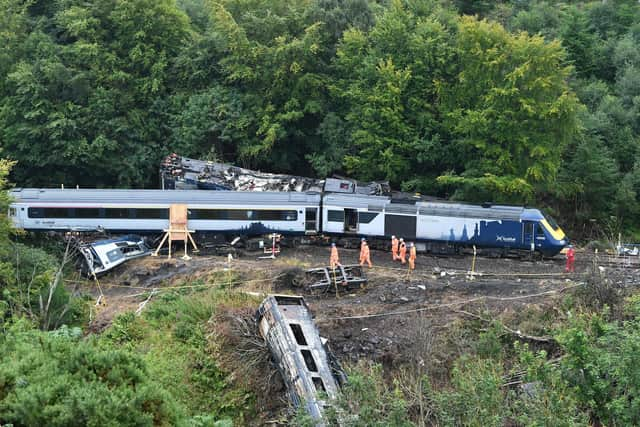
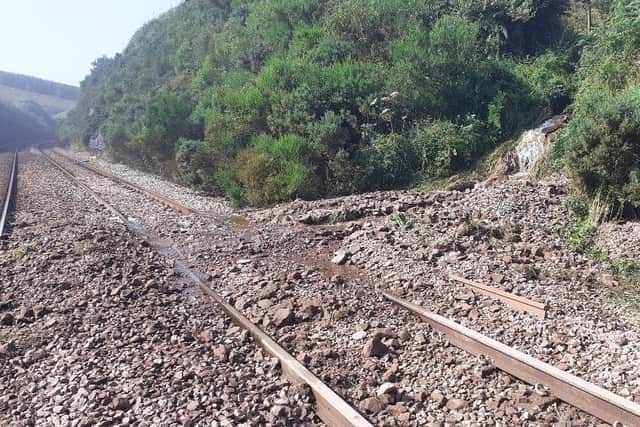
The train hit a bridge parapet at Carmont, south of Stonehaven after being derailed by debris washed on to the track by the wrongly-built field drain which had become overwhelmed by the downpour.
Network Rail was fined a record £6.7 million in 2023 for health and safety failings which resulted in the three deaths, in the worst British train crash for 13 years.
These included failing to inform the driver that it was unsafe to drive the train at a speed of 75mph or caution him to reduce his speed on the day of the derailment.
There were also failings in construction, inspection and maintenance of drains and in adverse and extreme weather planning.
Train drivers’ union Aslef described them as a “staggering level of governance and corporate failure that must never happen again”.
The FAI in January heard the three men had suffered “multiple un-survivable blunt force injuries” while the other six people on the train, who included an off-duty conductor, were injured.
Sheriff Lesley Johnston made no recommendations in her 199-page determination but noted that the “vast majority” of the 20 recommendations made by the official UK Department for Transport Rail Accident Investigation Branch (RAIB) investigation report in 2022 had been implemented, with the rest being “actively progressed”.
She said the derailment could have been avoided if construction firm Carillion had built the drain in accordance with the design it had been given.
She said the drain, which was built in two phases in 2011 and 2012, had deviated from the design in “a number of respects”.
This included issues with piping and the materials used, and the addition of a “bund”, or ridge, which prevented the drain from working as intended.
The sheriff also said Network Rail had “failed to ensure” the drain was constructed properly and in line with the drawings.
She said Carillion failed to prepare “as built” drawings of the finished drain and provide them to Network Rail, and that Network Rail had failed to ensure it was “in receipt” of these.
Carillion went into compulsory liquidation in 2018.
The determination stated: “The drain was not constructed/installed in accordance with the design.
“As a result, the drain was unable to accommodate the flow of surface water during the intense rainfall in the area on August 12 2020.”
Sheriff Johnston said she made no recommendations over the crashworthiness of the Intery7City “High Speed Train” involved, which is nearly 50 years old, because the fleet is due to be replaced by the end of 2028.
She said there was no “real or lively possibility” that the driver’s death could have been avoided if he had been wearing a seat belt, which are not fitted in trains.
The sheriff also said there was no evidence that seat belts would have avoided Mr Stuchbury’s death.
The 6.28am Aberdeen-Glasgow train was halted just past the crash site for more than two hours because of a landslip further down on the line.
At about 9.28am, it was authorised to return to Stonehaven, and struck the “washout” from the drain at about 9.37am.
The determination stated: “When the train collided with the washout, it was travelling at around 73mph, just below the normal speed for the line concerned as instructed by the signaller and in accordance with the railway rulebook.
“The collision caused the train to derail and deviate to the left, before striking the parapet of bridge 325 (over Carron water), causing the train vehicles to scatter.”
Sheriff Johnston also paid tribute to the survivors for taking part in the FAI.
She said: “I am mindful of the six individuals who survived the derailment, and whose statements formed a crucially important part of the evidence to this inquiry.”
Liam Sumpter, Network Rail Scotland managing director, said: “Since August 2020, we have been working hard to make our railway safer for our passengers and colleagues, to deliver on the RAIB recommendations and to fully support the FAI process to reach its conclusion.
“We have made significant changes to how we manage the risk of severe weather since the accident and to increase the resilience of Scotland’s railway.”
ScotRail chief operating officer David Ross said: “The safety of our customers and staff is our priority, and we only operate trains that meet the stringent safety requirements expected of our fleet.”
Kevin Lindsay, Scottish organiser for Aslef, said: “We have consistently said this tragedy should never have happened. The failings of Network Rail and its contractor Carillion, identified by the RAIB report and supported by the FAI determination, represent a staggering level of governance and corporate failure that must never happen again.
“The determination also confirms our worries over train safety. We have relentlessly stated that the crashworthiness of the trains was, and continues to be, a concern. The FAI determination corroborates this and reinforces our call to urgently remove the [train fleet] from service as soon as possible.”
A spokesperson for the Rail, Maritime and Transport union, which represents train conductors and other rail staff, said: “We were fully involved in the working group set up following the tragic derailment at Carmont which cost the lives of three people and led to serious injury to others.
“General secretary Eddie Dempsey said that the union supported every recommendation which helps make the railway a safer place particularly around drainage, earthworks and weather forecasting.
“We also support the removal of the ancient intercity fleet of rolling stock involved in this crash as it is clearly not up to modern standards.”
Comments
Want to join the conversation? Please or to comment on this article.