
University of Edinburgh lecturers to walk out over planned £140m cuts
Princpal defends six-figure pay package as he refuses to rule out compulsory redundancies in front of MSPs
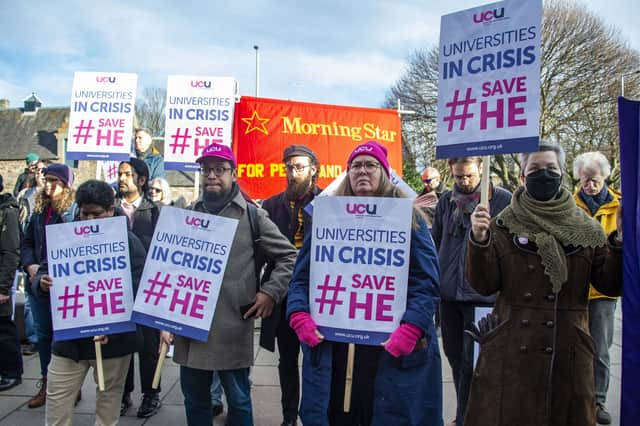
Lecturers at the University of Edinburgh are set to walk out in a dispute over the university’s refusal to rule out “unacceptable” compulsory redundancies as part of plans to save £140 million.
The action will see members of the University and College Union (UCU) strike during an open day on June 20, followed by a further five-day walkout in September to coincide with the university’s “welcome week” for new students.
Union members are also set to take part in action short of a strike, including working to contract, not covering for absent colleagues, and a “possible marking and assessment boycott”.
The UCU announced the action following a ballot which saw a 60 per cent turnout, with 84 per cent backing strikes and 93 per cent voting in favour of action short of a strike.

The news came on the same day university principal Professor Sir Peter Mathieson appeared before a Holyrood committee, where he defended his six-figure salary and acknowledged the university is not in deficit.
Sophia Woodman, UCU Edinburgh University branch president, said it is “not too late” for the strike to be averted, and she called on senior management to rule out compulsory redundancies.
“Staff want a sustainable future for the university as much as anybody and we want to work with senior management to end this dispute,” she said.
“But we’re clear that the use of compulsory redundancies is unacceptable.
“With the resources and reserves held by the university it can easily afford to rule out sacking staff.
“The decision to let the strike continue, with all the disruption to students that it entails and a possible marking and assessment boycott, is a matter of choice for Peter Mathieson and the university senior management.
“The union’s door is open to talks and I’d appeal to them to heed this final warning, rule out compulsory redundancies and end this unnecessary dispute.”
Proposed £140m cuts ‘largest ever’
The union claimed the proposed £140 million of cuts would be the “largest ever” made by a university in Scotland, and said management have failed to make a case for cuts of this size while at the same time planning “record” investment in buildings and infrastructure.
It added that research and teaching staff are the “backbone” of the university, and cutting them rather than buildings is a “false economy”.
Jo Grady, UCU general secretary, said: “UCU members at Edinburgh University are ready and willing to strike to save jobs and save this university, but disruption can still be avoided.
“Edinburgh University is a wealthy university with, at the last count, over £3 billion in its reserves.
“The Scottish Government should follow the lead of ministers in Wales and call on universities to use their reserves to avoid job losses.”
The union said walkouts will take place on June 20 and September 8-12, with action short of a strike beginning on June 20.
Responding to the announcement, Sir Peter said: “We have been transparent about the savings urgently needed to secure our financial footing, with forecasts showing that we will be in deficit from the next financial year should we not act now.
“Failure to take preventative steps would leave us in an unsustainable situation, requiring deeper savings.
“We respect colleagues’ right to take part in industrial action, and will do all we can to minimise disruption to students should this take place.
“We will also continue to work with our joint trade unions as plans develop to deliver these savings.”
Earlier, Sir Peter defended his six-figure salary to MSPs at the same time as he refused to rule out making compulsory redundancies as the institution seeks to make £140 million of savings.
He insisted that paying the senior management team at the university “nothing” would “make largely no difference to the size of the expenditure challenge we face”.
Pressed about the cuts the university is planning, including a £90 million reduction in the wage bill, Sir Peter told MSPs: “I’m confident the action we’re taking now is in the best interests of the university and I am proud of the leadership my team and I are providing in delivering.”
He told Holyrood’s Education Committee he does “not know the precise numbers” of his salary, telling MSPs when challenged on this: “I don’t carry that figure around in my head.”
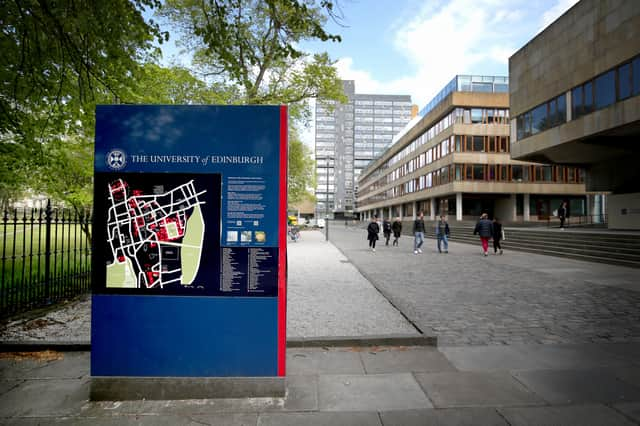
Sir Peter however accepted he is “very well paid”, with committee convener Douglas Ross pointing out the principal’s reported salary of £418,000 is more than the combined wages of both First Minister John Swinney and Prime Minister Sir Keir Starmer.
Sir Peter however said when he had checked the salaries of the heads of organisations with a similar turnover to the university, “for one of them it was £5 million, for another it was £17 million”.
He then added: “I was made an offer by the University of Edinburgh when I was appointed and I accepted it, and I am very satisfied with the package I was offered.”
He said his “basic salary” is “about £350,000”, adding there is a pension supplement on top of this.
Salary reduction would make ‘largely no difference’
Asked by Mr Ross if given the “massive cuts” the university is planning there could be a reduction in his salary, Sir Peter said: “You could pay the senior team of the University of Edinburgh nothing and that would make largely no difference to the size of the expenditure challenge we face.”
Edinburgh University has already confirmed about 350 staff will leave under a voluntary severance scheme, which will save it about £18 million a year.
Sir Peter said while he would “very much hope” future job losses could be made on a voluntary basis, he could not rule out compulsory redundancies – something trade unions have urged the university to do.
“We have not done so because we genuinely don’t know if they are going to be necessary and it would be dishonest to pretend that we do know,” he said.
He was pressed on how many jobs would have to go to make savings of £90 million, with the principal saying: “We don’t know the answer to that because it depends entirely which jobs. We have staff paid a wide range.”
Challenged by Mr Ross to say roughly how many posts could be lost, he said: “We haven’t done that calculation.”
He stressed however the need for action – saying income from international students had come in at about £20 million below the university’s target for the past two years.
“We have intervened because we felt we needed to,” he told the committee.
“We’re taking pre-emptive action to try and make sure the university remains in a sustainable position, we’re not waiting to be in deficit before we do it.”
Leadership plea
Mr Ross however suggested the principal could “lead from the front” by giving up some perks of his job, including free use of the university principal’s house, where his utility bills are also paid for him, and a driver.
The convener said: “The driving service, the house, the utility bills, you could put that forward to say ‘this is a saving we can make’ to show you can lead from the front with your organisation.”
Pressed further on whether the principal’s house could be included in the review of properties the university is carrying out as it looks to make sayings, Sir Peter said: “All of the buildings of the University of Edinburgh are under consideration as to whether we need them or not, that is for sure.”
Asked directly by Mr Ross if he needs a principal’s house – a five-bedroomed property in Edinburgh’s Regent Terrace – Sir Peter said: “That’s not for me to comment.
“If I thought selling off the principal’s house would solve the problems of the University of Edinburgh, then it is certainly something that could be considered, but it would be a tiny contribution to what is a massive challenge.”
Make sure you keep up to date with political news from across Scotland by signing up to our free newsletter here.
Comments
Want to join the conversation? Please or to comment on this article.