
Exclusive:SNP accused of 'dereliction of duty' after Cabinet failed to discuss water scarcity despite dry summer
The Scottish Government has been criticised after failing to discuss Scotland’s water scarcity crisis during the summer.

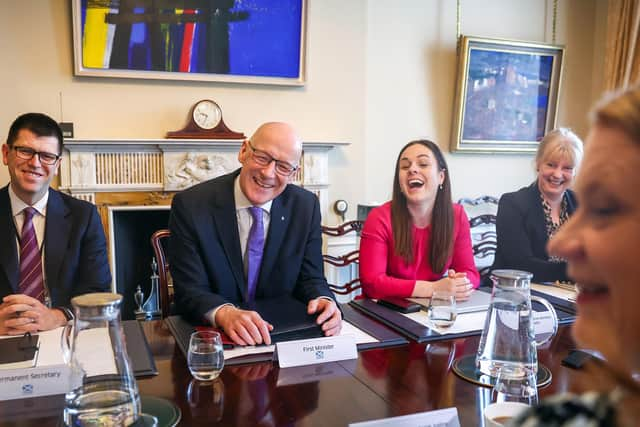
SNP ministers have been accused of a “complete dereliction of duty” after John Swinney’s Cabinet failed to discuss water scarcity between May and September this year, despite it being one of Scotland’s driest summers on record, The Scotsman can reveal.
The failure of Mr Swinney’s top team of ministers discussing the water scarcity crisis came despite his Cabinet receiving warnings in March and May about the impending risk of dryness across Scotland and as water restrictions were issued by Sepa over the summer.


Cabinet records, obtained through Environmental Information Regulations (EIR), reveal the last meeting of the Scottish Cabinet that received a submission on water scarcity was on May 13.
Two days later, SNP ministers were specifically made aware of the risk of moderate water scarcity in the east of Scotland. On March 5, the Cabinet received advice drawn from the Sepa winter water situation report that highlighted the potential for water scarcity for Scotland more generally over spring and summer.
On June 5, Sepa put out an update warning saying “the east of Scotland has seen its second driest spring in 100 years”. The warning said “some parts of the east coast have had below average for the last 12 months” and “some areas of the north and north-east are still at risk of reaching significant water scarcity”.
Water scarcity continued into July, with an update warning “the first half of the year in the east of Scotland has been the driest since 1973”.
It added: “These exceptionally dry conditions, following on from a dry autumn and winter last year, have led to the lowest groundwater levels for June on record in Fife and parts of Angus.”
An update in August warned “rainfall data for the east coast of Scotland shows that every month since the beginning of the year has had less than average rainfall”, adding “in some parts of the east, this deficit extends back to June 2024, where these areas have received 40 per cent less rainfall compared to the long-term average”.
Last month, Scots were urged to save water as reservoir levels remained up to 28 per cent below average despite heavy rain after the summer dry spell. Scottish Water said that following the driest spring in Scotland in 70 years, and a drier than average August in the east, many reservoirs were below normal levels.
READ MORE: SNP 'slowing' climate action as MSPs approve targets before seeing strategy to achieve them
The last update on Thursday from Sepa warned three areas “remain at significant water scarcity”, while other parts of Scotland “remain vulnerable to water scarcity” amid a risk “conditions could deteriorate quickly during any further prolonged dry periods”.
Scottish Labour net zero spokesperson Sarah Boyack said: “It is a complete dereliction of duty that in one of Scotland’s driest summers John Swinney's Cabinet didn't discuss water scarcity once. This week Sepa continues to report significant and moderate water scarcity, while some communities experienced flooding as a result of Storm Amy.

“We urgently need the SNP Government to prioritise action on the climate emergency. This neglect demonstrates the contempt they have for Scotland’s natural environment and for all of us who rely on it.
“If having dozens of areas across the country experiencing water scarcity doesn’t even warrant a conversation, let alone action, how can they be trusted to safeguard our future and deliver for Scotland?”
A Scottish Government spokesperson said: “Over the summer, the Scottish Government worked closely with SEPA, Scottish Water and key stakeholders to monitor and manage water availability.
“Ministers, including the First Minister and the Cabinet Secretary for Climate Action and Energy, received weekly updates from officials on water levels across the country and plans to ensure that public and private water supplies were supported in effective and sustainable ways. Cabinet minutes provide a full account of actions, but are not a verbatim record. As such, it is not possible to determine with certainty when or how many times a particular topic has been discussed at Cabinet.”
Comments
Want to join the conversation? Please or to comment on this article.