
Scotland braced for unpredictable parliament but will Holyrood tear itself to shreds again over independence?
Will another battle over independence halt any progress in the next Scottish Parliament?


John Swinney is poised to be sworn in as first minister for the second time next week as his opponents lick their wounds from a bruising election . But following a hostile campaign that threw together arguably the most assorted and diverse parliament in the history of devolution, can we expect Holyrood to achieve anything in the next term?
The day before the election that saw Mr Swinney returned to power, he told The Scotsman that he would not work with Reform outwith the duties he must undertake in keeping with the ministerial code.
But Holyrood’s maverick new presiding officer, Kenny Gibson has other ideas.

“I want to make sure that every party has a role to play in this parliament”, Mr Gibson told MSPs, moments after taking up his place in the hotseat.
We do not yet know how seriously Reform MSPs will take the Scottish Parliament and what role, if any, they will play in how it operates.
What we do know is that last week’s election threw up some early and pertinent headaches for parliament bosses.
For the first time since devolution, two parties were tied for second place - with Scottish Labour and Reform securing 17 seats apiece.
Despite jokes from Labour figures that “it will only hold until Reform get someone suspended”, a solution is needed.
Labour and Reform in FMQs conundrum
Anas Sarwar, who insists he is carrying on as Scottish Labour leader, has asserted that his party should be seen as the second largest party over Reform, in part down to its history.
It is understood that Scottish Labour acknowledge the potential optics of Reform UK Scotland leader, Malcolm Offord, doing his bit at FMQs before Mr Sarwar every week would be a terrible outcome for the party.
That will be decided this week by the so-called parliamentary bureau, made up of the party business managers and the new presiding officer.
One Labour MSP suggested that Mr Gibson, who gave up his SNP affiliation when he became presiding officer “must have offered Reform something”, adding that “it appears like Reform all backed him” to become presiding officer.
That decision over who goes first could be crucial for how the Scottish Parliament operates. Parties might gang up on Reform and make them go after Labour or they could take turns with Mr Sarwar’s party.
Despite having a really difficult election, Scottish Labour is trying to focus on being perceived as a the grown-up opposition party against the backdrop of Reform entering Holyrood.
Mr Sarwar said that “Scotland deserves a parliament focussed on the issues that matter and a government that will deliver on its promises”.

He added: “Scottish Labour is committed to being the credible opposition Scotland needs – working constructively in the national interest and holding the SNP to account on its record.
“We cannot let the division and noise of Reform provide cover for the SNP or derail the important work that needs to be done over the next five years.
“Scottish Labour will focus on the issues that matter – making life more affordable, fixing our NHS, delivering opportunities for young people and strengthening our communities.”
Reform has insisted its MSPs will not disrupt the Scottish Parliament but the party’s manifesto was thin on devolved policies.
The party’s MSP for Glasgow, Thomas Kerr, has argued Reform is "shaking up the system inside this place”.

Mr Kerr claimed that Reform was “absolutely petrifying the Holyrood establishment”.
“We’re not here to be their pals”, he added.
That sounds like fighting talks rather than a party willing to work with others.
We might not yet know whether Mr Sarwar or Lord Offord will get their shot at FMQs first, but we do know where the parties and their MSPs will sit. Despite around half of the MSPs elected to Holyrood being new faces, Holyrood bosses have kept seating arrangements in the chamber pretty similar to before the election.
READ MORE: Labour's downfall cannot mask unionists' failure to oust SNP as Reform and Greens charge forward
The SNP and Greens will share the central section, with Labour and the Lib Dems on the left from the perspective of the presiding officer, with Reform placed on the right, with the Scottish Conservatives behind them.
Cabinet choices
The focus will be on Mr Swinney this week when he is officially voted in as first minister by MSPs on Tuesday, before he is sworn in at the Court of Session on Wednesday.
Some of the early decisions for Mr Swinney will be his Cabinet. There are key vacancies to fill after Angus Robertson failed to defend his Edinburgh Central seat, while Shona Robison and Fiona Hyslop did not seek re-election.
Stephen Gethins would be a natural fit for Mr Robertson’s position, given his polished background in international relations. Even his most ardent political opponents would admit that Mr Gethins is a brainbox.

Former SNP Westminster leader Stephen Flynn would likely enter government in some form, even though such a move has been downplayed by the Aberdeen South MSP. For Mr Swinney, failing to bring him into government may look like a snub, a move his opponents would seize on.
Glasgow Central MSP Alison Thewliss would also be a huge asset to Mr Swinney’s government.
Speculation has mounted that Mairi McAllan is a shoo-in to be the next deputy first minister. While that would surprise nobody, other senior SNP ministers such as Shirley-Anne Somerville might get the nod. Scotland also needs a finance secretary.
The SNP, in the last parliament, still reeling from the pandemic, had a frustrating time of it, in terms of legislation. You could argue that after UK government interventions in the gender recognition reforms, the deposit return scheme and legislation to embed the UN Convention on the Rights of the Child into Scots law, that Holyrood lost its confidence as a legislative power.
Mr Swinney, whilst falling short of securing a majority, will have the confidence and a fresh personal mandate to bring forward legislative plans that will give him his own identity as a politician and a leader.
Although Mr Swinney will need support of other parties to get legislation passed, in reality he is spoilt for choice. The make-up of the parliament means that although it is likely the Greens and potentially the Lib Dems will back a lot of Mr Swinney’s plans, he may find common ground with Labour, which will be desperate to re-brand itself, and the Tories, in a similar boat, on certain issues.
Cost of living focus
We can expect to hear from Mr Swinney, in the coming days, about how he intends to use the powers of the Scottish Parliament to protect people from the seemingly never-ending cost-of-living crisis.
The SNP leader will publish his draft legislation for his ambitious plans to cap food prices and extend a £2 bus fare cap, currently in action in the Highlands and Islands to Glasgow, Ayrshire, Dunbartonshire, Renfrewshire, Lanarkshire, and Inverclyde.
Mr Swinney said that during the election campaign “the people of Scotland were clear with me that the cost of living was their biggest concern”.
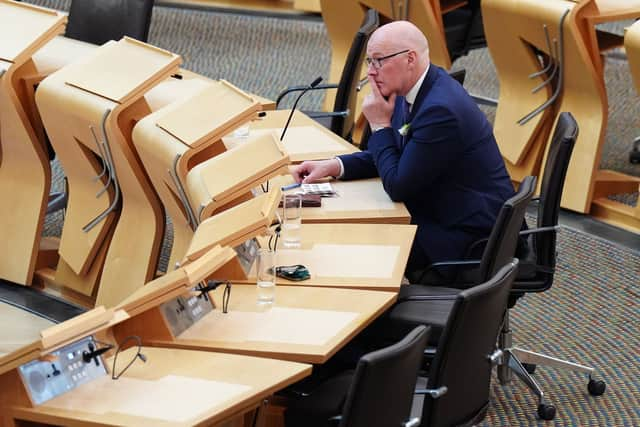
He added: “I pledged that doing everything I can to support people through it would be top of my agenda as first minister – and that is exactly how I will govern.
“We will take swift and early action to support people with the cost of living.
“In the first 100 days of the new government, we will take action on food prices, we will begin reducing the cost of people’s daily commute and we will offer first time buyers up to £10,000 support to get on the property ladder.
“That is exactly what you get from a Scottish government working for Scotland.”
Mr Swinney contrasted his vision with Westminster, which he branded as being “in a state of almost constant crisis”, with a Prime Minister “almost entirely focused on saving his own job rather than providing the support people need”.
Can the SNP push forward independence?
The new parliament has a huge pro-independence majority, despite the SNP falling short of a majority - with a record 15 MSPs returned by the Scottish Greens. But Mr Swinney’s independence strategy is no further forward. He will need permission from Westminster to make any moves and going by last week, it remains unclear whose head within the UK Labour government Mr Swinney will need to turn in order for them to grant his Section 30 order.
That being said, expect the first day of a new SNP government to include a vote on making a formal request to Westminster.
Mr Swinney believes the cost-of-living crisis heightens the need for Scotland to become independent but might we see a change of tact from his government, if, as is highly likely, his requests hit a brick wall.
Labour MSP Paul Sweeney has suggested that a cross-party convention could be used to agree a trigger point of any future independence referendum - arguing there is a need to “settle” the issue that has become a “force of paralysis”.
The SNP returned to government has a mandate to pursue independence, but without some movement on the constitution one way or another, the next Scottish Parliament, which looks set to be more unpredictable than ever, risks tearing itself to shreds once again over the constitution.
Comments
Want to join the conversation? Please or to comment on this article.