
Exclusive:Scotland's £50bn floating wind industry in crisis talks as contracts cull expected after SNP over-ambition

Industry bosses expect more flagship floating wind contracts to be returned to Crown Estate Scotland as the sector grapples with cost pressures.
Scotland’s renewables bosses have held crisis talks over plans to prioritise just four floating wind projects as more developers are expected to relinquish flagship ScotWind leases amid fears SNP ministers “oversold” a promised £50 billion boost to the economy.
Industry insiders have told Scotland on Sunday that, following the “sugar rush” that came after the Scottish Government announced its world-leading ambitions for floating offshore wind almost five years ago through the flagship ScotWind process, the sector is now trying to build support for four projects in the hope that they can be constructed.
Several more flagship leases are expected to be handed back through “attrition” to Crown Estate Scotland in the coming months.


There are also fears that the potential problems in commercially scaling up floating offshore wind projects at the pace promised could be seized on by political parties wanting to see a move away from renewable energy.
Concerns have also been raised with Scotland on Sunday that the UK government could turn its back on floating wind with cost-reductions in small modular nuclear power at similar projections.
Unlike traditional fixed-bottom offshore wind, floating projects can operate in waters deeper than 60m - with the potential to open up huge parts of the North Sea, Celtic Sea and other waters across the globe for renewable energy projects. If floating wind can be scaled up, it could harness strong winds that are not able to be captured with fixed bottom developments.
The turbines essentially float on the water and are anchored to the seabed.
The world's first floating wind farm to be constructed is Equinor’s Hywind Scotland development off the coast of Peterhead, which opened in October 2017. The Kincardine floating wind farm, with a capacity of just 48MW, is also operational, off the coast of Aberdeen.
Of the 30 potential floating wind developments earmarked for Scottish waters, as well as the two operational sites, only the single 3GW Culzean turbine is under construction and only three projects have obtained planning consent.
The Scottish government’s flagship ScotWind contracts specified around 60 per cent of the agreements as floating offshore wind, with SNP ministers giving expectations that the developments could be generating clean power in the 2030s.
Announcing the ScotWind winners in January 2022, then SNP net zero and energy secretary, Michael Matheson, boasted that “ScotWind is by far the world’s largest commercial round for floating offshore wind”.
He added that it was “inspiring to see the tremendous rate of innovation in this technology and what more could be possible 10 to 15 years from now in this fast growing sector”.
But speaking at the annual floating offshore wind conference in Aberdeen, Kajsa Jernetz, offshore wind lead for strategic researchers, BloombergNEF, starkly warned that very little progress is expected to be made over the next few years.
She said: “The industry has gotten caught up in a negative spiral where the supply chain doesn’t have the order certainty it needs in order to invest which brings higher costs, leading to project delays and decreasing project viability.
“The first year of gigawatt-scale installations is still more than a decade away. We expect floating wind to remain niche in comparison to bottom-fixed offshore wind all the way out through to 2041.”
A pipeline of 24GW of floating wind capacity has been drawn up in Scottish waters which would potentially lead to £50bn of investment if all projects can become operational. The four projects to be prioritised would amount to just 1.6GW of clean power.
Scotland on Sunday understands that crisis talks have been held in Aberdeen between the industry and developers to rally behind four key projects to get those over the line. As part of those talks, support is being sought to back the 960MW Buchan Winds project, the 2GW Caledonia project, of which around 500MW is to be floating - which both won ScotWind contracts.

Efforts are also being made to rally around the 100MW Pentland development, which has received backing from GB Energy and the Salamander 100MW project, which won a contract in the Innovation and Targeted Oil and Gas (INTOG) leasing round.
Hopes had been put on the 560MW Green Volt project, being brought forward by Floatation Winds and Norwegian company, Vårgrønn, to press ahead with development after it secured planning consent.
The development would be the world’s biggest floating wind farm when completed. But speculation has emerged that Vårgrønn is poised to pull out of the project in another worrying signal.
A Vårgrønn spokeswoman told Scotland on Sunday the company has “not confirmed that it will withdraw from Green Volt”.
She added: “We continue to progress the project towards its next key decisions .”
That potential blow would come after Shell handed back its 2GW lease to Crown Estate Scotland for the floating CampionWinds development in November last year, before Ocean Winds relinquished the 500MW Arven South floating project near Shetland earlier this year.
The Scottish government had hoped that Chinese turbine manufacturer Ming Yang opening a proposed £1.5bn factory at Ardersier in the Highlands would kickstart domestic supply chains for floating wind, but the plan was blocked by the UK government in March over national and cyber security fears.
One senior industry source has told Scotland on Sunday that “there was a sugar rush” for floating wind five years ago.
READ MORE: Warning Scottish floating wind projects could be 'delayed or cancelled' under energy plan pressure
They said: “There was a lot of good work in that time in ports investments galvanising developments and actually getting projects into the planning system. But we’re coming off that sugar rush now.
“ScotWind was a complete moonshot - there’s going to be more attrition. We will likely see more leases relinquished. The sector is now thinking about how we get ahead of it.”
They added: “We need to put forward a more credible offering, rather than kidding ourselves that we’re going to be deploying gigawatts and gigawatts and gigawatts of floating wind by 2030 or 2035.
“Actually, what this is now about is picking winners.”
The senior insider argued that the floating offshore wind industry is struggling to win “hearts and minds” at the UK Treasury.
They said: “When they are looking at us, small modular nuclear reactors are on a similar cost-reduction pathway as floating - why don’t we put our eggs into this basket?
“The conversation that’s happening now is about how we get everyone on board with backing certain projects. There’s a gathering of minds to do that.
“We’re getting to a sharp point where the sector is going to have to say something, which looks like a step down from the lofty ambition - it’s a realistic climbdown.
“The peril point for the UK government is the credibility of the whole thing. The peril point for the Scottish government is that maybe we have oversold what was possible by the end of the decade.”
Gillian Morrison, head of offshore wind development at Crown Estate Scotland, has warned that a “sense check” is needed for floating projects.

She said: “We have the strongest supporting mechanisms coming around this from public finance institutions, from stakeholders, from industry. And yet still it feels that we are in an incredibly challenging space right now.
“We have worked hard since the inception of floating wind to understand the scale of the opportunities, what it needs, how do you unlock some of these key investments. And whilst there are challenges, we also recognise that this is an industry that is committed to moving forward.”
Ms Morrison added: “We need to, just at this moment in time, take a bit of a sense check.
“What is it we are going to achieve from this and how are we going to unlock it? We cannot wait for this time next year to be saying ‘what do we want from floating wind’.
“The time-limited opportunity that we spoke about five years ago is now really narrow. And yet, we have a hugely supported infrastructure around us. But we are challenged to get investments over the line.”
Clare Lavelle, the industry chair of the Scottish Offshore Wind Energy Council, stressed that the UK is an “enviable stable policy environment for renewables”.

She said: “I need to be absolutely honest in saying it’s an incredibly challenging environment in which to be progressing floating projects at the moment.
“We are nearly five years on from the award of the ScotWind projects. This was a programme we thought was going to be fully constructed by 2030. I don’t think we thought we would be in the position we are today.”
Ms Lavelle, who is also the project director for the Buchan Offshore Wind development, added: “I think any one of these risks in isolation could be enough to stop a project, to stop an industry in its tracks. Cumulatively, they are sending all of the wrong signals to investors. I can’t say that many of those issues have changed positively in the last 12 months.
READ MORE: SNP handed stark 'wake-up call' over frittering away £100m ScotWind revenues to balance books
“What is absolutely critical is the decisions that we take in the next 12 months because they are absolutely going to determine the size and shape of the industry that we have ongoing.
“It’s really a once in a lifetime opportunity and if we don't deliver on it in the next couple of years, we will not deliver what we need to do in terms of oil and gas energy transition opportunities.”
Scottish Labour economy spokesperson, Daniel Johnson, said: “If ScotWind licences begin being handed back by industry then that would raises serious questions for the Scottish government, their energy strategy and delivery plan.

“Energy should be central in powering economic growth in Scotland but we need delivery,not more unachievable promises.”
Scottish Conservative energy spokesman, Liam Kerr, said: “The SNP's flagship ScotWind programme looks set to fall far short of what ministers promised.
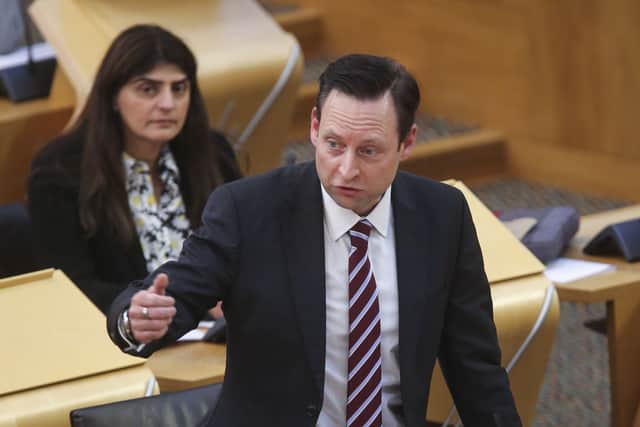
“They boasted about how it would enable Scotland to become a leader in offshore wind, but in typical SNP fashion, reality has not even come close to matching the rhetoric.”
He added: “Offshore wind has a role to play in Scotland's energy mix, but these damning remarks make it clear SNP ministers were unrealistic about it.
“This must be a wake-up call for them to finally accept that oil and gas and nuclear must also be part of Scotland's energy mix if we are to protect jobs and our energy security.”

SNP energy minister, Stephen Gethins, said: “In order for Scotland to meet its full offshore wind potential, the UK government must reform the unfair transmission charges that put Scottish renewable energy generators at a commercial disadvantage, and ensure the upcoming Strategic Spatial Energy Plan (SSEP) fully reflects Scotland's established offshore wind pipeline.
“A final SSEP pathway that does anything less would risk undermining investor confidence in the offshore wind sector and in the wider UK market.”
Comments
Want to join the conversation? Please or to comment on this article.