
Exclusive:Warning window closing for Scotland to lead world on floating offshore wind as 'cumulative risks' fuel jitters
Warnings have been issued by the industry body that Scotland’s chance to lead the world on floating offshore wind is “time-limited”.
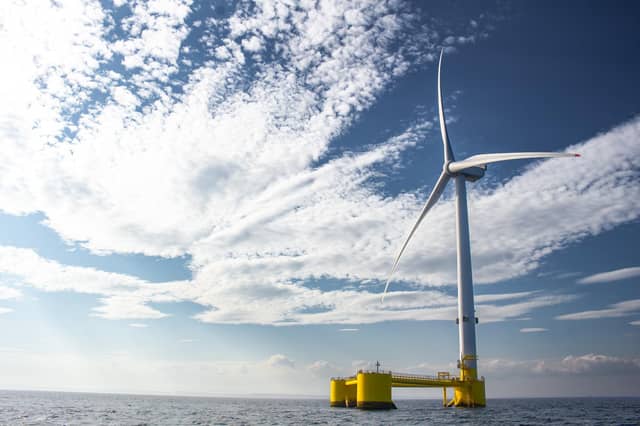


John Swinney has warned there is “no guarantee” that Scotland will lead the world with the SNP government’s flagship floating wind hopes - amid fears the industry is grappling with “the cumulative impact of a whole range of uncertainties and risks”.
Industry bosses, who are now gathered in Aberdeen for an annual offshore floating wind conference, have now suggested that Scotland’s window to lead the way in the sector is closing.

The First Minister, in an address to the conference , heaped pressure on the UK government to ensure Scotland does not miss out on potential economic benefits that scaling up the sector could bring.
Almost two thirds of the Scottish government’s flagship ScotWind projects are earmarked as floating offshore wind, but with costs for the emerging technology still incredibly high and domestic supply chains still not having been built up in Scotland and across the UK, fears have been raised about the future of the projects.
READ MORE: Warning Scottish floating wind projects could be 'delayed or cancelled' under energy plan pressure
Floating wind can be anchored to waters deeper than 60m, unlike fixed-bottom offshore wind - opening up larger parts of the sea for development that could harness stronger winds.
But Angela Hepworth,CEO of industry body Scottish Renewables, ,told the conference that “the sector is facing some significant challenges and uncertainties”.
She said: “We’ve got a really strong pipeline of projects but those projects are finding it challenging to reach final investment decisions.

“When I talk to developers about the obstacles that they face, they tell me it’s not about one single issue, it’s about the cumulative impact of a whole range of uncertainties and risks.”
Ms Hepworth pointed to upcoming decisions to be taken by the UK Labour government that will impact whether offshore floating wind is pushed forward - particularly over its upcoming strategic spatial energy plan and the next contract for difference auction round, the so-called AR9 - with AR8 winners poised to be announced later this year.
“It’s really critical that the developers and the supply chains can see a very strong signal from the UK government of their intent for the floating offshore wind sector”, she warned.
“There are problems with transmission charges for projects here in Scotland - we urgently need a transitional solution to enable projects to put credible and competitive bids into the AR9 auction.
“Projects across the UK face challenges with the timing of their connections and uncertainty around connections. Projects are still taking too long to get through the planning system and planning bottlenecks are impacting the development of the grid. There’s a whole range of uncertainties.”
READ MORE: Flagship North Sea floating wind projects stall as SNP warned not to 'squander' renewables potential
Ms Hepworth warned that “it’s nearly five years ago, now, that Scotland signalled its ambition for floating offshore wind”.
She added: “Those leasing rounds generated global interest and created the conditions to have a thriving industry in Scotland and in the UK - creating good jobs and supply chain opportunities.
“That ambition was built on a solid rationale. It’s clear that we need to push the boundaries of renewable technologies and unlock the potential of our deeper waters. There is a clear strategic need for floating wind and there’s a clear strategic case for investment now.
“Scotland and the UK have a time-limited opportunity to be at the forefront of the development of this sector, globally. Scotland in particular has a time-limited opportunity to build on the expertise of the oil and gas sector and create the green economy of the future.
“We have the skills, the capabilities, the expertise, the innovation. What we’re waiting for is projects to secure their route to market and construction.”
Mr Swinney, addressing the conference via a pre-recorded video, told industry leaders and developers that “we are not content simply to follow global developments”, adding that “we are creating them”.
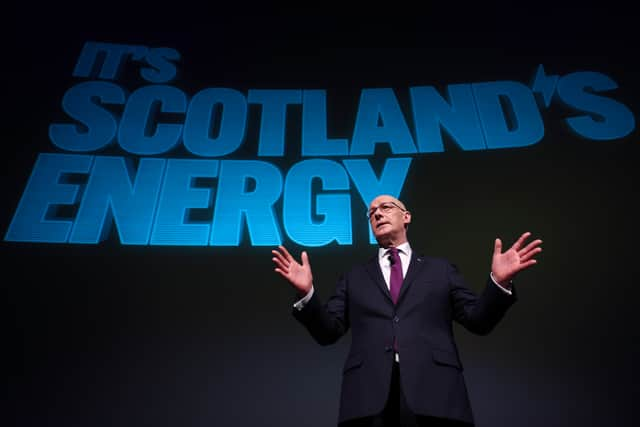
The SNP leader warned that “while the opportunity before us is immense, it is not guaranteed”, as he pointed to “a time that is critical for the sector”.
He added: “The decisions made by the UK government over the next few months will determine where jobs are created, where factories are built, where infrastructure is developed and where economic and social value is captured for decades to come.
“UK government policy decisions must match the world-leading ambition of Scotland’s offshore wind sector. It is not acceptable to focus attention on policies that only deliver at scale for the rest of the UK. Scotland must get our share.
READ MORE: SNP handed stark 'wake-up call' over frittering away £100m ScotWind revenues to balance books
“We deserve policies that deliver stable market frameworks informed by a reliable route to market to support sustainable investment. We need contract for difference auctions that create the conditions for success for floating offshore wind.”
Mr Swinney argued that the Labour government’s strategic spatial energy plan must “reflect our full offshore wind pipeline".
He said: “We’ve made it clear to the UK government that anything less will not be accepted by my government.
“The right conclusion is critical for Scotland and critical for the growth of your sector.
Getting this right means Scotland can become the global centre of floating offshore wind.
“Success will come through collective efforts. The UK government , industry, investors and communities all have a vital role to play. Together, working in partnership, we can seize one of the greatest opportunities of our generation.”
A UK government spokesperson said: “Floating offshore wind is key to harnessing more of our natural clean energy resources.
“We are working with the National Energy System Operator on delivering the strategic spatial energy plan, which will set out a strategy for how new infrastructure should be spread across the country and create growth in every postcode.”
Comments
Want to join the conversation? Please or to comment on this article.