
MSPs urged to 'look terminally ill Scots in the eye' and back assisted dying

The final vote on the historic bill will take place at 10pm today
MSPs have been urged to "look terminally ill Scots in the eye" and back controversial plans to legalise assisted dying in Scotland as supporters and opponents launched last-ditch efforts to influence a historic vote in Holyrood today.
The final vote on the Assisted Dying for Terminally Ill Adults (Scotland) Bill will take place at 10pm this evening, in what will mark a “defining moment” in the history of the Scottish Parliament.
The outcome is thought to be on a knife-edge, with the fate of the legislation in the hands of fewer than half a dozen wavering MSPs.
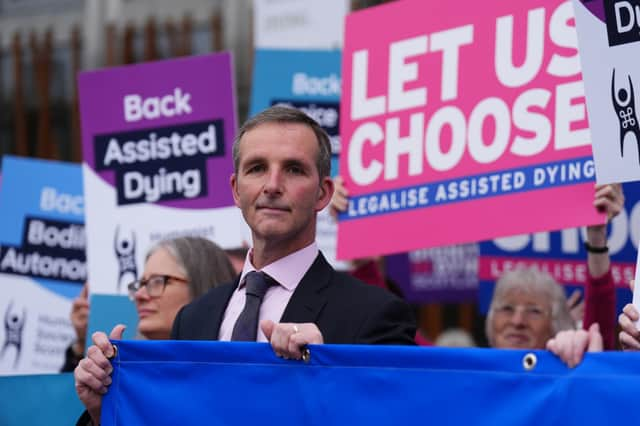

The bill would allow for terminally-ill Scots to seek help to end their lives, and supporters insist it is the “toughest and most comprehensively safeguarded” legislation of its type anywhere in the world.
But opponents say it would be a “catastrophe in terms of how our society confronts illness and disability”, leaving vulnerable people open to exploitation and abuse and potentially leading to a slippery slope in which safeguards are loosened in future.
READ MORE: Scotland assisted dying: Final pleas from campaigners as MSPs set for historic knife-edge vote
MSPs spent dozens of hours debating the bill late into the night over several days last week, including during a rare sitting on a Friday, and accepted 175 amendments.
Liam McArthur, the Liberal Democrat MSP behind the move, said: “When I launched this bill, I said that I wanted to deliver a robust and well safeguarded law that would give terminally ill Scots with mental capacity the choice of an assisted death if they wanted one. After five years of development, consultation, revision and amendment, that bill now sits before Parliament.
“Throughout this process public support has been unwavering. This bill has the overwhelming support of a significant majority of Scots regardless of religious affiliation, political party or disability status.
“MSPs have added detailed amendments on coercion, prognosis and protection of vulnerable groups and there are cast iron protections for healthcare professionals ready to go.
“To my MSP colleagues I want to say this: This is now the toughest and most comprehensively safeguarded assisted dying bill in the world. If you believe that dying people should not have to suffer against their will and you have heard, like I have, of the many instances where they have been simply failed by the lack of compassion and safety in our current law, you now have to back this bill. It is time to look terminally ill Scots in the eye and make this change.”
Mr McArthur’s proposals would allow Scots aged 18 or over to seek help to end their lives legally, with the bill requiring two doctors to confirm that a person is terminally ill and has the mental capacity to make such a request.
Meanwhile, a change introduced last week would mean that people should be “reasonably expected” to have six months to live or less before they would be eligible for an assisted death.
This is the third time MSPs have considered legislation on assisted dying, with two previous attempts having failed at their first vote.
Supporters and opponents of the bill will gather outside Holyrood today. Kate Forbes, the Deputy First Minister, will be among those voting against it.
“I will vote against assisted dying because the bill is now riskier and less safe after MSPs rejected critical safeguards and outsourced essential protections for doctors to the UK government,” she said.
“Doctors, psychiatrists, pharmacists and palliative care specialists – the people who would be tasked with implementing this – are asking us not to do it.
“These are the people on the front line of compassion in Scotland, the people who have dedicated their lives and careers to helping people in life and in death. They think this bill is unsafe.
“Similarly, Hospice UK raised concerns that if the bill passes, people will have a legal right to state-funded assisted dying and no legal right to palliative care operated by charities.
“I know MSPs are motivated by compassion, and so we should heed interventions from doctors and nurses whose whole careers are dedicated to caring for us.”
READ MORE: Scottish Secretary insists UK government 'will not stand in way' of assisted dying law amid row
SNP Health Secretary Neil Gray said the vote will be a “defining moment” for decades to come. He previously raised concerns that aspects of the bill lay outside the powers of the Scottish Parliament, but believes it is now “within legislative competence”.
Mr Gray told BBC Radio Scotland’s Breakfast programme: “I’ve been neutral on the bill, representing the government’s neutrality. It’s been, I think, a very good debate from both sides of the argument almost the entire way through.
“I think Liam has led the bill with grace. I think opponents of the bill have set out their case, often in a very compelling way, and MSPs now have a choice on a bill that I believe is now within legislative competence to choose on the merits or otherwise of assisted dying.
“It is a significant moment for this Parliament. We are in unprecedented territory, and it will be a defining moment, I believe, of this parliamentary session, and could potentially be a defining moment in Scotland for decades to come.”
Some changes to the bill prompted a backlash, with the Royal College of Psychiatrists (RCS) and Royal Pharmaceutical Society saying they now oppose it.
While the RCS said it “remains neutral” on the principle of assisted dying, it added that the removal of a key section of the legislation had “drastically weakened essential safeguards” for psychiatrists and other medical staff.
With employment rights reserved to Westminster, there were fears that if Section 18 had remained in the bill, it would have been outside Holyrood’s competence.
A deal has been agreed with the UK government that should enable employment rights to be protected should MSPs pass the legislation when it comes to the final vote tonight.
Professor Sir Harry Burns, who served as Scotland’s Chief Medical Officer from 2005 until 2014, has also spoken out against the legislation.
Sir Harry, who is Professor of Global Public Health at the University of Strathclyde, said: “The present debate over Liam McArthur’s assisted suicide bill has forced MSPs to examine how we should look after patients with incurable illness. Arguing that we should kill them is deeply disturbing and ignores many ways in which we can and should support them.
“Passing a law which allows people to be killed because they can’t be cured ignores the reality that we can still allow them to feel the contentment of being in control, rather than the torment of being abandoned.
“Engaging positively with them to manage their symptoms and suffering, gives them agency and dignity.
“We may have no medical cures for their physical illness, but we can and should give them a sense of control over their lives, not a pathway to death.”
Gordon Macdonald, chief executive of Care Not Killing, which campaigns against assisted dying, said: “Legalising assisted suicide changes the culture surrounding care for sick and dying people, and would be a catastrophe in terms of how our society confronts illness and disability – not to mention devaluing suicide prevention efforts.
“The bill’s so-called safeguards assume that those who will request assisted suicide will know their own minds beyond doubt. This is a false assumption.
“In today’s individualistic society the pressures on sick, disabled and elderly people to avoid placing ‘unfair burdens’ on others are very great.
“Maintaining the law’s protection of this silent and vulnerable majority is more important than giving choices to a minority of strong-minded and highly resolute people.”
Emma Cooper, convener of Friends at the End, which supports the bill, said: “We hope that MSPs will reflect the clear wishes of the people they represent.
“The vast majority of people in every single constituency across Scotland are asking for assisted dying to be made available to those who are mentally competent and in the last six months of their life.
"We cannot deny those who are going to die the right to choose. It is simply a misconception that pain relief can alleviate the suffering of all conditions at the end of life. Passing this Bill is the right thing to do, the only compassionate decision.”
Comments
Want to join the conversation? Please or to comment on this article.