
Scottish Secretary insists UK government 'will not stand in way' of assisted dying law amid row

The UK government has vowed to allow a section 104 order to be agreed - ensuring any assisted dying legislation from Holyrood is legally competent.
Scotland Secretary Douglas Alexander has insisted the UK government will not “stand in the way” of ensuring Holyrood’s assisted dying legislation will be legally competent - vowing to press ahead with an agreement needed for parts of the law reserved to Westminster.
A row has erupted as MSPs debate the final amendments to be attached to Liam McArthur’s assisted dying legislation.


First Minister John Swinney waded in on Wednesday night, suggesting the UK government could block any assisted dying law agreed at Holyrood from being legislatively competent.
Mr Swinney told MSPs that Mr McArthur’s bill “did not recognise” issues that the Scottish government had “put on the record”, when it had “consistently” noted that measures around the medication that would be used to end someone’s life and about employment rights for medics are “outside legislative competence”.
If the legislation is passed by Holyrood, the First Minister said a section 30 order – where Westminster permits Holyrood to legislate on areas which are usually outside its powers – would be agreed to resolve some of these issues.
But the First Minister added a separate section 104 order would also be needed or the Bill “will be legislatively incompetent”.
The section 104 order would ensure the legislation had the authority over the medication used for assisted death and also employment rights in allowing medical professionals such as doctors and pharmacists from opting out of providing an assisted death on moral grounds.

During this week's lengthy debate, Mr McArthur, has stressed that a section 104 order “is entirely in keeping with standard practice in medicine”.
He added: “The expectation that either the UK government or the Scottish government, which have operated in good faith throughout the process, would somehow divert to a different course of action after the Parliament has decided to support the bill is not backed by any evidence.
“Section 104 orders are regularly used to make consequential modifications to reserved law in relation to acts of this parliament.
“A recent example would be the right of celebrants not to participate in ceremonies under the Marriage and Civil Partnership (Scotland) Act 2014, which was passed unanimously by this Parliament.
“There was no opportunity to take forward discussions on section 30 and section 104 orders until the Scottish Parliament had stated its will on the principles of the bill. As soon as we did that in May last year, both governments have worked at pace to put in place arrangements that allow the reserved elements of the bill to be dealt with appropriately and fittingly.”
Asked by The Scotsman about discussions by the UK government over the assisted dying bill, the Scottish Secretary said: “Officials from the Scotland Office have been in touch with Liam McArthur.”
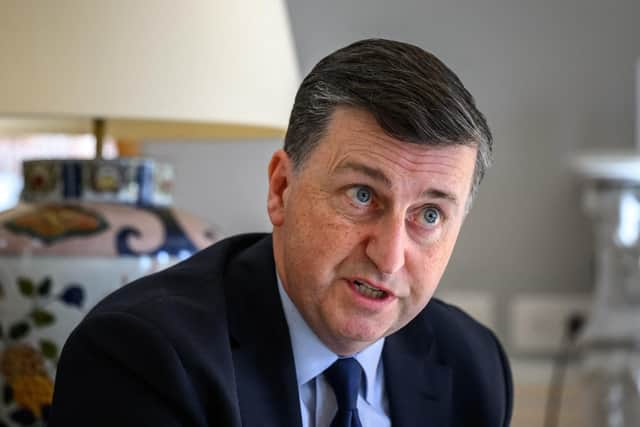
He added: “The position of the UK government, both in relation to Liam’s bill here in Scotland and the assisted dying bill at Westminster, is one of policy neutrality.
“But we have been very clear that we are not seeking to inhibit the ability of the Scottish Parliament to reach its own decision on assisted dying.
“We have made sure that the appropriate conversations and steps have taken place in that regard - both with Liam McArthur and the Scottish Government.”
Pressed for clarity on whether the UK government will grant a section 104 order if Holyrood votes in favour of the legislation, Mr Alexander said: “We’re not going to stand in the way of that.”
Comments
Want to join the conversation? Please or to comment on this article.