
Exclusive:'Alarm bells' over UK taking Norwegian gas 'for granted' in North Sea drilling ban
Industry chiefs have warned the UK’s energy security is being put at risk by relying on maintaining gas imports while banning North Sea oil and gas drilling.
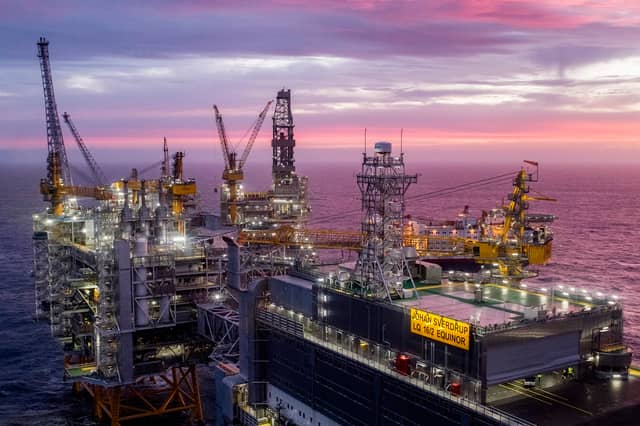


The Labour government has been issued a “stark warning” over taking Norwegian pipeline gas imports “for granted” amid fears pressing ahead with a ban on new drilling would make the UK increasingly reliant on shipping in fuels from across the globe.
The alarm comes amid pressure put on Andy Burnham, expected to become the next prime minister, to change course on the UK’s energy strategy and embrace the oil and gas sector, based in Aberdeen.
Industry chiefs argue that as gas imported from Norway uses infrastructure which is part of the UK industry, if the pipelines become economically unviable due to the failure to ramp up domestic production, it risks the stable import of Norwegian gas. The UK would then be increasingly reliant on importing liquid natural gas (LNG) from the United States and the Middle East.

Writing in The Scotsman this week, Mr Burnham said that in Scotland, “the opportunity is renewables”, adding that “it is hydrogen and carbon capture”. But he did not mention North Sea oil and gas, which is a dwindling resource as the basin matures.
The UK government under Sir Keir has argued that scaling up renewable energy is the best way to boost energy security, while climate scientists and the International Energy Agency has warned that no new fossil fuel licences are consistent with global efforts to cut harmful emissions.
Speaking to The Scotsman, Offshore Energies UK (OEUK) energy policy director, Enrique Cornejo, has warned that the UK risks taking “for granted” a direct pipeline from Norway, that provides around 43 per cent of our gas, the same proportion that comes from domestic production.

The remaining gas, currently a little under 20 per cent, comes from liquid natural gas (LNG), imported mainly from the United States, with some from other countries including the Middle East.
Although all oil and gas is high in carbon emissions, LNG is substantially worse for the climate than domestic oil and gas, while Norwegian pipeline imports are even less carbon-intensive than our homegrown fossil fuels.

“We’re already importing, in the UK, about 40 per cent of our energy”, Mr Cornejo said.
“If we continue down this pathway, we will continue to over-rely on imports, particularly of oil and gas.
“We’re seeing what’s happening in the Middle East with geopolitics. It may seem, for some, the right choice to think we can rely on Norwegian imports of gas.
“About 40 per cent of our gas already comes from Norway, about the same that comes from domestic UK (production).
“The key here is that we can’t take that Norwegian gas for granted.”
He added: “Our operators, our owners of infrastructure, are not only telling us but the government as well, that the infrastructure that is used to process those imports, the pipelines, the terminals, that relies on domestic supply.
“We also use it to import. But if domestic supply declines quicker than it should, the economic viability of all that infrastructure is at risk.”
Mr Cornejo argued that “there is already very intense competition for those Norwegian molecules”, pointing to continental Europe, which has shifted away from Russian fossil fuels following the invasion of Ukraine.
“There’s very different pathways in terms of how much we will rely on LNG in the UK if we don’t get this right”, Mr Cornejo said.
“If we continue at the current trajectory with no unlocking of this investment, by 2035 about 46 per cent of our gas could come from LNG.
“But in a scenario where we prioritise domestic supply, that gap narrows and it’s only less than 10 per cent.”
OEUK has warned that the fragile and unpredictable nature of geopolitics could hamper any required supply of LNG.
“Most of our LNG doesn’t come from the Middle East, it comes from the US”, Mr Cornejo said. “But you don’t know if there’s going to be any future trade restrictions and we can no longer get hold of that LNG.
“When you look at it in the round, it really just makes sense to prioritise our domestic supply.”
SNP MSP for Aberdeen Central, Jack Middleton, has hit out at the UK Labour government’s “pig-headed approach to our offshore industry”, arguing that it “has weakened our energy security while destroying jobs across Scotland, especially here in the North East”.

“There can be no serious discussion about Scotland’s energy that does not recognise the geopolitical context and just how fundamental our North Sea is to our energy security.
“It makes zero sense to wreck oil and gas jobs in Scotland to support jobs on the other side of the world. “
Scottish Conservative MP for Gordon and Buchan, Harriet Cross, said: “This stark warning from OEUK should set alarm bells ringing for Labour and SNP ministers.

“We need to double down on North Sea drilling now, before Britain becomes dangerously dependent on fragile supply chains or potentially hostile foreign regimes for the oil and gas we still need to keep the lights on.”
The Labour UK government is prioritising ramping up renewables to eventually replace oil and gas and currently does not believe that more oil and gas drilling is needed.
Around 15GW of wind and solar contracts secured in the last annual round of auctions will avoid the need to import 78 LNG tankers every year by 2030, with more to be agreed in the coming years.
The UK’s North Sea oil and gas production is forecast to drop by 99 per cent by 2050, compared to 2025 levels. Analysis by Carbon Brief has found that new licences would only mitigate this by 2 per cent, with it dropping to 97 per cent.
A UK government spokesperson said: “Oil and gas production will be with us for decades to come, and we will manage existing fields for the entirety of their lifespan – while actively scaling up clean energy industries in the North Sea.
“Issuing new licences to explore new fields cannot give us energy security and will not take a penny off bills.”
Comments
Want to join the conversation? Please or to comment on this article.