
Why Rachel Reeves' tax-raising Budget will be a hammer blow for Scottish Labour
For voters who want Scotland to change after next year’s election, the choice between the SNP, Labour and Reform UK could not be clearer
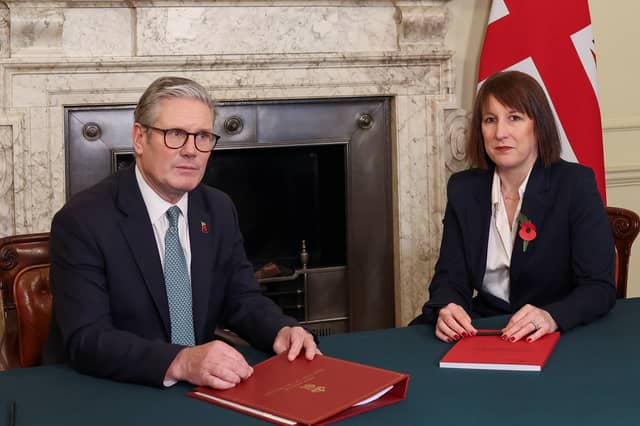


As we enter November, the clock is ticking down towards the second Budget of Rachel Reeves. Just 22 more sleeps before she puts us out of our misery and tells us which taxes she is going to dream up and those she is going to raise – on the back of the £41.5 billion of additional tax she took last October.
The question is not so much if it will be an unpopular Budget or not, but just how unpopular it might be. To win friends and make at least some people happy, there will have to be some winners.
Given she has created a black hole in the public finances – and accordingly has no money to pay out and cannot borrow more – Reeves will have to increase taxes even higher than otherwise to appear generous those groups who might vote Labour.
It's known as robbing Peter to pay Paul but it is not going to drown out the pain and anguish that savers, pensioners, the self-employed and other Labour targets are likely to feel.

Economic doom loop
Worse, unless Reeves is able to pull off a miracle and not depress economic growth even more, there is already the strong possibility that she will need to plan for further tax rises in the next autumn’s Budget. And probably the Budget after that.
The economic doom loop that Reeves has taken us into is also a political doom loop for Labour, and it is especially being felt in Scotland (and Wales too), where the devolved elections take place in May.
In Wales the outcome now looks to be a straight fight between Reform UK and Plaid Cymru’s nationalists. In Scotland, Anas Sarwar’s tilt at the Holyrood windmill is beginning to look a forlorn exercise as voters’ regret towards Labour escalates as the experience of Keir Starmer, Reeves and Ed Miliband having power delivers a bitter reality.
Last summer it looked like the SNP’s days in charge of the Scottish Government were numbered but, with the Conservatives consigned to Room 101 and Labour in charge at Westminster, Scottish voters have to ask themselves which party can they vote for that offers the hope of change?
Even though the SNP government spends the majority of public money in Scotland, runs the big public services, creates most of the laws and prepares the guidance (when it can be bothered) that directs how they are applied, Starmer’s Labour is now seen as being in charge.
Want the latest Scottish headlines sent directly to your phone? Sign up to our new WhatsApp Channel here.
Reform vs SNP
In Stirling last week a by-election saw the SNP trounce Labour in a ward that should have been painted red. The voters confirmed a trend that can be seen in polling as Reform and Labour fight for second place.
Compared to a previous Survation poll, the SNP has fallen three points on the constituency vote and two points on the regional list, while Reform UK climbed four points in each category. Using the survey to compare with the 2021 Holyrood elections, pollster Mark Diffley modelled the SNP down from 64 seats to 55 and Reform at 22 seats ahead of Labour’s 19.
After a nasty budget, Reform could well pull ahead of Labour and become the real contender to take on the SNP. If that becomes the main fight, with Labour support either staying at home or blue-collar votes going to Reform, then the SNP could yet find it faces a real battle.
It possibly sounds fantastical to some, but the SNP record is so bad that it will do everything to avoid this becoming the subject of the election. ‘Dead cats’, like independence referendums and other distractions, will be given life to avoid discussing past SNP overpromising that leaves Scotland’s finances on the edge of tartan austerity.
Starmer and Reeves hurting Scottish Labour
I’ve heard it said Reform is making a likely SNP victory possible, but I disagree. For me I think the arrival of Reform in Scottish politics is the last hope for change, because if it did not exist we would need to invent something like it. Without Reform criticising the Scottish political establishment – of which the SNP is the largest member – John Swinney would be hoovering up even more anti-Labour votes.
So long as Reeves is the Chancellor, and probably so long as Starmer is Prime Minister, I cannot see Labour being accepted as the answer to the SNP. Indeed it’s far more likely that following next May’s election Labour and the SNP might find an accommodation that allows one or the other, if not both, to run Holyrood and keep Reform out.
Reform’s plan is longer term than is generally appreciated. In 2021, the intention was simply to field enough candidates to give people experience and build a core of activists so the general election would be properly contested. That was achieved. In the 2024 general election, the task was to run a complete field of candidates so a bigger assault could be made in the next Holyrood elections. That was achieved.
SNP’s wasted years
In the forthcoming Holyrood election, Reform will seek to present itself as the real opposition to Holyrood waste, administrative incompetence, partisan favouritism and out-of-touch and extravagant posturing worthy of a student union. The purpose will be to build a platform for the 2029 general election and the Holyrood election after that. It will be about building credibility, political momentum and becoming a government-in-waiting.
For Scotland to be rid of the SNP and its 19 wasted years requires Scottish voters to recognise Swinney’s team is responsible for the poor decisions harming our health service, schools, universities, policing and roads – all while local councils are hollowed out and our taxes encourage talent to leave the country.
For those wanting change, the choice between SNP, Labour and Reform could not be clearer.
Brian Monteith is a former member of the Scottish and European parliaments and senior adviser to the Tax Reform Council
Comments
Want to join the conversation? Please or to comment on this article.