
Why COP30 climate change summit in Brazil should be renamed the Hypocrisy Olympics
Brazil markets itself as an environmental champion while bulldozing protected ecosystems for COP30 conference logistics


It’s that time of year again, when squadrons of jet-fuelled aircraft, brigades of lobbyists, officials, academics and politicians, together with a heap of broadcast media luvvies, are packing their bags and preparing to attend the annual climate change junket run by the United Nations.
Known as the UN Conference of the Parties on Climate Change, this year’s political photo opportunity par excellence will be the 30th, and held over 11 days (10-21 November) in Belém, Brazil.
With past venues including Paris, Duba and Sharm-El-Sheikh, the COP gathering is often held at an exotic or romantic destination (Glasgow’s COP26 excepted) and can be relied upon more credibly than climate change predictions to provide a rich seam of hypocrisy.
Indeed, such is the reek of shameless self-contradiction at these annual gatherings that one could be forgiven for mistaking them as Hypocrisy Olympics, and this year’s is already shaping up to break world records for insincerity.
The ‘Liberty Avenue’ problem
Naturally the topic of saving the natural environment, be it Brazil’s Amazon rainforest or massive savannas like the Cerrado, is high on the agenda but this is already causing shame and embarrassment for the Brazilian government and the UN.
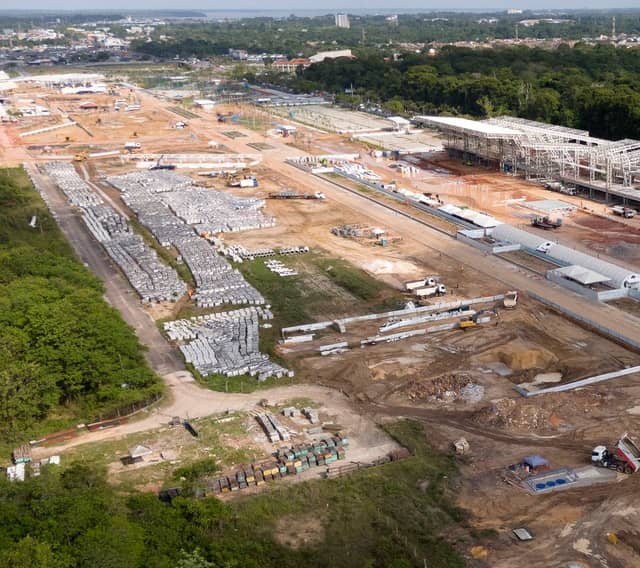
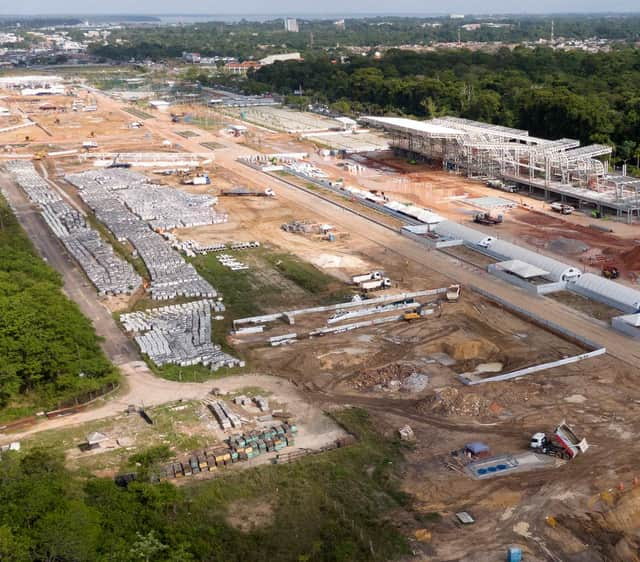
First out of the blocks was the construction of a 13km four-lane highway called the Avenida Liberdade (Liberty Avenue) that slices through the protected Amazon rainforest to connect the airport to the venue for the 50,000-plus climate summit attendees. And yes, the vast majority of those attending will be flying there, just as they had to for Baku last year, Cancun and Doha etc.
The accommodation in Belém was sadly lacking, with only 18,000 beds, so additional accommodation had to be found, with two cruise ships providing an extra 6,000 beds.
The highway had been an unfulfilled dream of the provincial government since 2012 but was repeatedly shelved because of environmental concerns – until Brazil needed it for COP30, then it suddenly became a priority. The road destroyed some 18,400 acres of protected Amazon ecosystem – an area larger than Manhattan. Local communities making their living from harvesting açaí berries report construction has wiped out their trees.
Ironically, COP30's core themes are "preserving forests and biodiversity" and "climate justice" – but the highway directly contradicts both.
READ MORE: SNP 'slowing' climate action as MSPs approve targets before seeing strategy to achieve them
Rainforests cleared for soybean production
The next embarrassment came this month when Cade, the Brazilian equivalent of our competition authority, announced the suspension of the Amazon Soy Moratorium that had been established in 2006 to discourage rainforest clearance for soybean production. Brazil’s reputation for rainforest clearance is about to get a whole lot worse just when everybody in the media is turning to look at the South American country.
Soybean production, largely for poultry, pig and and fish feed, takes up an area larger than Germany, and continues to pose a huge threat to the rainforest. However, stakeholders agreed in 2006 to impose a voluntary moratorium and stop sourcing soy from the region, establishing the Amazon Soy Moratorium – the world’s most successful private-sector conservation initiative.
This agreement between major grain traders, environmental groups, and the Brazilian government prohibited soy purchases from farms which cleared Amazon rainforest after July 2008. Over nearly two decades, the moratorium has prevented around 18,000 square kilometres of Amazon deforestation – an area equivalent in size to Portugal – while allowing Brazilian soy production to expand dramatically on already cleared land.
The moratorium became the gold standard for zero-deforestation commitments worldwide, inspiring similar agreements in cattle, palm oil, and other sectors. It demonstrated how environmental protection and agricultural expansion could coexist within agreed parameters, providing a model for sustainable commodity production that protected critical ecosystems while maintaining global food security.
Although the scale of the achievement should not be underestimated, the moratorium faced constant challenges. Despite the attempts to reduce forest and savanna clearance, soy production in Brazil continued to clear 500,000-800,000 hectares of wilderness annually – equivalent to destroying an area nearly the size of Cyprus every year.
Energy from fatuous hot air?
Such environmental damage is of public relevance to consumers who are oblivious to the environmental harm being done. Knowing if a product is produced in a sustainable manner is not always a choice made available but it should be our goal.
Brazil has complete dominance of the global soybean market accounting for around 40 per cent of global production, of which China imports 73 per cent of Brazil’s exports by value.
If the fatuous hot air of COP gatherings could be captured and used as an energy source it might just serve a purpose, but unfulfilled pledges are cheap, especially while delivering on commitments is observed primarily by guilt-tripping Western nations who cut their forests down centuries ago to build armadas or provide pit supports when mining coal.
Cult of net zero
In the UK we too are about to extend the practice of chopping down woodland and clearing agricultural land all in the name of erecting time-limited solar panels or wind turbines that create their own pollution problems when redundant within 25 years.
Since 2007 Scotland has already sacrificed 17 million trees for ‘green’ infrastructure and now a proposed change in English law is going to grant the same legal powers to the Forestry Commission to, er, remove forestry, in favour of solar panels and wind turbines. It’s utter madness but the cult of achieving net zero brooks no heretics suggesting restraint.
Brazil’s highway project and the ending of the soy moratorium perfectly encapsulate the gap between climate rhetoric and action. Brazil markets itself as an environmental champion while bulldozing protected ecosystems for conference logistics.
More than 50,000 people will be driven on a highway built through destroyed Amazon rainforest to attend a conference about protecting forests. They'll discuss deforestation in a city reached by cutting down protected rainforest.
So yet again the climate change conference works against its own stated goals.
Brian Monteith is a former member of the Scottish and European parliaments and editor of ThinkScotland.org
Comments
Want to join the conversation? Please or to comment on this article.