
Why Andy Burnham and the BBC need to stop being so ignorant about Scotland and the SNP – Joyce McMillan
The statement signed by the SNP, Plaid Cymru and Sinn Fein in Cardiff outlined a better future for the nations of these islands but the reaction from some quarters was decidedly hostile, writes Joyce McMillan

If supporters of Scottish independence ever find their enthusiasm flagging, in these troubled times, then they could do worse than make a regular date with BBC Radio 4’s Westminster Hour; your weekly reminder of just how insular, self-satisfied and ill-informed Westminster politics can be, at its insufferable worst.
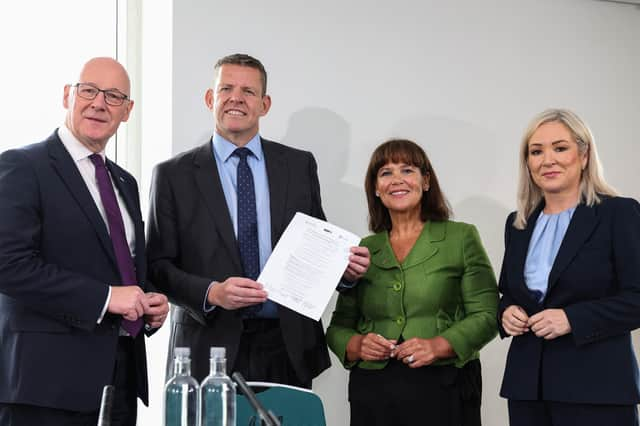
Last Sunday, for example, the programme’s producers felt it necessary to say something about the forthcoming meeting of the Welsh, Scottish and Irish First Ministers in Cardiff, to sign a memorandum of understanding about their determination to work for a new and more equal relationship among the nations of the UK.
For several minutes, a Labour MP, a Tory MP, and a couple of London-based commentators were given free rein to dismiss all three governments, and their meeting, as foolish, wrong-headed, and merely “performative”. No one seemed to find it strange to do this without inviting any comment from any SNP or Plaid Cymru MP; and so the item came and went without capturing any sense of the political sea-changes that have led to a situation where all three administrations, outside England, are now led by parties formally committed to the dissolution of the UK.

Burnham wrong on two points
And in truth, this kind of wilful ignorance about the other UK nations, and complete lack of interest in really understanding their politics, is fast becoming a prime indicator that the UK as presently constituted is in a degree of trouble. At Prime Minister’s Question Time last week, for example, Andy Burnham answered an SNP question on future Sottish and Northern Irish referendums, and in the course of a single short paragraph delivered two political howlers which demonstrated, at best, a hazy knowledge of the UK’s recent constitutional politics.
On Northern Ireland, he said that the Northern Ireland Secretary was required to consider a border poll when there was a “clear consensus” in favour of constitutional change; and he added, “I would say exactly the same situation for Scotland”.
He was wrong, of course, on both points. The Good Friday Agreement requires only an apparent majority in favour of change to trigger a vote, not a consensus; and Scotland has been repeatedly told by all UK governments since 2014 that a further referendum is “off limits” – a position from which Labour has not previously deviated.
READ MORE: Why nationalists should be concerned by John Swinney's latest outlandish claim about Scottish independence
The Scottish Claim of Right
Within 48 hours, therefore, all suggestion of a policy change was being denied; and John Swinney was told once again that a new referendum was out of the question. Andy Burnham, in other words, did not mean or perhaps fully understand what he said at PMQs, and was not about to apologise for his mistake; and this familiar combination of arrogance and ignorance increasingly signals to Scotland, Wales and Northern Ireland that they simply are not on Westminster’s radar, and certainly are not viewed as partners in a union of equals.
So here, for those who have missed a few episodes in recent UK politics, is a brief primer on where we are now, and why. First, it should be understood by everyone involved that the UK is not, and never has been, a unitary state. It is a union state involving four recognised nations, and its history in that form is relatively recent, commencing in 1801, and evolving again with Irish independence in 1922.
Secondly, while post-Brexit Westminster cherishes the idea of its absolute sovereignty over all four territories, both the Labour and Liberal Democrat parties were signatories to the 1988 Scottish Claim of Right, which asserted Scotland’s right to determine its own constitutional future.
Labour should therefore cease its attempts to portray the SNP as wild-eyed “separatists” for advocating an independent if collaborative future, and remind itself that centre-left politics in Scotland has always embraced a cross-party continuum of ideas about popular sovereignty and home rule, for all the UK’s nations.
‘Nationalist’ an ineffective insult
Thirdly, it should be understood that the rise in support for the SNP and Plaid Cymru is not driven primarily by “nationalist” sentiment, but by serious political differences about the UK’s rightward direction of travel since the 1980s, which reached a crisis-point in 2016’s deeply damaging Brexit vote. Using “nationalist” as an insult against the SNP and Plaid therefore does not work in Scotland or Wales, where people know those centre-left parties, and why they vote for them.
Then finally, it should be acknowledged just how profoundly Westminster has failed to come to terms with its own 1997 devolution settlement. Currently, the British state has a real chance to modernise; to begin to move forward in dialogue with its new devolved governments, and to let Westminster – perhaps through a reformed second chamber – absorb and reflect these positive changes.
Instead, it has generally ignored devolved governments and their policies; and particularly since Brexit, has responded to the growing electoral success of Plaid Cymru, the SNP and Sinn Fein with ever more dogmatic and unrealistic statements of traditional unionism and constitutional absolutism – a position now apparently required even of the great decentraliser, Andy Burnham.
There is a better future out there, of course – the one described in the broadly mild-mannered memorandum signed at the Cardiff meeting; a future in which the nations of these islands evolve towards a genuine confederation of equals, finding strength in diversity, and unity in shared values, like the European Union we should never have left.
And although the three leaders’ implausible assertion that Westminster is “coming to an end” struck a jarring note in an otherwise sensible statement, it is nonetheless increasingly clear that UK politics has changed for good; and the sooner Westminster learns to acknowledge and understand those changes, and work with them, rather than against them, the more chance it will have of avoiding a diminished future, and remaining an effective and respected institution, through the coming century of crisis.
Comments
Want to join the conversation? Please or to comment on this article.