
Why a bland BBC report about migrants should make us fear for our future
On the question of immigration, the UK’s ‘Overton Window’ of acceptable views has been shifting in an alarming direction


In Glenn Beck’s 2010 novel, The Overton Window, evil public relations genius Arthur Gardner – who helped turn Che Guevara into a style icon among other scandalous acts – decides time is up for American democracy.
With the secret backing of a shadowy elite, Gardner sets out to create a world “ruled by the wise and the fittest and the strong, with no naive illusions of equality...” In order to persuade politicians to get behind his diabolical plan, he skilfully shifts the ‘Overton Window’ of acceptable views using the dark arts of PR.
Beck, a right-wing US talk-show host, claimed his book was not simply a work of fiction but instead ‘faction’, ie a blend of imagination and reality. A delightfully waspish review in the Washington Post said the success of the book “will be measured not by its literary value (none), or its contribution to the thriller genre (small), or the money it rakes in (considerable), but rather by the rebelliousness it incites among anti-government extremists. If the book is found tucked into the ammo boxes of self-proclaimed patriots and recited at ‘tea party’ assemblies, then Beck will have achieved his goal.”

Moving the window
The actual Overton Window, developed in the 1990s by an American political scientist called Joseph Overton, describes a spectrum of political positions from “more free”, which in his libertarian view meant less government regulation, to “less free”, which meant more.
At both ends of the spectrum, there are ideas that are considered “radical” or “unthinkable” by the public. These are outside the window of the “politically possible” and are deemed “unacceptable”.
Just inside the window are ideas that are considered “reasonable”, then, moving closer to the centre, “sensible” and “popular”, while ones that have become government policy are in the middle. The job of a think tank like the one he worked for, Overton argued, was to shift the window so that good but politically unacceptable ideas would fall within it or that reasonable ones would become public policy.
In recent times, Overton’s radical idea, in various forms, has gained significant currency and is no longer the preserve of right-wingers, moving within its own Overton Window. The Encyclopaedia Britannica gives examples of political stances once considered unacceptable that became mainstream, including the abolition of slavery, the granting of women’s suffrage, and the introduction of same-sex marriage. All three represent progress.
READ MORE: How humanity is about to enter climate danger zone with 'catastrophic risks' for billions
Putin’s destruction of democracy
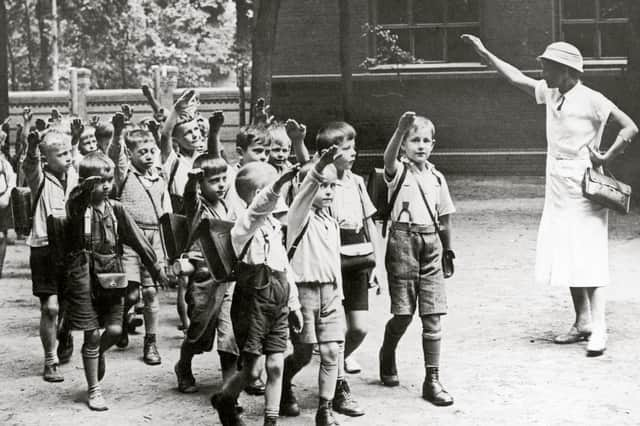
Beck’s book may have delighted delusional right-wing conspiracy theorists but it also performs a useful function – as a reminder that the Overton Window can also move in ways that are sinister, dangerous and downright evil. The acceptance of the Nazis’ vile beliefs by millions of ordinary people in 1930s Germany provides the ultimate warning of how vicious humans can become, all while believing they are behaving reasonably.
Today, the level of support for Vladimir Putin in Russia is perhaps the worst example of an Overton Window shifting in the wrong direction, although that country’s experiment in democracy was brief enough that acceptance of dictatorship was probably not much of a stretch.
In the UK, attitudes towards trans issues have changed, although they appear to be heading back in the other direction of late, perhaps an indication that some politicians introduced policies which many voters thought were too “radical”.
BBC impartiality
However, perhaps the biggest shift has been the rising hostility towards immigration, which helped win the Brexit vote, destroy the Conservatives, and is now powering the rise of Nigel Farage’s Reform UK party.
When anti-migrant riots broke out last summer, some on the hard-right expressed sympathy with the rioters, despite their victims having absolutely no connection to the incident that sparked the violence, the Southport stabbings.
However, it was a fairly bland report on the BBC recently that really started to make me think about how far our ‘Overton Window’ has shifted. The idea of BBC “impartiality” has always been something of a myth. They do try to be impartial, but what that actually represents is a very political question. It seems to me that what they are really doing is operating in the centre of our Overton Window, even as it moves around.
‘Hostility’ towards RNLI volunteers
So the first line of that BBC report may strike many as perfectly reasonable: “Lifeboat crew members who are called out to migrants crossing the Channel in small boats have told the BBC they make no apologies for saving lives at sea.”
Another way to write this sentence would be: “Lifeboat crew members who are called out to people in distress have told the BBC they make no apologies for saving lives at sea.” How on Earth could we have possibly got to a situation in which this needs to be said? Are we truly a country that might contemplate letting fellow human beings, whoever they are, drown when we could save them?
The article states matter-of-factly: “The RNLI has faced accusations from some on social media, including Nigel Farage, that it was acting as a ‘taxi service’ for people trying to enter the UK illegally.” It then quotes RNLI volunteers defending their actions because of the “hostility” they have faced.
I don’t think there’s anything wrong with the article, it’s more what it tells us about ourselves. An intelligent alien arriving from another planet might get the impression from the report that, while there is a difference of opinion, both views are reasonable to hold.
So it might not take too much of a further shift to move the RNLI’s philosophy – they are “the charity that saves lives at sea” and aim “to save every one” – from “reasonable” to “radical” and, therefore, outside the Overton Window of politically acceptable views.
That its ethos dates back to 1824 and has been uncontroversial for two centuries underlines just what a profound departure from our long-standing values this would be. And sympathy for violent rioters and disdain for life-savers may only be the start.