
The warning signs are all red about the effects of the digital world on our children – Dr Sohail Bhatti
The evidence of harm to children’s social development and motor skills is concerning

Up until the 17th century, children were treated as mini adults. The Victorians created a paradoxical world where childhood was a golden age of innocence and play for the well-off, whilst for the working class it was brutal and exploitative.
This dichotomy survived into the 20th century when laws finally banned most child labour. Even doctors came to understand that children were not mini adults with the founding of the British Paediatric Association in 1928. The recognition that physiological and neurodevelopmental processes were at play and problems could have lifelong consequences if not addressed seems logical and obvious to us now, but medical progress often mirrors society at large.
The groundwork for what became labelled “scientific medicine” was laid in the 1960s, then built upon by Archie Cochrane in the 1970s and David Sacket a decade or so later. Archie was born in Galashiels and he expounded the importance of randomised controlled trials in finding out true impacts. His name continues in the Cochrane Collaboration where up-to-date systematic reviews of such trials are published and influence policy in healthcare.
This has been a long journey, but the outcome is that, increasingly, treatments are evidence-based, and are therefore more likely to be effective, with clarity about where they might not work or where there’s not enough evidence.
Growing concern about children
This is the context in which the current dispute between clinicians and various educational establishments is currently taking place. In my independent report, Our Future Selves, I referred to the growing concern amongst clinicians about the harm that unfettered access to digital media could cause our children which would effect their future development.
The concept, promoted by the Scottish government, that every child should have a laptop or tablet by 2021 in the context of the Covid pandemic was sound. It endeavoured to ensure universal access to remote learning, and at that time this made profound sense as we sought safety at home, with schools closed.
The entrepreneurial Scottish Borders Council was quick off the mark and was able to get funding for and access to iPads, even for some in primary school. Other councils such as in Glasgow, Edinburgh, Falkirk and Fife were not far behind.
READ MORE: Parents will be urged not to share children's images online as part of mobile phone ban tech blitz
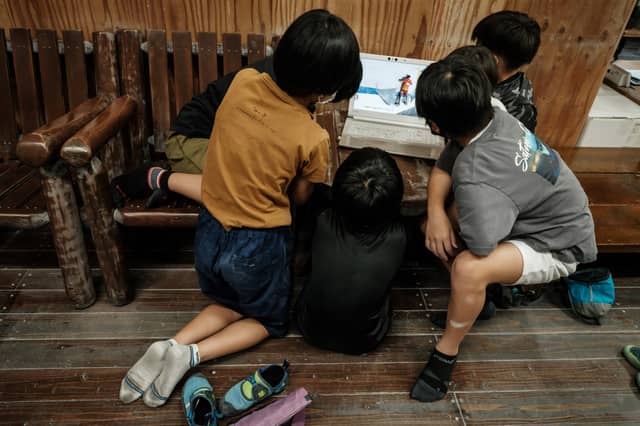
This has created a dependency on electronic support for learning. Children are going to physical education lessons with iPads and are taking instruction from YouTube videos. Was this the original intention? The pervasive use of digital learning aids and the gamification of learning have become an unwelcome tsunami promoted by commercial interests, where our children are seen as consumers, and parents as bystanders.
The Academy of Medical Royal Colleges, in its submission to the Westminster government earlier this year, likened the addictiveness of social media to that of smoking. It called it a public health emergency, and as a former director of public health, I support that.
Addiction, depression and self-harm
Indeed, I led a group trying to scope out this very problem via multiple agencies in a Public Health Action Team on behalf of the Scottish directors of public health. Recently, interest in this issue has increased as it has become clear that digital and social media have been deliberately designed to be engaging, are addictive and are therefore stop us from engaging in other activities, including the important one of growth and development for our children.
I have found that though the director of public health has duty to publish an independent report, there was no legislative basis for that in Scotland, unlike England. I have written to Maree Todd, the relevant Scottish minister, asking for her to provide that framework. Only in this way can important matters be raised, regardless of the interests that might not welcome this. Health boards and councils should be obligated to receive the report, and have due regard to its recommendations.
Earlier this year, Australian researchers published an analysis of 153 studies that examined the impact of digital media use on the health and developmental outcomes of children and young people up to the age of 18. They identified increases in depression, self-harm and slight drops in academic achievement and self-perception from social media.
Video games were seen to result in an increase in aggression but promoted the ability to concentrate. Speech and language therapists report that they are seeing delayed development in the youngest of children, and the skills that children learn from play are often lacking, both in terms of social development but also motor skills.
The Lancet, a leading medical journal, reported in October that addictive algorithmic recommendation systems, predatory platform design and the incentives linked to commercial tracking all cause real harm to young people.
Risk of being overwhelmed
Let us be clear. The evidence is only now coming in. Earlier action during the pandemic was well meaning. The nature of an evidence-based approach is that it takes time to gather the research, to sort it and identify common features.
In most areas of life this does not matter, but in the digital world where things move fast, we are at risk of being overwhelmed. The early warning systems are all showing red.
Parents are concerned. The Scottish government has started to convene summits. It urgently needs to commission research, but also ensure there are guardrails in place to protect children in collaboration with public health colleagues.
How tightly we clutch our children when we go to a fairground or busy market, fearing for their safety and strangers we have not vouchsafed. So why would we want our children to wander into the digital world full of strangers and risks and harms? We should not be Luddites, but we must put the safety of our children first. Only then can they manage the demands of this strange, new, AI-empowered wonderland.
Dr Sohail Bhatti is an executive member of the British Medical Association's Public Health Committee
Comments
Want to join the conversation? Please or to comment on this article.