
Silence of the Goats: Slaughtered animals reveal how SNP is creating £4.7bn black hole in public finances
The Scottish Government has had no real fiscal discipline because they can always blame Westminster if anything goes wrong

My MSP of the week, she might be surprised to learn, is Rachael Hamilton, the Tory who represents Ettrick, Roxburgh and Berwickshire, for an eloquent plea on behalf of goats, in a Holyrood committee.
In a week when the SNP admitted it has dug a £4.7 billion black hole for itself – or rather, for all of us – it is a significant story not only for goat-lovers but as an illustration of how money is squandered without any understanding of what it is intended to achieve. I’ll get back to the goats.
The bleak warning from Shona Robison, the hapless Finance Secretary, was slipped out in time for MSPs to go off on a two-month break. If I were taking a scythe to public expenditure, Holyrood and its countless apparatchiks would be a symbolically good place to start, before moving on to the quangos.
READ MORE: 'Treasured' feral goat herd to be culled by 85 per cent as Langholm petition launches to save them

Bad spending decisions
For openers, Ms Robison promised cuts of £1bn a year to “administration costs”. These are a symptom of the malaise as well as a cause but at least it seems to have dawned that spending money they don’t have, then blaming “Westminster” for not sending enough, has hit the buffers of credibility.
The mission of the devolved government should be straightforward if the rules are observed – ie, you have a fixed budget, plus tax-raising powers, and your job is to spend it efficiently and effectively. The SNP have never respected these rules because they crave for entirely different ones. That conflict is incapable of resolution.
By any reasonable standard, the Scottish Government is very well funded and receives far in excess – £22bn at the last count – of the revenues raised in Scotland. So get on with it. Instead, there has been no real fiscal discipline because the escape clause will always be to blame someone else.
The £4.7bn black hole is made up of hundreds of spending decisions, few of them open to meaningful challenge at Holyrood, and many devolved to quangos which control massive budgets. There is no equivalent of the Public Accounts Committee at Westminster, which might penetrate the culture of waste and obfuscation.
Ancient, wild herd
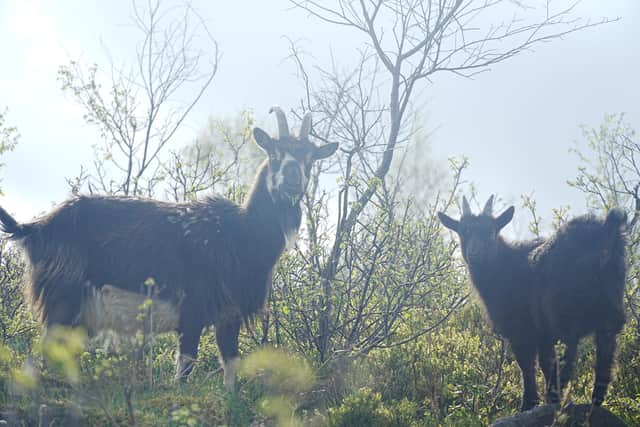
But let me return to the goats of Newcastleton, whose plight is deserving of attention in its own right. They are, Ms Hamilton explained, victims of the Scottish Government’s efforts to promote a market in “natural capital” which requires large areas of Scotland to be flogged off to “green” speculators intending to make large profits out of carbon credits.
To be fair, she didn’t put it like that, but it is a fair summary. In this case, an Exeter-based outfit called Oxygen Conservation Capital acquired 11,400 acres of Langholm moor in 2023 and now intend “to cull 85 per cent of the ancient herd of wild goats on the moor”.
This, Ms Hamilton told the Scottish Parliament, “is causing distress in the community. Those goats are not only of ecological importance but are of significant cultural and heritage value. More than 12,000 local residents have signed a petition for the goats’ protection”. Alas, Ms Hamilton reported, the cull was already underway and “the goat meat is in the butcher’s shop”.
Then came the nub of her argument. “I do not think that the issue is really about goats, though… my point speaks entirely to the fact that grants from the Scottish Government have gone to an offshore investment company that is creating very few jobs and has upset 12,000 people,” she told MSPs.
She added: “The government needs to look at this, because we are at the very start of the natural investment process. Pension companies will buy up swathes of land and do pretty much what they want, without the say of communities.” Well spoken, Ms Hamilton.
Carbon credits
That, in SNP terms, is what passes for ‘land reform’ and, of course, it is also inflating land values to make Scotland’s land ownership structure even more grotesque. Simple question: Why are many million pounds of Scottish Government money encouraging this speculative process rather than taking community interest as the starting point?
I can find no trace of that fundamental question having been debated at Holyrood before it became an assumed good that subsidising speculators in carbon credits should be the preferred approach on the road to net zero. Once that silo was created, it was there to stay.
For the sake of completeness, I should acknowledge that Ms Hamilton moved an amendment to the Land Reform Bill calling for an “ethical framework for natural capital investment... developed in consultation with individuals and communities that have a legitimate interest”. That sounds pretty reasonable but it was defeated by five votes (four SNP, one Green) to four. Greens Against Goats, apparently.
Proper funding for high priorities
The Scottish Government’s approach to spending imposes no requirement to take an overview of priorities in order to review them. Just keep adding… more commitments, more quangos, more civil servants. It has taken nearly 20 years to embed these silos and they have no intention of being disturbed. Ms Robison certainly isn’t going to do it.
A day-one commitment by the SNP’s opponents must be to a Comprehensive Spending Review, with no line of expenditure exempt. The highest priorities must be funded properly. However tenaciously guarded by vested interests, the spending silos, large and small, must be challenged.
There has to be a real sense of change from a devolved government which respects the rules and has no agenda other than to deliver for Scotland. And if that involves not handing money to ‘green’ speculators to slaughter much-loved goats, I will make sure Ms Hamilton gets her share of the credit.
One final quango-related thought. What was the Scottish Funding Council doing for years while Dundee University was sinking into the mire? That’s another £62 million that might have gone elsewhere. It all adds up.
Comments
Want to join the conversation? Please or to comment on this article.