
Mainstreaming of far-right ideas in UK politics shows why John Swinney was right to raise alarm
The First Minister deserves praise for bringing together colleagues from across the political spectrum – apart from Reform – for a summit about the dangers posed by the far-right
Received wisdom at Westminster has it that the far-right has never made it into UK politics. Coupled with that theory is then the debate by the same commentators around what constitutes the ‘far-right’. However using the measurement of policies pursued, which is, after all, the very essence of a political movement or party, the far-right has most certainly arrived in UK politics.
UK parties, across the political spectrum, now embrace the hardest of hard Brexit, unthinkable even in the aftermath of the referendum in June 2016, and a policy that has done untold damage to the economy and our rights. We also had a government that promoted the sending of asylum seekers to Rwanda and MPs who openly campaign on leaving the European Convention on Human Rights (ECHR), which has underpinned our rights since the end of the Second World War. Were the UK to leave, it would be joining Russia and Belarus in doing so, hardly polite company.
Brexit, leaving the ECHR, and the Rwanda scheme are or were mainstream policy proposals in the UK yet they are policies that far-right parties elsewhere in Europe would baulk at. Even the hardest of hard-right parties in other parts of Europe such as the National Rally in France, the Vlaams Belaang in Belgium or Alternative fur Deutschland in Germany have abandoned plans to leave the EU, given the UK’s Brexit debacle.

An attack on justice
Yet despite these policy failures, the mainstreaming of the far-right has become all too common in our politics along with their tactics. Over the past few days alone, Conservative Shadow Justice Secretary, Robert Jenrick, attacked the Labour Attorney General for doing his job and defending his clients. His remarks were described by former Conservative Attorney General Dominic Grieve “as a direct attack on our principles of justice”.
As we saw in this week’s Hamilton by-election, we in Scotland are certainly not immune. Nigel Farage’s attack on Anas Sarwar, which he doubled down on when challenged by the press, should act as a warning to us all.
Such remarks are unacceptable and whereas I may have legitimate policy differences with the Scottish Labour leader, they should have no place in our political discourse. For all the heat of the campaign in the run-up to what was a hard-fought by-election, it was good to see SNP and Labour leaders call out these disgraceful comments.
Zia Yusuf’s resignation as chair of Reform on Thursday and his concerns around Reform in the Commons should also act as a warning.
Calling out bigotry
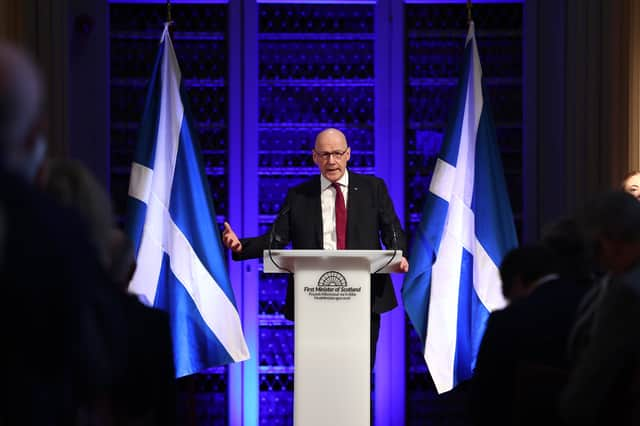
That is why the First Minister was right to bring together colleagues from across the political spectrum in a summit seeking to “lock out” Reform from Holyrood earlier this year. John Swinney is right to call out their policies and the “bigotry” that they represent and to call out Farage as “an accomplice of the Russian agenda”.
Fair play to the politicians and representatives of civil society who put any political differences aside and joined the First Minister. That meeting was criticised at the time by the Conservatives and a range of commentators. Given Reform’s tactics and language over the course of the by-election campaign, we have seen just how badly needed that stance was and remains.
Labour will be pleased with Thursday’s win, and I congratulate them on it, however, no party can afford to be complacent about Reform. One of the lessons from Hamilton must be that the key to taking on the far-right is to challenge them on their ideas.
Nigel Farage’s track record is not a particularly good one. He has been a driving force campaigning to leave the EU for decades. That was a decision that has exacerbated the cost-of-living crisis, removed rights from UK citizens, damaged business, especially small-to-medium enterprises (SMEs) and ultimately made us all poorer.
He backed Donald Trump whose presidency has destabilised the world, seen tariffs introduced that have damaged the global economy, and undermined efforts to support Ukraine against Russian aggression.
‘Island of Strangers’
The Reform policy platform is weak. For their opponents, that should provide ample targets. Yet, in the Westminster bubble their policies are given far too much credibility. There is an omertà around discussing the glaring failure of the Brexit experiment and the less said about Keir Starmer’s “Island of Strangers” speech on migration frankly the better.
John Swinney would be the first to admit that the Scottish Government haven’t got everything right. However, on the big calls around our relationship with the EU, the impact of Donald Trump’s presidency, migration, child poverty and the rights we should enjoy as citizens, the SNP leader has maintained credibility for his stances, winning plaudits at Westminster and further afield.
Politics is about ideas and Reform’s are simply not good ones. The Conservatives and Reform are increasingly aligning on a range of policies and a pact or even merger is not out of the question. This is to be expected, given that Reform draws its politicians and many voters from the Conservatives. They have, in turn, turned their backs on One Nation conservatism, and instead the party is dominated by the Johnson/Truss populist wing, which is not so different from Farage and Reform.
This week’s by-election and the preceding campaign must act as a wake-up call. During the run-up to the Holyrood elections, there is an opportunity for all parties to set out their vision for Scotland. On the one hand, there is an inclusive, outward-looking and internationalist vision represented by John Swinney, on the other is Reform’s inward and exclusive offering. I know which one I’m backing.
Stephen Gethins is the MP for Arbroath and Broughty Ferry
Comments
Want to join the conversation? Please or to comment on this article.