
How John Swinney let slip that this is as good as it gets for Scotland under SNP
Rather than being a reflection of devolution’s potential, John Swinney’s remark that ‘the limits of devolution’ have been reached is an admission of his own inadequacy

John Swinney launched another cut-and-paste case for independence this week and hardly anyone noticed. It was a ritual to be performed on the eve of his party’s conference and one might reasonably ask why the public purse paid for it, rather than their own coffers.
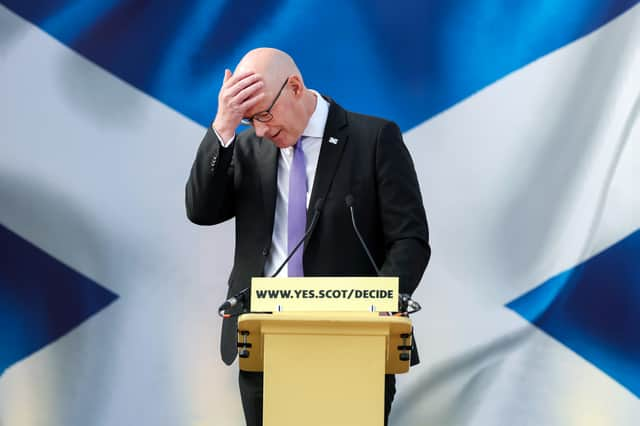
However, the exercise had inadvertent value for one sentence which Mr Swinney delivered: “I suppose what I'm saying is we're reaching, or have reached, the limits of devolution.” That sentiment should be hung round his neck every day until next May.
Loosely translated, it means: “As far as we’re concerned, this is as good as it gets. On the NHS. On education. On attainment gaps. On drugs. We have run out of ideas for Scotland’s progress other than through independence. Within the constitution as it stands, we have reached our limits. We are done.”

Take Swinney at his word
Then take the logic one step further. If independence is not on the agenda – as generally agreed and even for those who aspire to it – what is the point of electing a political party whose leader declares it has “reached the limits” of what it can deliver? Might it not make sense to make way for fresh ambition to test these limits?
In fact, it is absurd to claim that any limits have been reached – insulting, even, to those who worked to create the Scottish Parliament. Rather than being a remotely accurate reflection of devolution’s potential, it is a confession by Mr Swinney of personal and political inadequacy. He should be taken at his word.
Headlines of recent days point to the limits which Mr Swinney has reached. A million Scots on NHS waiting lists. The flagship policy on children in care facing “significant delivery risk” due to lack of planning. Astonishingly, 573 charges of drug-dealing dropped because the cases were time-barred.
None of these random examples result from the limits of devolution but from failings of government – ie, Mr Swinney and his dismal band. Yet his decoded message is: “This is as good as it gets unless you opt for independence because we’ve reached the limits of devolution.”
Failing to learn from other countries
I took a look through their independence paper and found it predictably full of fallacies and assumptions you could spit peas through. Its starting point is to hold devolution within a larger state in contempt though this is the constitutional framework within which the vast majority of Western Europeans live and generally prosper.
For meaningful comparators, they could look to the nations and regions which make up France, Italy, Germany, Spain… But what use would that be to them, since it would only demonstrate their own failure to use economic and social levers to make Scotland a better place, far less learn from elsewhere. So much easier to whine about limits.
The paper holds up Denmark, Norway and Ireland but only, of course, because they exist rather than for what they too might teach us of practical value. They have the cheek to include a section on Danish “localism” when a fundamental principle of SNP rule has been to centralise everything they can lay hands on, sucking power and accountability from councils and communities.
We are to be like Ireland but not, rather critically, by emulating its “policy choices on, for example, low corporation tax”. EU membership is taken as a given, though there is not the slightest evidence of its availability. Norway’s continuing commitment to oil and gas exploration does not rate a mention.
If only we could be like these baseless comparators, it is asserted Scottish households could be over £10,000 better off each year. Is there any wonder they have reached the “limits” of ambition for devolved Scotland, when their permanent fixation is with this delusory world of make-believe?
Loss of English electricity market?
Renewable energy is now a favourite subject but, my goodness, what a mess they have made of that too, with nobody to blame but themselves. The ScotWind licences were sold off at absurdly low values but not a penny of the money raised was then directed towards the infrastructure required to deliver them.
“We are a net exporter of electricity… worth around £1.5 billion in the most recent year,” the document declares proudly. But exporters to where? Exclusively, of course, to the rest of Britain which has plenty other options if required.
It is already costing UK consumers £1bn a year to pay for wind farms, mainly in Scotland, not to generate electricity when there is too much supply for the system. How many billions does Mr Swinney think would be acceptable (to Scottish consumers alone) if he ever managed to separate us from that market?
Land reform box-ticking
The document has the brass neck to talk about land reform for which, allegedly, the House of Commons “could not find time” which is another historic falsehood. Land reform depends on political will, not constitutional change, and even I am surprised by the SNP’s failure in 18 years to produce anything of worth.
There is a Crofting Reform Bill going through Holyrood just now which the local authority in the Western Isles, along with everyone else who knows the subject, has dismissed as “so unremarkable that it is difficult to explore or challenge” with “more focus on semantics than on deep-rooted issues”.
Crofting reform is a minority issue but that description is a fair metaphor for so much that Mr Swinney and his colleagues touch. Even on something so distinctively Scottish, there is no soul, no conviction, no commitment. Government is about box-ticking, cheap headlines and scattering money around while waiting for the promised land.
As Mr Swinney has helpfully confirmed, the nationalists have reached their limits of devolution but not yet touched the bottom of mediocrity. We can’t say we haven’t been warned.
Comments
Want to join the conversation? Please or to comment on this article.