
SNP gathers in Aberdeen under the 'darker' shadows of Nicola Sturgeon and Alex Salmond's legacies
The party continues to grapple with the complex legacy of its two former leaders

John Swinney has plenty of reasons to be cheerful. Just 15 months after the SNP’s bruising general election defeat, the party is comfortably ahead in the polls and looks set to return to power for a remarkable fifth term next year.
But as the party gathers for its conference in the vast, cavernous space of the P&J Live arena in Aberdeen this weekend, the complex legacies of two individuals will nevertheless cast a shadow over proceedings.
Sunday will mark one year since the death of Alex Salmond, the former first minister who arguably did more than anyone to advance the cause of independence, but who passed away at the age of 69 while still estranged from the party he once dominated.


His spectacular falling out with Nicola Sturgeon, his successor and one-time mentee, caused lasting rifts in the nationalist movement. The latter is now engaged in a lengthy book tour to promote her memoir, Frankly, which includes an entire chapter dedicated to Mr Salmond and the breakdown of their relationship.
It is a psychodrama that has yet to fully play out. But as activists meet in the Granite City's bars and restaurants over the coming days, neither name will be far from their lips.
Independence frustrations
Meanwhile, the SNP is grappling with internal frustrations over its independence strategy, which has stalled in the face of Westminster intransigence. Mr Swinney has put forward a conference motion arguing that securing a majority at the Holyrood election next year is the only uncontested route to a second vote, but a rebel amendment resurrects the idea of fighting it as a “de-facto referendum”. It will likely be voted down, but is nevertheless a visible sign of restlessness.
"Swinney is the most popular leader, or the least unpopular leader, in Scotland by quite some distance, really," said the pollster Mark Diffley. "He's not seen as particularly kind of dynamic or energetic, but he hasn't got the negativity attached to him, at least at this point, that some of the other leaders have."
The SNP and polling
The rise of Nigel Farage's Reform UK has benefited the SNP, he said.
"They [the SNP] are doing well, but they haven't particularly recovered hugely," Mr Diffley explained. "They are polling on average 35 per cent at the moment, which is 5 per cent up on where they were at the general election last year, so that's not to be dismissed.
"But they are still well behind where they were in 2021. They have still lost some 13, 14 percentage points of the vote, which is a good chunk of voters. They are helped, really, by the fact that the opposition, the anti-SNP vote, however we want to describe it, is further diluted by the rise of Reform."
Fergus Ewing’s thoughts
Fergus Ewing, the former SNP rebel who now sits as an independent, puts it bluntly. "Nigel Farage has been John Swinney's bestie, in polling terms at least, if nothing else," he told The Scotsman.
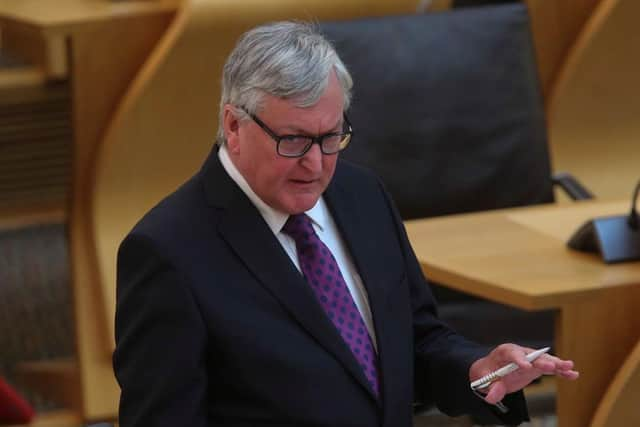
Mr Ewing, who has represented Inverness and Nairn since 1999, and was previously a senior government minister, now has a withering view of the party he devoted much of his life to.
"I think the SNP is in more difficulty than it realises," he said. "It hasn't got a plan for independence. It's given up on the economy. Its performance in government has been dire.
“It's lost its way, it's lost its mojo, it's losing much of its leadership, it's capitulated to the Greens. It's just a shadow of what it was under Alex Salmond's leadership, where it was broadly respected across the whole of society."
Mr Ewing believes the opinion polls are exaggerating the SNP’s support. "The vote has never been softer, and I think the party will have very serious problems in getting its vote out at the Holyrood election,” he said.
Mr Diffley pointed to Labour's general election victory last year, which was "a very large majority, but very shallow", adding: "In terms of where the polls are now, we might see something relatively similar [for the SNP] next year."
Swinney’s steady hand
Many in the party are well aware of this. "I think John has steadied the ship and tidied up some areas and has got us on a surer footing, but is gaining by the weakness of the opposition rather than the strength of our policies,” one MSP said.
They expected Mr Swinney's conference speech on Monday to include a big policy announcement. "I would expect at least something," they said. "For it to be declared a success, the troops need to be galvanised and ready to get out campaigning."

But whether they will be galvanised by the First Minister’s rhetoric on independence is another matter. James Mitchell, professor of public policy at Edinburgh University and an expert on the SNP, said the party was “deeply divided” on its constitutional strategy.
He described Mr Swinney’s motion as a "weird concoction", adding: "It's not about the constitution. This is about internal politics. Everything is thrown into that resolution. There's something there for just about everyone.
"But it is incoherent. It's meaningless from a constitutional point of view, but that's not it's point, I think that's the key thing. It's really about trying to keep the party together."
The legacies of Mr Salmond and Ms Sturgeon “touch a very raw nerve” inside the SNP, the academic said.
"They have been living in the shadow of the referendum for a long time,” he said. “But they are now living in a very different and much darker shadow of Sturgeon and Salmond. That is a very difficult one.”
Comments
Want to join the conversation? Please or to comment on this article.