
How Boris Johnson's hard Brexit led directly to English Channel small boats crisis
As a member of the European Union, the UK was able to return large numbers of migrants to Europe
Sitting as an MP at Westminster, it has been hard to escape the observation that, across the UK, many people have become scunnered with politics. The promises of Boris Johnson that never materialised, the catastrophe of Liz Truss’s brief tenure that those of us with a mortgage are still paying for and, of course, the ‘change’ election in 2024 that delivered a different colour of government but more of the same from a policy perspective.
Much of the scunner factor comes from the EU referendum, and in Scotland, the independence referendum when people were promised the world by the respective successful campaigns, yet nothing was delivered.
During the Brexit campaign, UK voters were told that they would “take back control”, “Britain held all the cards”, and citizens would maintain the benefits of European membership with none of the drawbacks. That was nonsense then, and nonsense today.


Lost freedoms and red tape
The aftermath of the EU referendum saw chaos break out in Westminster. There was no agreement in the government as to what kind of Brexit the UK wanted to pursue, and it took over two years for the UK Cabinet to reach an agreement on a policy for leaving the EU. Even then that was rejected. The problem remains that, whilst there are 27 states pursuing independence within the EU, a clear model, there is only one state pursuing a post-EU life, and not very successfully either.
That has not stopped those who argued for Brexit setting out how they propose helping those damaged by the policies they pursued, be it the small businesses facing more red tape, the scientists facing barriers to cooperating over research or the young person who no longer has the freedom of movement within the EU that previous generations enjoyed.
Rather those who pursued Brexit have simply decided to shout louder that the fault lies in not pursuing a pure enough version of Brexit, whatever that may be, rather than owning the blatant failure of the project.
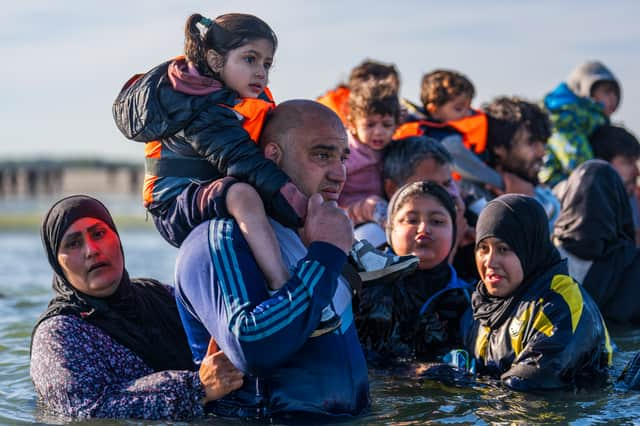
The latest version of the Brexiteer anger has turned on those desperate enough to clamber into small boats and cross the English Channel. Reform politicians have even raised the prospect of public disorder and invasions, claiming asylum seekers could be coming to ‘do us harm’. It’s the kind of victim-blaming and othering of some of the most vulnerable people on the planet deployed by the far-right across Europe.
READ MORE: Why Scottish independence is the opposite of Brexit and John Swinney's plan is the right one
The Brexit effect
Don’t get me wrong, no one should be forced into small boats and the people-traffickers are criminals who should face the full force of the law. However, much of the blame for the crisis can be laid at the door of those who actively sought a hard Brexit.
Prior to leaving the EU, the UK was a member of what’s known as the Dublin Regulation. This was first signed in 1990, coming into force in 1997. The regulations set the rules around the examination of asylum applications, with the UK able to return large numbers of asylum seekers because they had not requested asylum in the first EU member state they reached.
Given geography, the UK took a smaller number of applications, and one criticism of the system was that a few states took in the vast majority of cases. There was a particular burden on states bordering some of the world’s trouble spots especially in the EU’s south and east.
However, the hard Brexit that has been pursued by successive UK administrations meant that deal has been ripped up. Since several non-EU states have signed the Dublin regulations, the UK now finds itself, as with other issues, isolated in democratic Europe. The UK is now the only part of Western Europe that is not signed up to the Dublin Regulation.
This has seen an explosion in small boats crossings. Figures released by the Commons library this week show just how much of a driver leaving the EU has been on the crossings. The library notes that there is only data for 2018, the first year when such crossings were noticed in “significant numbers”. Even then the numbers were just 299, by 2022 these figures had grown to 46,000 with 30,000 crossings already this year.
Migration a positive thing
Straw-grasping Brexiteers have tried to argue that the increase in crossing is because the border agency is clamping down on those hiding under lorries. With the best will in the world, this seems implausible given the huge increases post-Brexit.
In fairness the Prime Minister accepts that sitting outside Dublin is a headache for his administration, telling the Commons this week that Dublin was “ripped up when we left the EU by people who made promises that wouldn’t be the case”. He did go on to flag the one unilateral agreement that is now in place. However, that is something of a sticking plaster when it comes to the challenge of fixing the endless problems caused by leaving the EU.
Migration is a good and positive thing, as those working in our businesses, education institutions and public services like the NHS will know. However, governments should also be able to control migration.
Brexiteers have made that job harder and must own the small boats crisis in the English Channel. Every time a Reform or Conservative politician – they are pretty interchangeable in their arguments – stands up and rails against illegal migration, it is worth noting that they and their colleagues created many of the problems we are now dealing with. Like so much else, the victim blaming is merely a smokescreen for the failure of their signature policy ‘achievement’.
Stephen Gethins is the SNP MP for Arbroath and Broughty Ferry
Comments
Want to join the conversation? Please or to comment on this article.