
Nigel Farage can make life difficult for John Swinney and SNP
Young men - of voting age - are now twice as likely to be right than left wing


Pity poor Michelle Ballantyne, forgotten pioneer of the populist right in Scotland.
Back in 2021, when Nigel Farage’s reputation in Scotland could scarcely have been worse and he and his brexiteer allies were routinely identified by First Minister Nicola Sturgeon as the enemies of Scottish “values”, Ballantyne joined Reform UK, becoming the party’s first representative at Holyrood.
The South of Scotland MSP, who’d quit the Scottish Conservatives the previous year after failing to win the party’s leadership, spent four months, between January-May 2021, as Reform’s woman in the Scottish Parliament before losing her seat. Outside Holyrood, Ballantyne continued in her role as leader of the party in Scotland until February of the following year.
Given that her party has only existed - having transitioned from being the Brexit Party - as Reform for six years, Ballantyne has a reasonable claim to being a significant figure in its history.
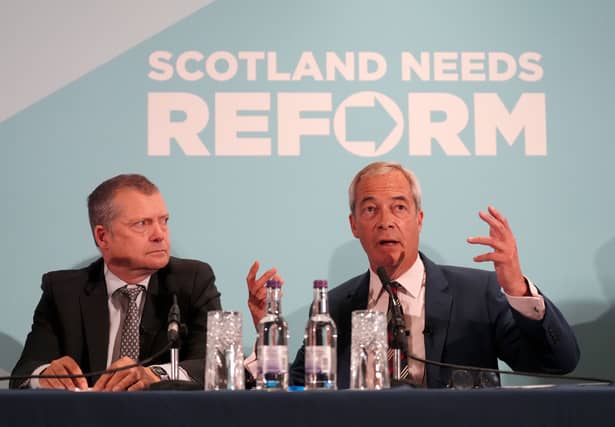
On Wednesday, at a press conference in Broxburn, West Lothian, Nigel Farage introduced Graham Simpson, a defector from the Scottish Conservatives, as Reform’s first MSP.
It was as if Michelle Ballantyne had never existed (a sentiment that might also reasonably be formed after examining her record as a parliamentarian).
Anyway, Wednesday was all about Nigel Farage and Graham Simpson. Nige and… Simmy?
Leaving the Tories was a wrench, said Simpson, smothering anger with sorrow. His soul, you may be reassured to know, had been searched before he decided to give some of his colleagues what he believed they wanted.
Nige appeared delighted to have Simmy onboard but his promise that a Scottish leader would be in place before next May’s Holyrood election didn’t read as a ringing endorsement for the new recruit whose status, if nothing else, would seem to make him the obvious candidate for immediate installation in the position.
I do not intend to be mean but it is difficult to honestly sum up Graham Simpson’s career at Holyrood without appearing so. He achieved little during nine years in parliament.
Simpson’s unpopularity among Conservative colleagues was made explicitly - and entertainingly - clear in an anonymous briefing made during press conference.
“Graham Simpson,” said an excitable character assassin, “is a pathetic, nasty little man who won't be missed. Just last year, he had to apologise to a young female member of staff for acting in a totally inappropriate, bullying and intimidating way towards her. The way he spoke to her was so bad that he was forced to sit down and say sorry in person. He'll be more trouble than he's worth for Reform.”
I’ve heard some vicious briefings in almost three decades of politics but that one was a doozy, delivered so swiftly that journalists were able to ask Simpson about the allegations during the press conference. He denied them.
Graham Simpson's Micawberesque something-will-turn-up replies to questions about Reform policy in Scotland exposed a lack of substance.
However, Graham Simpson’s capabilities as an MSP will have no impact on support for Reform UK in next year’s Holyrood election. Nigel Farage is the face of Reform in Scotland just as he is in England.
Twelve years ago, the right-wing populist was chased off the streets of Edinburgh by an angry crowd.
Today, the same left-wing activists who shouted him down in 2013 will still vocally oppose Farage’s presence in Scotland but the reality they describe, in which the Reform leader is loathed by an entire nation, is inaccurate.
On current polling, Reform will come third in next May’s election, behind a second-place Labour. Farage’s party continues to devour the Tory vote and there’s nothing the party’s leader in Scotland can do about it. Russell Findlay is Quint, Reform the great white shark.
Although the Scottish Conservatives stand to lose most heavily to Reform next year, Farage’s party also represent a threat to the SNP.
In June’s Hamilton, Larkhall, and Stonehouse by-election, made necessary by the death of SNP MSP Christina McKelvie, Reform came third with 26 per cent of the vote. The Tories’ vote fell by 11.5 per cent while the SNP’s dropped by 16.8 per cent.
The numbers say that Nigel Farage can make life difficult for John Swinney.
The Scottish nationalists have long taken comfort in polling showing overwhelming support for independence among young voters. But, while it remains the case that a majority of Scots under 50 back the break up of the United Kingdom - a poll published in March by Statista showed 54 per cent support for independence among voters aged 16-49 - this foundation upon which future victory is to be built may not be as strong as it once appeared.
Polling conducted by the John Smith Centre for Public Service at Glasgow University and published in March showed that 26 per cent of men aged 16-29 described themselves as right-wing compared with only 15 per cent of women.
Only 13 per cent of men in that age group considered themselves on the left, compared with 20 per cent of women.
That young men - of voting age - are now twice as likely to be right than they are left wing is a headache for Swinney.
It was easy - and wise - for the SNP to hold Farage up as a bogeyman in the days when Reform support in Scotland came overwhelmingly from disaffected, ageing, right-wing Tories.
But times have changed. The past is forgotten, taking Michelle Ballantyne with it.
Next May, John Swinney will be fighting for the votes of young men who, in increasing numbers, see Nigel Farage as a man with the answers.
Comments
Want to join the conversation? Please or to comment on this article.