
As German far-right praises Keir Starmer, Scotland needs its own immigration system
The Prime Minister is wrong on immigration. It is not ‘strangers’ Scotland should fear but economic stagnation


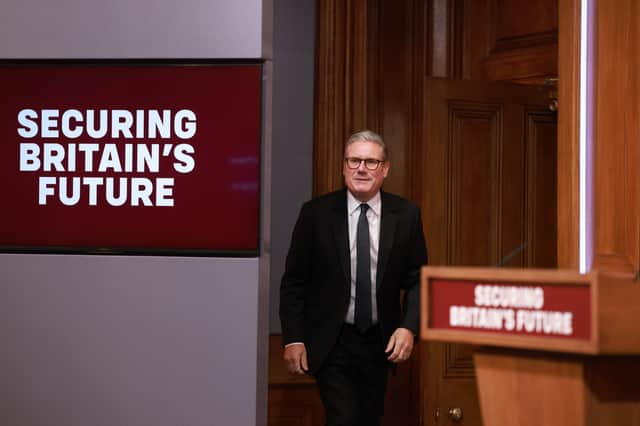
The Prime Minister’s speech on immigration this week was as disgraceful as it was misleading. Summoning the spirit of Enoch Powell – not because they share a political philosophy, but rather because the Prime Minister mistakenly thinks it’s what people want – Labour’s Keir Starmer warned of Britain becoming “an island of strangers”, inviting suspicion and division at a time when, after 14 years of Conservative drift, the UK clearly needs leadership, transformation and purpose.
It was a predictably tone-deaf speech that took all the wrong lessons from the English local government elections. There will be only one winner here: Nigel Farage. No wonder the member for Clacton stood up in the Commons chamber this week and said he “very much enjoyed” the Prime Minister’s speech and that Starmer had “learnt a great deal” from Reform UK.
Immigration is not a problem to be solved, but a solution to be embraced. That is not to say we cannot hear, listen to and understand differing views on immigration – a democratic society demands that we must, as differing views are a fact of political life. But for a Labour Prime Minister to pick up where the most migrant hostile Conservative government finished, and continue to present migrants as burdens or threats, is as politically bankrupt as it economically illiterate.
Critical issue for Scotland
It was the strongest sign yet that the government has given up on its mission of achieving economic growth – something that no administration can hope to achieve with an immigration system designed to keep foreigners at bay, or outside the EU for that matter.
For Scotland in particular, this is a critical issue for our economic prosperity and the resilience of our public services – particularly our NHS, social care, agriculture and hospitality industries. Our population is ageing faster than the UK average.
In rural areas in particular, our problem isn’t one of immigration but of emigration; communities are shrinking, with local services and local businesses under strain because of depopulation. Key industries are in a constant battle to find the workers they need. This is not a theoretical future risk; it is a current and urgent crisis across Scotland, and one that was only made worse by the loss of freedom of movement within the EU.
Yet despite these obvious challenges in Scotland, UK immigration policy, whether set by a red or blue administration, has nothing positive on offer. In fact, it is evidently about to get worse, as the system becomes more hostile and remains rigidly centralised and wholly unresponsive to Scotland’s needs.
Devolving immigration
Any Scottish MP worth their salt understands that it is their job to stand up for Scotland’s interests at Westminster. That is why I have brought forward legislation to devolve power over immigration from Westminster to Edinburgh – a rational, practical proposal that would give Scotland’s parliament the powers to tailor immigration rules in line with our national needs and circumstances.
This is not a radical departure from international norms: Canada and Australia already grant significant immigration powers at the state and provincial level, to best respond to local economic and labour needs.
With the devolution of immigration law, Scotland could introduce targeted schemes to support rural repopulation and address labour shortages. We could reopen Scotland to the European talent we have lost and build a system rooted in dignity, cementing our reputation as a country that welcomes people, not simply content to be the northern province of Fortress Britannia.
Such policies can work, and we know they would make a materially positive impact to our country. When we still enjoyed freedom of movement, communities across Scotland – particularly rural Scotland – were strengthened and made more resilient by the arrival of other Europeans from across our continent.
They opened businesses, staffed care homes, and brought life to towns and villages facing decline. The farming industry benefited from seasonal workers whose absence is now acutely felt. The NHS, and particularly social care, has long relied on staff from overseas – a reliance that will only grow in the years ahead.
German nationalists approve
Scotland, like the rest of the UK, has benefited enormously from immigration. That is not something we should mutter about apologetically but embrace as one of our key successes. Migrants are our friends, neighbours, colleagues – and, increasingly, our lifeline. They do not make us a country of strangers. They make our country stronger. That is something I still believe in, even if Keir Starmer no longer does.
The PM needs to reflect on the fact that he was called out for his comments by former child refugee Lord Alf Dubs, and praised by the Putin-sympathising German nationalists, Alternative für Deutschland.
That is not the company I would want to keep. The PM’s grotesque attempt to weaponise migrants for political gain is destined to fail. Nobody who recalls the Keir Starmer of just a few years ago – pro-EU, pro-freedom of movement and pro-immigration – will be convinced by his attempt to imitate Nigel Farage.
Driving voters towards Farage
The Prime Minister is free to risk and ruin his own reputation as he so wishes – he has been thoroughly exposed as willing to say whatever he thinks voters want to hear – but he has no mandate to sign Scotland up to a future of economic decline that is hostile to those who do us the honour of building a life here.
It is not strangers Scotland should fear, but stagnation in our economy and living standards. That is what’s driving hordes of angry voters into the hands of Nigel Farage – a man who offers no solution to the challenges we face.
We must make the case for immigration with clarity and with courage – not only as an economic necessity, but as a reflection of the kind of country we aspire to be. If Keir Starmer will not lead on this issue, then I know that John Swinney will.
Stephen Gethins is the MP for Arbroath and Broughty Ferry
Comments
Want to join the conversation? Please or to comment on this article.