
Why Starmer is a gift to SNP – and how Swinney could waste it
John Swinney needs to continue being the best of a bad bunch and ignore those within the SNP who want the party to shift to the right
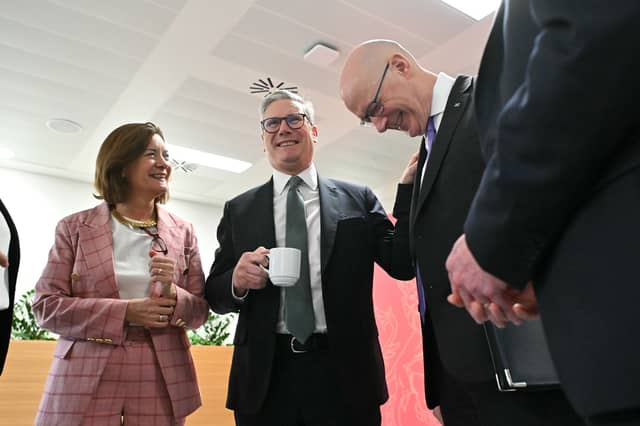


One year on from his surprise decision to return to frontline politics as leader of the SNP and First Minister of Scotland, John Swinney is one politician, in a largely disgruntled UK, who must be struggling to believe his luck.
At the age of 60, after a year away from ministerial office, Swinney stepped up to hold his party together in moment of profound crisis, following the collapse of Humza Yousaf’s leadership; and he led it, as he doubtless knew he would, into a night of electoral carnage at last year’s UK general election, when Scottish voters desperate to end the Tory years moved towards Labour in large numbers, while the SNP lost 39 of its 48 Westminster seats.
Yet this historic collapse in Westminster representation did not, to the dismay of its opponents, signal the terminal decline of the SNP, following its years of dominance in Scottish politics. On the contrary, the party has now returned to that dominant position, regaining only a few points on its July 2024 performance, but doing so in an electoral landscape transformed both by the collapse of Scottish Labour support from 35 per cent last year to around 20 per cent now, and by the rapid rise of Nigel Farage’s Reform, mostly at the expense of the Tories.

Labour’s betrayals
Under these conditions, the SNP now has a strong chance of emerging once again as by far the largest party in the Scottish Parliament, come the May 2026 Scottish election; and as the poll numbers suggest, most of the responsibility for that shift lies squarely at the door of the man in 10 Downing Street, Keir Starmer.
Instead of building on the modest 34 per cent support that took them to a huge Westminster majority last summer, the Starmer government has embarked on policy after policy that marks a clear betrayal of undertakings made on their way to power, and in some cases might have been designed to rile Scottish voters, from the cancellation of winter fuel payments to the crushing of the hopes of Waspi women.
And most culpably of all, instead of challenging the toxic right-wing narrative which blames migrants and people on disability benefits for the perpetual financial struggles and stress that millions of British households now face, they have actually played along with that narrative, and reinforced it.
In that respect, Starmer’s ill-judged speech on immigration this week, in which he coined the phrase “an island of strangers”, and declared without evidence that recent high immigration had done “incalculable damage” to the country, represents a striking new low in the history of Labour flirtation with the political right, and is likely to have disgusted regular Labour voters on a scale that dwarfs any possible gains from Reform.
READ MORE: How Tories can defeat Reform and save UK from catastrophe – if they change to this leader
Staunchly centre-left
The question of how this rightward lurch by the Starmer government will play out in Scottish politics, though, is one that remains to be resolved. On one hand, the forces that are driving English politics to the hard right are also present in Scotland; it is wise to assume, for example, that the relatively low salience of immigration in Scottish politics – and the consequent smaller surge of of support towards Reform – owes more to the relative absence of mass migration here, than to any huge difference in social attitudes.
Yet still, Swinney’s staunchly centre-left and liberal SNP remains Scotland’s most popular party, and provides the kind of bulwark against hard rightward drift that is now also provided – on a much larger scale – by leaders like Canada’s Mark Carney, and Australia’s Anthony Albanese.
That Swinney could still squander that lead by is obvious. From some opponents, and even from some in his own party, he will face pressure to ape Starmer’s rightward shift – a false move that would devastate his electoral support among loyal centre-left voters, for little if any gain.
Independence diehards
From some noisier voices in the independence movement, meanwhile, he will face pressure to put independence front and centre in his election campaign; “first paragraph, first sentence” is the current cry.
Swinney, though, is a veteran in dealing with independence diehards who simply cannot grasp that the vast majority of voters care far less about independence as a principle, than they do about its possible practical consequences in terms of economy, society, and a viable future for their children and grandchildren; and my guess is that he will strive to keep those positive, practical ends in view, and aim to present independence simply as an increasingly attractive way of achieving them.
A year is a very long time in politics, of course; and as this week’s renewed row over the Glen Rosa ferry shows, the SNP’s 18 years in government inevitably offer a litany of failures, broken promises, and examples of incompetence that may make the idea of “change” attractive to voters.
Politics of decency and common sense
Yet after last year’s heavy use of the word “change” in Labour’s election campaign – followed by a year in government that has looked like far too much of the same again – voters will have reason to be much more sceptical about the idea that “change” is a good thing in itself.
Labour, after all, now seems rudderless in a sea of abandoned values and policy U-turns, the Conservatives are still profoundly discredited by the nonsense of the Johnson and Truss years, and Reform are a bunch of billionaire-backed opportunists who care about the wellbeing of the British working class the way Donald Trump cares about the fate of the workers who keep his golf courses lush and green come drought or high water.
And Swinney may be about to discover that in a grim times for the politics of decency and common sense, being the best of a bad bunch may still be a reliable route to power, and even – depending on how the cards fall – to another independence referendum, before the end of the decade.
Comments
Want to join the conversation? Please or to comment on this article.