
I competed in a 320-mile EcoRally across Scotland - forget speed, being bang average wins this race


Jim McGill returns home as Dundee plays host to the third FIA ecoRally Scotland event, navigating technical glitches and grumpy dogwalkers along the way
“45, 47, let’s try 50, now 52, back to 43. Perfect: 45 is your sweet-spot. Now ease up to 48; try 50.”
I went to sleep on Sunday night with the incessant instructions from my ever-patient and experienced co-driver Ian Wallace still rattling round my subconsciousness. Over the previous 36-hours we’d driven 350-miles, 164 of them covering the 12 competitive stages which formed the third running of the FIA ecoRally Scotland. And throughout those 12 stages, we lived on a constant delivery of the speed in kilometres per hour that I was to drive at.
Now let’s get one thing straight right from the start. This was no hanging the car sideways drifting majestically and powerfully through long, sweeping gravel stages running through the Scottish forests.
No. This is what’s called a regularity rally. It’s aim? Not to be the fastest driver but to maintain a precise average speed over a set route, this time on public roads, passing through checkpoints at predetermined times.
One thing I quickly learned was, given that ecoRally Scotland is run to the meticulously, bureaucratically-specific rules and regs of the FIA — that’s the Federation Internationale de l’Automobile, the Paris-based governing body of global motorsport – it’s a pedant’s paradise. Run in tandem with Motorsport UK’s Streetcar programme, which encourages more people to getbehind the wheel and enjoy the sport specifically using a standard, unmodified car, the actual planning of the event fell to the Scottish Motor Racing Club (SMRC).

Formed in 1946 and boasting a rich motorsport heritage represented by all of Scotland’s leading drivers, including the likes of F1 world champs Sir Jackie Stewart and Jim Clark to today’s leading racing drivers such as Gordon Shedden and Sandy Mitchell, the club is “committed to promoting carbon neutral motorsport for generations to come”.
Significant then that a crucial point to highlight is, as its name suggests, the ecoRally is devoid of fuel-injected, turbocharged petrol engines. Quite the contrary. This was an event open solely to road-going, fully electric vehicles. The sort of car the Government is trying harder and harder to get you to buy.
And it’s definitely not an insignificant event. ecoRally Scotland formed round eight of the Bridgestone FIA ecoRally Cup. A total of 21 crews and cars gathered in Dundee for the two-day rally, with teams coming from as far afield as France, the Czech Republic, Bulgaria and Latvia. And in case you wondered, Latvia to Dundee is a 1,900-mile drive … each way.
Why, I hear you ask, was the event based in Dundee? The city boasts “sustainable innovation credentials” as the City Council plays a key role in delivering Scotland’s promise of a net-zero society by 2045.
For more than a decade, the Council has been committed to transforming transportation, as one of the UK’s leading EV cities, with 34% of fleet vehicles being electric.
The city also boasts an extensive network of electric vehicle charging hubs and infrastructure through ChargePlace Scotland which, coincidentally, supported the fully-electric vehicles taking part in the event.
As you would expect, some of the leading EV manufacturers were represented, with models from Kia, Hyundai, Skoda, Volkswagen, Audi, Cupra, MG, Honda, BMW, Tesla, Alpine and Omoda. My electric chariot for the event was the Omoda E5. Featuring a 61kWh battery and WLTP-estimated range of 257 miles, it promised to be the perfect EV to ensure not only did I remain competitive in the event, but would manage to do so in a certain degree of comfort.
The initial gathering point for all competitors was registration, signing-on and scrutineering hosted at John Clark Motor Group’s spanking new “benchmark” multi-franchise dealership in the city. Grabbing the opportunity to catch-up with John Clark, himself a veteran not only of the automotive industry but also a legend in the Scottish motorsport world, both as a supporter and competitor, he took pride in showing me round the mightily-impressive Seat, Skoda, and Cupra dealership.
He was also quick to highlight: “We have solar panels on the roof here, so a lot of the electricity we’re using today is being supplied by them. We are very impressed by Motorsport UK’s commitment to creating and supporting a competitive environment for EV, and particularly that it’s in Scotland, and more importantly, the ecoRally is based in Dundee.”
Day one dawned on Saturday morning, and before the crews heading into the opening five stages through Tayside and Fife, there was an unforeseen glitch. All competing cars are fitted with a sealed GPS tracker which feeds the car’s position, location and speed back to HQ. It’s this data which decides the outcome of the event.
For the first time in the UK, measurement was to be down to 1/10th of a second. Timing was to be measured by new trackers built and delivered by a company in Spain. Frustratingly, despite promises to the SMRC organisers over the previous few days, they hadn’t arrived for the event start. It was an immediate test for Clerk of the Course Richard Crozier and larger-than-life SMRC director Becky Smith, and one they handled with forthright honesty, openness and a Scottish sense of “we’ll beat whatever’s been thrown at us”.
Despite understandable grumblings from a number of the European-based competitors, the decision was taken that the first two stages would be run as ‘non-competitive’ tests. The reason? The new trackers were now at Edinburgh Airport and the SMRC was confident they could be collected and fitted to all cars when we got to Knockhill for Stage 3.
When we arrived at Knockhill, after tests through ‘Braes of the Carse’ and ‘Path of Condie’, the new trackers were duly fitted, and everyone was happy.
After lunch, the Omoda E5 was in its element driving through the always-stunning Glen Devon before undertaking two more stages at ‘Glen Eagles’ and ‘The Dragon’ before heading back to Dundee where the cars were recharged and locked away under parc ferme conditions; essentially meaning no one could touch them.
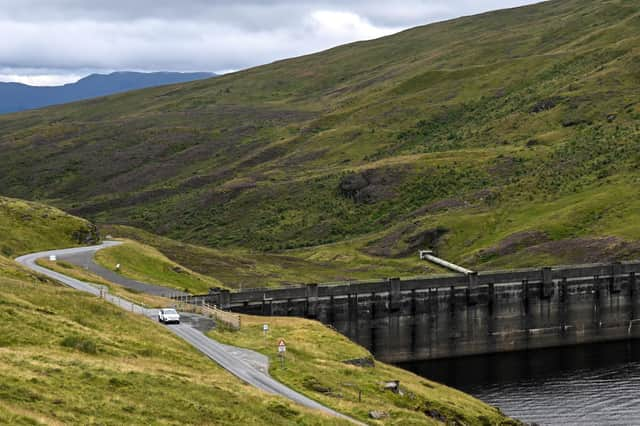
Leg two on Sunday was the longest of the weekend, including seven timed stages. From Glen Almond we headed to Glen Quaich, down into Kenmore before driving along the north side of Loch Tay then heading into the stunning scenery of Ben Lawers and the Bridge of Balgie. Next-up was the Pass of Killiecrankie, before finishing at Tulliemet and Lunan Lochs.
Having been born and raised in Dundee, and then spending my first two summers after leaving secondary school working in and around the Loch Tay area, this was very much a return to the beautiful Scottish geography of my formative years.
Fair to say though, certainly on the competitive sections, I saw very little of the spectacular scenery. My eyes danced between the digital km/h speedo straight in front of me — as Ian, who also happens to be Omoda & Jaecoo UK PR boss, rattled off the speed he wanted me to hit to maintain our average through the test — and the road. There’s no denying it’s a demanding test, both for the driver, and from my perspective, moreso for the co-driver. I just drove; but the patience, attention to detail and organisation required to co-drive is all-consuming.
We thoroughly enjoyed our two-day ecoRally Scotland adventure, though we did need to concede defeat to overall winners, Czech duo Michal Zdarsky and Jakub Nabalek in their Hyundai. The Omoda E5 actually was a hoot to drive. Range was never an issue over the two competitive days, and it handled the mix of road types and surfaces — the stages were essentially run on our typical Scottish single-track roads — with ease. Power delivery was instant, especially when I had five or six seconds to accelerate quickly to catch-up on the time we’d dropped at a junction or through a tight twisty bit. The 0-62mph time of 7.2secs was handy. And at the end of each long day there were no aches or pains: it’ a comfortable piece of kit to drive. Yours from £33,065.
As for regularity tests? Hmmm … ? One of my colleagues labelled it the “Olympic race walking of motorsport”. I know what he means, but it is a bit harsh. It does, however, split opinion. Being run on public roads, the SMRC was comprehensive in mail-dropping all houses on the competitive stages to inform the residents of the event. For the main part we were greeted by families — often three generations — standing at the end of their drives waving as the cars went passed. On other occasions, often walkers, cyclists, or dog owners aired on the ‘grumpy, intolerant’ side. Most likely they were visitors to the area and were not aware of the event. I’ll give them that leeway.
In all, despite some glitches, the event was a success. For Ian and I, it was definitely a learning experience. He’s done these types of things before, but more in the ‘historic’ category. It was my regularity debut. At times I wondered what the point of it was? No surprise that my favourite ‘stage’ was at Knockhill where we simply had to fly two laps round the undulating handling course as quickly as possible. I was in my element, proudly leaving an Alpine, driven by a much more experienced rally exponent, in my dust. The Omoda’s low centre of gravity, thanks to the positioning of the batteries, helped maximise grip.
Should, in the future, we return to ecoRally Scotland, or some other regularity test, we’ve committed to ‘going big’. Like the ‘serious competitors’ on the event, rather than rely on the ‘standard’ timing app we were given, we too will get our own GPS boosters for the car — to improve the accuracy of the readings — plus a big tablet to stick on the fascia showing this info to both driver and navigator at the same time. EcoRally Scotland was great fun … but we live and learn, ready to rise to the challenge.
And in the future, whenever I struggle to sleep, forget counting sheep. I’ll just recite: “45, 47, let’s try 50, now 52, back to 43. Perfect: 45 is your sweet-spot. Now ease up to 48; try 50.”
Comments
Want to join the conversation? Please or to comment on this article.