
The Odyssey: How Scots castle ruin became hideaway of Greek sorceress


Special steel frame built around medieval pile as part of epic production
It is a ruined clifftop fortress that has witnessed some seminal moments in Scotland’s past, from the invading Viking forces of King Haakon IV in the 13th century through to a dramatic siege ordered by Mary, Queen of Scots.
Now, a fresh chapter in the storied history of Findlater Castle is being written thanks to the release of one of the year’s most lauded and eagerly anticipated blockbuster movies.
Findlater Castle, set on a spectacular yet narrow quartzite promontory overlooking the Moray Firth, is arguably the most striking filming location to have been used by the Oscar-winning director, Sir Christopher Nolan, for his new film, The Odyssey.
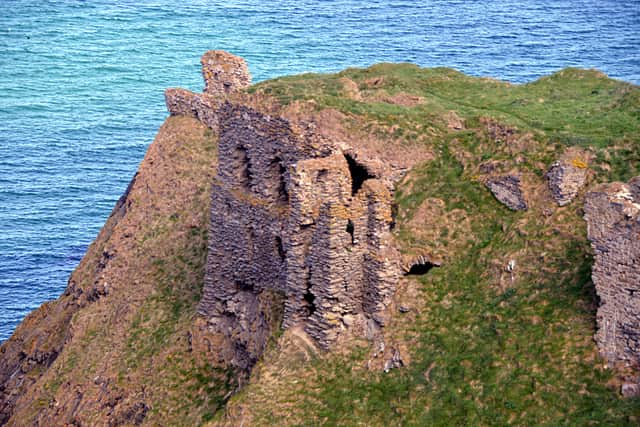
One of several Scottish locales to feature in the movie, the ancient seat of the Earls of Findlater and Seafield was transformed into part of an ancient Greek world, with the cast and crew spending around six weeks filming at the ruins.
But unlike most outdoor film locations, the decision to use Findlater brought added challenges, and not simply because of its perilous cliffside location.
The castle, which dates back to 1246, is a scheduled monument, designated by Historic Environment Scotland (HES) as a national important site.
As a result the heritage body played a key role in advising Sir Christopher and other members of the production team on how best to film around the ruins in a way that would not jeopardise the structure or its surrounding area.

In order to transform the medieval castle into Aeaea, the island home of the ancient Greek sorceress, Circe, the team chose not to film within Findlater’s surviving walls. Instead, a new building was created on the approach to the promontory.
Even so, as Orla Craig, designations officer at HES, explains, that decision was not without its own risks.
“As they had spoken to us early in the design process, we could explain the constraints of building on a scheduled monument,” she said. “The set designers knew that they would not be able to secure set pieces into the ground, as this could damage archaeological remains.
“It was also important that the ground was not compressed. The pressure from a lot of weight in one place can impact buried archaeology, changing our understanding of the site in the future.”
With an agreement in place, the recreation of Aeaea got underway, with the set pieces - made from plywood and light plastic blocks, which were then painted to look like stone - constructed by the filmmakers. The pieces were then mounted on a special steel frame designed to spread the weight of the set.
“They were very lightweight and could be put into place without risks of damaging the monument,” Ms Craig explained in a blog for HES. “As we walked around the set, these blocks were being painted to match the stone of the castle. Set painters were painstakingly adding lichens and mosses during our visit.”
With The Odyssey hitting cinemas around the country this weekend, Ms Craig said she was looking forward to audiences having a chance to see the historic castle with their own eyes.
“I’m excited to see Findlater Castle’s moment in the spotlight, and am happy that this part of Scotland’s history will now be seen by cinemagoers around the world,” she added.
Comments
Want to join the conversation? Please or to comment on this article.