
Church of Scotland: Tributes paid to stalwart of General Assembly who gave moving palliative care speech
The Church of Scotland technician played a key role in the General Assembly for five decades.

Key figures in the Church of Scotland have paid tribute after the death of a “remarkable” and “deeply compassionate” man who received a rousing ovation after delivering a moving speech about his own experience with terminal illness during this year’s General Assembly.
John Williams, who spent five decades playing a vital behind-the-scenes role at the annual gathering, has died at the age of 71 after receiving dialysis treatment for seven years.
The audio-visual technician made headlines after addressing the assembly earlier this year. He spoke candidly about his own experience living with terminal illness, and called for major improvements in the way palliative care is financed and delivered across Scotland.
In an interview with The Scotsman last month, Mr Williams said that although he did not expect to give the speech, he was glad to have done so after speaking with Rev Dr John Ferguson, convener of the church’s working group on assisted dying, and hoped it would help others.


“I’ve told people what I’ve been going through and I’ve been honest at every stage,” he said. “Sharing your story is so valuable to people and just talking to folk is really important.”
Leading the tributes to Mr Williams, Dr Ferguson said the experience of watching and listening to his speech moved everyone in attendance.
‘Truly remarkable’
“When John asked if he could speak during the assisted dying debate at the General Assembly, there was initially some uncertainty whether that would be possible as he wasn't a commissioner,” he recalled.
“Thankfully, it was made to happen and John spoke powerfully and with great courage about his illness and all that he had gone through. It was a moment which left its mark on the assembly.
“It was wonderful that after serving the assembly for 50 years in the audio visual area that John was able to address it in such a profound and moving way. He was a truly remarkable, courageous and deeply compassionate human being.”
The health problems experienced by Mr Williams were complicated by the fact he was also diagnosed with cancer of the small bowel that later spread to his lung and spine.
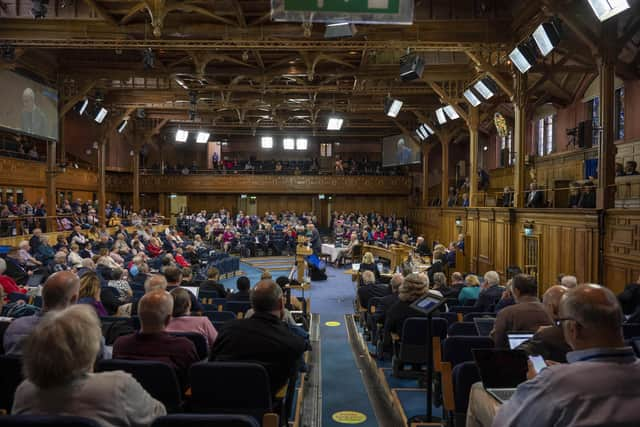
In his speech to the assembly in May, he said he could not support the assisted dying legislation that passed an initial vote at Holyrood earlier this year, but pointed to an opportunity to achieve “better” laws that addressed key issues.
“How are you going to square doing this with the medical profession - how is that going to work in practice?” he asked. “I think that’s the really difficult one. It’s not going to be easy, whatever happens, and I honestly don’t know what will come next, but there has to be detailed thought given. I’m concerned the Bill is being rushed through.”
He later told The Scotsman that while he could decide to stop his dialysis treatment if the burden of his cancer became too great, he found it difficult to reconcile the fact that others living with life-limiting illnesses had no such choice open to them.
“You think ‘why me and not other people?’” he reflected. “I can understand people who want to go down that road. I just hope that anyone who does it does so for the right reasons, and that everything else has failed. You’ve got to be really, really careful as to how it’s worked out and what discussions take place beforehand.”
Hospice funding concerns
During his 14-minute long speech to the assembly, Mr Williams also spoke of the care he had received at St Columba’s Hospice and described the level of resources given to hospices as a “disgrace”.
“There just isn’t the capacity there, and the number of people who die in hospices is just a tiny figure,” he said. “The hospices are just not supported or properly funded and they need volunteers just to run things.”
Mr Williams’s long career involved working on television programmes for BBC and STV, as well as video production work for the University of Edinburgh, Erskine Stewart Melville and George Heriot’s School.
In the wake of his speech, Modrator Rt Rev Rosie Frew thanked Mr Williams for sharing his story “so openly and so honestly” and helping people to understand what he had been going through.
Rev Fiona Smith, principal clerk of the Church of Scotland, said Mr Williams’s death represented a “very sad day” for everyone who knew him.
‘Heartfelt, compelling words’
“He was a remarkable person with an indomitable spirit who endured his long illness with tremendous faith, courage, cheerfulness and good humour,” she said. “During over 50 years of service to the church, his expertise in filmmaking and his meticulous planning became an essential part of our General Assemblies, making it possible for people to watch the discussions no matter where they were.
“At our last assembly, John knew his life was drawing closer to the end. But as he had always done, he still gave his all - but now he had another gift to give, this time to the wider world. His powerful speech advocating for better, more thoughtful palliative care was heard. Every person listening in the hall and outside it was moved and changed by his heartfelt, compelling words.”
She added: “John was so loved by so many people. He quite simply was a legend who inspired and enriched our lives hugely - he will be sorely missed. Our thoughts and prayers are with his widow, Diane, son Nick, grandson Owen, and the wider family at this time.”
Comments
Want to join the conversation? Please or to comment on this article.