
Assisted Dying Bill: Hospices and care homes must not be forced to participate
The Assisted Dying Bill should state explicitly that care homes and hospices would not have any obligation to discuss assisted dying with patients
It is a fair criticism of the Holyrood parliament chamber that it seldom rises to the occasion when it comes to debate. Too often we simply see a succession of backbenchers reading out highly partisan speeches, sometimes written by a researcher, which bear little relation to what has been said before. Because of timings, the opportunities for interventions to be made and taken, and a genuine discussion opened up, are rare.
There can be exceptions to that rule, and last week’s debate on stage one of the Assisted Dying Bill was one of them. It is extremely unusual at Holyrood for issues to be discussed which are genuinely subject to a free vote, where all MSPs have to make up their own minds without being told what to do by the party whips.
And so it was on this occasion, with quality speeches both for and against the Bill. Both George Adam and Elena Whitham made moving contributions, drawing on their personal experiences caring for loved ones, to explain why they supported it.
READ MORE: Assisted dying Scotland: Historic moment as legislation passes first stage at third attempt
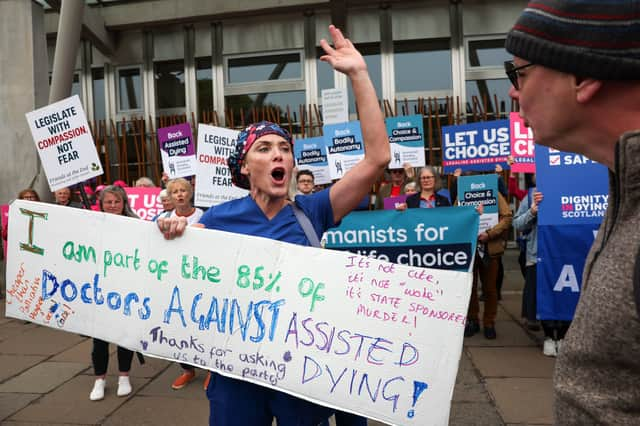

A narrow majority
On the opposition side, my Conservative colleague Edward Mountain drew on his own battle with cancer to explain why he couldn’t back the Bill, whilst the Labour MSP Pam Duncan-Glancy, in the best speech of the afternoon, expressed her concern that, as a disabled person, her life would be valued less should assisted dying be legislated for.
The Bill passed stage one by a narrow majority of 70 votes to 56, but a number of those voting in favour were clear that this was only to allow the debate to continue, and this did not necessarily mean they would support the legislation in its final stage. The discussion now shifts to the detail of the Bill, and whether it is capable of being improved to remove the many concerns that have been expressed about its potential consequences.
Legal specialists have already warned that the Bill is deeply flawed as it stands, and carries with it a large number of risks. The Law Society of Scotland has said that there are significant issues that need to be carefully considered.
Dr Mary Neal, reader in law at the University of Strathclyde, went further, saying: “There is so much MSPs are going to have to address to try and mitigate some of the serious risks that the Bill poses. Some of those risks, as I see it, are just unfixable. Almost every aspect of the Bill is deeply flawed and ill-conceived.”
Medical profession’s concerns
There are particular concerns around a number of areas, including the role of the medical profession. Many doctors and nurses are very clear they want nothing to do with offering assisted dying to patients, indeed palliative care doctors have come out strongly against the legislation in principle. There must be firm protections for those who do not wish to participate.
Those protections also need to cover settings such as hospices and care homes. There can be no suggestion that hospices should be under an obligation to discuss assisted dying as an option with patients if they feel that is fundamentally objectionable and contrary to their ethos. Such a protection needs to be stated explicitly in the Bill.
There remain concerns around the question of whether the Bill falls within Holyrood’s legislative competence. The law on medical opt-outs and on the regulation of medicines is reserved, and Holyrood cannot pass laws in these areas without Westminster consent. This issue needs to be resolved if the Bill is to progress further.
These legal concerns are real and serious but, as we saw in the debate, the principal arguments against the legislation remain at a more philosophical level.
Both Pam Duncan-Glancy and Jeremy Balfour spoke from their perspectives as disabled MSPs, about the pressure that they feel would be put on disabled people to end their lives prematurely. Against a backdrop of a rapidly aging population and spiralling care costs which governments are unable or unwilling to meet, these concerns are real.
Slippery slope is real
There is also a very real worry that passing this legislation simply opens the door to it being expanded in future. I have met many constituents on both sides of the argument, including those pressing for a change in the law to allow assisted dying, and what has struck me in many of the cases of individuals with whom I have met is that they would not actually be eligible for assisted dying under this Bill.
That means even should this Bill be passed, there will be a push for the criteria to be expanded beyond the definition of those with a “terminal illness”. And once parliament has agreed in principle to grant a right of assisted dying to one group of individuals, there is essentially no argument in principle against extending that to others. As we have seen in Canada, the slippery slope is real.
I voted against the Bill essentially because I believe that granting a right to one group of articulate well-informed individuals with agency in their lives can only in this case come at the expense of putting at risk another group who are weak, vulnerable, and potentially subject to coercion. That remains my view, but I will certainly look to work with others to build in additional protections to what is a deeply flawed piece of legislation.
Already there are signs that the mood is shifting against the Bill. This week the General Assembly of the Church of Scotland, which had been widely expected to move to a neutral stance on assisted dying, instead voted to reaffirm its historic opposition, thus keeping it in the mainstream of Christian opinion.
It seems that the more people consider the arguments, the more likely they are to be opposed. Whether that will be enough to change the votes of seven MSPs who voted in favour – all that’s needed to prevent the Bill becoming law – remains to be seen.
Murdo Fraser is Scottish Conservative MSP for Mid-Scotland and Fife
Comments
Want to join the conversation? Please or to comment on this article.