
Supply imbalance sees prime industrial rents in Scotland’s Central Belt outgun UK

“While there is movement on new supply, more will be needed to address the imbalance that has built up over many years” – Andrew Hill, Knight Frank
Rents for industrial property across Scotland’s Central Belt are surging as a lack of supply and “resilient demand” put upward pressure on the market.
Deal activity is being constrained by low availability of high-quality space, despite a leap in take-up during the third quarter, according to the latest analysis from property consultancy Knight Frank.
Scotland’s industrial property market has been characterised by a lack of new supply over the past decade, especially within the Central Belt, because new development has been difficult to make financially viable.
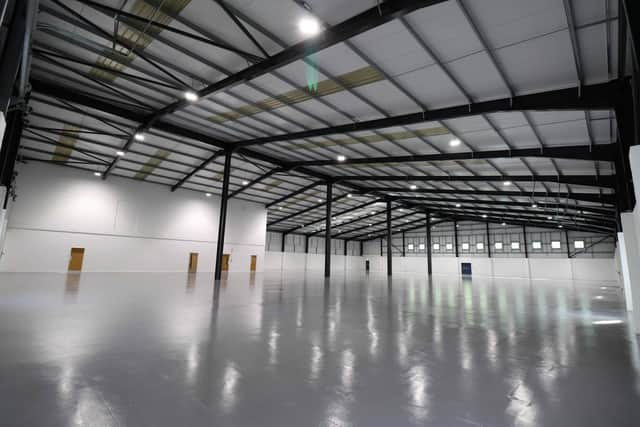

Knight Frank’s research has found that over the past two years, prime industrial rents in and around Edinburgh and Glasgow have risen 14 per cent compared to 9 per cent across the UK as a whole. In the last three years, the difference stretches to 23 per cent and 17 per cent, respectively.
Prime rental growth has been particularly strong in relation to units of under 20,000 square feet in size in Edinburgh, with a rise of nearly 27 per cent registered in just two years, from £13 per sq ft to £16.50 per sq ft.
Meanwhile, total take-up for units of more than 50,000 sq ft increased significantly between July and September of 2026, to 368,318 sq ft - surging 541 per cent quarter on quarter. However, property experts noted that this followed muted activity in the year to date at the larger end of the market, characterised by a lack of suitable supply rather than weakening occupier demand.
Across the 12 months to the end of the third quarter of this year, new or refurbished units accounted for just 6 per cent of total take-up, highlighting the limited choice available to occupiers seeking higher-quality space, according to the research.

With development activity remaining subdued, occupiers are increasingly been forced to compete for second-hand space, driving rents upwards, with Knight Frank now expecting average rental growth of 3.3 per cent for 2026 across Scotland.
Andrew Hill, lease advisory partner at Knight Frank Edinburgh, said: “Prime industrial rents in Scotland’s Central Belt are rising strongly. With very little development pre‑Covid, construction costs stubbornly high, and sustained occupier demand, newer Grade A sheds are seeing substantial increases, while competition for second-hand stock is also boosting that market.
“It is a reflection of the fact that appetite for modern industrial and logistics space remains strong, but opportunities to secure it are proving increasingly limited in the Central Belt,” he added.
“We have worked on cases at Fort Kinnaird, Newbridge, South Gyle and the wider Glasgow–Edinburgh corridor that have seen noticeable rises, particularly for trade counter operators. While there is movement on new supply, more will be needed to address the imbalance that has built up over many years.”
Want more stories like this? Subscribe to our weekly business newsletter here.
The Knight Frank report follows a study last month which revealed that Scotland’s retail warehousing was a “sector in demand”, despite challenging market conditions.
The investor research from Lismore Real Estate Advisors pointed to “limited supply and resilient demand” as being the leading driver of rental growth for retail warehousing over the next few years.
The firm’s quarterly poll of investors highlighted a preference for food store operators being in the tenant line-up which will be an important platform for retail warehousing performance, with 62 per cent of respondents selecting the category. This was more than double the proportion choosing discount/value retailers, while a further 14 per cent identified drive-thru and food and beverage (F&B) operators.
The findings varied by investor type, with food stores selected by 75 per cent of property company respondents and 56 per cent of funds. Funds showed a stronger preference for discount/value retailers, at 33 per cent, while investment managers placed greater emphasis on drive-thru/F&B operators, with 33 per cent identifying the category compared with 12 to 14 per cent across the other investor groups.
When asked about assessing retail warehousing acquisition, 34 per cent of investors selected “dominant catchment strength” as the most important acquisition characteristic, closely followed by 28 per cent selecting asset management opportunities. A further 21 per cent identified reversionary rental potential, with 7 per cent selecting strong anchor tenant covenant.
Both reports come as several large-scale speculative developments aimed at the industrial and logistics warehousing markets push ahead.
In September, the largest speculative forward funding deal for an industrial and logistics project in Scotland for 30 years was unveiled.
A £72 million pre-construction commitment has been agreed to unlock the delivery of Orchard Park, a 40-acre industrial and logistics development at the vast Eurocentral site, located next to the M8 motorway, between Glasgow and Edinburgh.
The speculative development aims to deliver more than 350,000 sq ft of new Grade A accommodation across five units ranging from 42,500 sq ft to 122,500 sq ft, with bespoke design options also available to suit occupier requirements. Development is scheduled to commence on site in the first quarter of 2027 with practical completion targeted for the second quarter of 2028.
Property advisor CBRE has brokered the forward funding commitment between a US-based investor and Newlands Developments, in association with Tulchan Development. Bryce Stewart, senior director at CBRE and Iain Davidson, a director at Colliers, are the retained letting agents on the scheme.
The investment decision is said to have been underpinned by sustained occupier demand across the country’s industrial sector, particularly within the Central Belt and along the M8 corridor.
Comments
Want to join the conversation? Please or to comment on this article.