
Scotland’s business recovery fails to keep pace with UK as inflationary pressures bite
“We are not yet back to growth, manufacturing continues to contract and our overall performance was not as strong as many other nations and regions” – Judith Cruickshank, Scotland board chair, RBS
Scottish business activity plateaued last month, in contrast to a rise south of the Border, as firms continued to face inflationary pressures and cut their workforces, a key report has revealed.
Output from Scotland’s private sector stabilised in January after falling in the previous four months, according to the latest Royal Bank of Scotland (RBS) regional growth tracker study.
The report’s headline tracker - a seasonally adjusted index that measures the month-on-month change in the combined output of Scotland’s manufacturing and service sectors - rose from 48.1 in December to the 50 no-change level in January. Any reading below 50 denotes contraction, above that figure expansion.
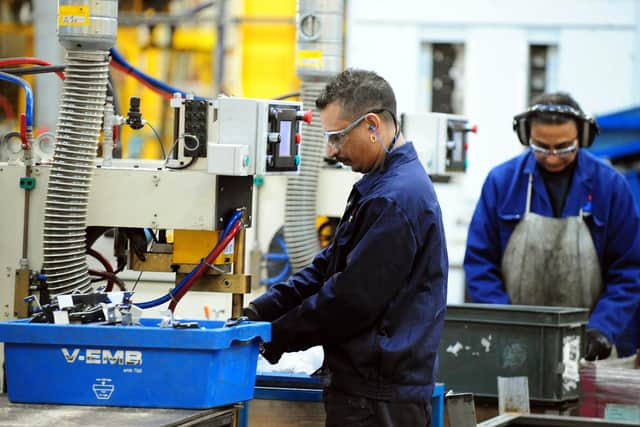

The stabilisation of output in Scotland compared with an accelerated rise in activity across the UK as a whole.
Sector data indicated that Scottish service providers recorded a fresh rise in activity in January. Respondents attributed the uptick to new customer wins and the commencement of projects. However, manufacturing output contracted, albeit at a slower rate.
The latest findings also signalled “continued cautious optimism” at private sector organisations regarding the 12-month outlook for output. Panellists stated that planned product releases and expansion into new markets were forecast to underpin growth.
Judith Cruickshank, Scotland board chair at Royal Bank of Scotland, said: “Our data shows that Scotland’s business community continued to face challenges at the start of 2026, with demand falling and inflationary pressures remaining stubborn.

“Business activity has stabilised, and we once again saw growth in services. However, we are not yet back to growth, manufacturing continues to contract and our overall performance was not as strong as many other nations and regions.
“Despite this, our growth tracker found that Scottish businesses continued to show hope of conditions improving over the next 12 months.”
Make sure you keep up to date with breaking news from across Scotland by signing up to our free newsletter here.
Scotland’s private sector recorded a 16th successive monthly fall in new orders during January. RBS said the pace of contraction had eased since December. Panellists noted that the higher cost of living and economic uncertainty had dampened sales.
Notably, Scotland reported the most marked reduction in new business across the tracker’s 12 monitored UK regions and nations. The north-west of England was the only other area to record a fall, with expansions registered across all other areas.
While the overall level of confidence across Scotland improved during the month, it was historically subdued and the second-weakest of the dozen tracked UK regions and nations, ahead of only Northern Ireland.
The tracker’s seasonally adjusted employment index was in contraction territory for a fourth straight month in January. The pace of job shedding across Scotland was described as “modest” but the fastest since last August.
Panellists often linked lower staffing levels to cost control measures, which included the non-replacement of voluntary leavers and redundancies. That said, the pace of payroll cuts north of the Border was weaker than the UK average.
The sustained reduction in new orders meant that firms were able to work through backlogs again during January, thereby stretching the current run of depletion to six months. The pace of reduction was the fastest since March last year and strong overall, RBS noted.
As has been the case since June 2020, average cost burdens at Scottish firms increased in January. According to panellists, higher supplier, labour and raw material costs were behind the latest uptick in operating expenses.
Efforts to pass on higher costs to clients where possible meant that selling prices across Scotland rose again last month. The pace of output price inflation was described as “solid”, but slightly weaker than in December and in line with the survey average.
Of the 12 UK regions and nations, Scotland and London recorded the joint-softest rates of output price inflation.
The latest RBS growth tracker came as a separate report from HSBC highlighted clusters of large businesses in Scotland that are outpacing the average UK growth rate for major firms.
Using data that draws on the most recent financial disclosures, the biannual HSBC UK tracker found that 50 per cent of Scotland’s fastest-growing large companies are located in clusters across Aberdeenshire, Edinburgh, Aberdeen and Glasgow.
Despite a backdrop of “continued economic uncertainty”, the bank noted that 157 large Scottish firms based in these clusters achieved annual turnover growth above the UK median rate for large businesses. The growth rates of 10.5 per cent between 2021 and 2024 outpaced the UK economy’s 7.73 per cent annual GVA (gross value added) growth over the same period.
Doug Baikie, head of corporate banking, Scotland, East Midlands, North of England and Northern Ireland at HSBC UK, said: “The performance of a relatively small number of large businesses will be critical to the success of the UK’s industrial strategy. Our research shows that the clusters we’ve identified in Aberdeenshire, Edinburgh, Aberdeen and Glasgow will play a central role in the UK’s future competitiveness.
“The UK economy is at a turning point and decisions taken here on investment, skills, research and development and supply chains will materially influence whether the UK meets its long-term economic ambitions.”
In Scotland, the clusters include digital and technologies, clean energy, and professional and business services, represented by growing businesses such as Aberdeenshire-based Ashtead Technology and Aberdeen’s Three60 Energy.
Digital and technology-focused corporates show growth spread relatively evenly across the four local authorities. HSBC said this pointed to a broad-based expansion of Scotland’s technology ecosystem, with Edinburgh, Aberdeen and Glasgow all contributing, rather than activity being concentrated in a single urban centre.
Comments
Want to join the conversation? Please or to comment on this article.