
Mike Welch OBE - tyres, entrepreneurship and the scaling-up conundrum
“Too often, business is presented as something academic or inaccessible, rather than something practical that people from any background can learn to understand”
More than a decade on from selling his Blackcircles online tyre fitting venture for £50 million, Mike Welch refuses to take his foot off the gas.
Which will come as little surprise to those familiar with the Liverpool-born entrepreneur, philanthropist and industry changemaker.
Since the age of 16, Welch has founded and scaled multiple businesses including Scotland-based Blackcircles, which was acquired by tyre giant Michelin in 2015. In May of this year, he announced the launch of Rolo Tires, a direct-to-consumer brand delivering “premium tyres at accessible price points”. It is being roll out to six European markets initially, including the UK.
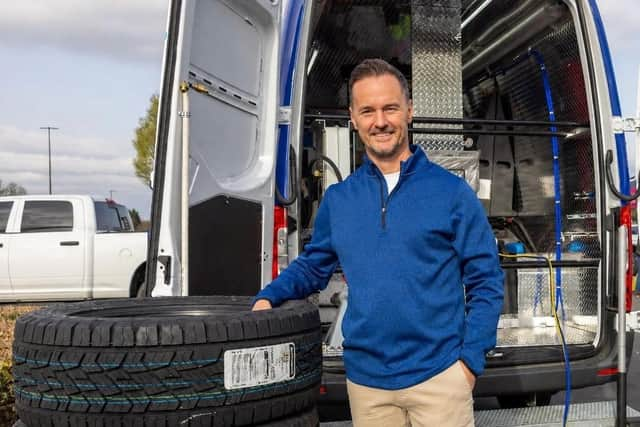

Welch, who was awarded an OBE for services to business and charity in 2016, tells us more about his latest project, what keeps him motivated and what ambitious businesses should do in order to scale.
How has the online tyre market changed and how are you adapting?
When I sold Blackcircles in 2015, online tyre retail was still largely about moving an existing retail transaction onto the internet. Today, the opportunity is much broader.
Consumers now expect transparency, convenience, rapid delivery and a direct relationship with brands. Marketplaces have also become hugely important, giving brands access to large customer bases while raising expectations around pricing, availability, fulfilment and service.

Technology now allows businesses to operate internationally with far less infrastructure than would previously have been possible. Today, cloud technology, digital marketing, international fulfilment partners and data tools allow businesses to test and enter markets much more efficiently.
The wider automotive market is also changing through electrification, connected vehicles, new ownership models and the growing role of software and data. Tyres remain one of the most important safety components on a vehicle, affecting braking, handling, comfort, efficiency and electric-vehicle range.
With Rolo, I am applying what I learned at Blackcircles, Tirescanner and TireBuyer, but this time from the position of owning the brand and product.
At Tirescanner and TireBuyer in the United States, I gained further experience in mobile installation, marketplaces, fulfilment and partnerships with major retailers. Rolo brings those experiences together.
What needs to be done to stimulate more entrepreneurship in the UK?
I think we need to make entrepreneurship feel achievable to people from every background.
I left school at 16 without particularly strong qualifications. I started my first business with a £500 grant from The Prince’s Trust. It gave me the ability to get started, but it also showed that somebody believed I was capable of building something.
We need more practical support at the earliest stage: access to small amounts of funding, experienced mentors, better financial education and more encouragement to take calculated risks.
Not every aspiring entrepreneur initially needs venture capital. Sometimes they need a few thousand pounds, help developing a basic plan and somebody experienced who will challenge and encourage them.
We should also expose more young people to entrepreneurship while they are still in education. It means showing them that it is a legitimate option and helping them understand the fundamentals of cash flow, pricing, sales, negotiation and risk.
Too often, business is presented as something academic or inaccessible, rather than something practical that people from any background can learn to understand.
We also need to stop treating failure as something shameful. Most entrepreneurs make mistakes. The important thing is whether they learn from the experience and have the confidence to go again.
What measures are required to boost scaling-up activity?
Starting a business and scaling one are very different challenges.
As the business grows, the challenges change. The founder has to build a leadership team, establish processes, manage more complex finances, enter new markets and make decisions that affect a much larger number of employees, customers and investors.
To scale, founders need access to patient capital, experienced leadership, international networks and people who have already been through the journey. We are reasonably good in the UK at encouraging start-ups, but less good at helping them become genuinely large international businesses.
However, I think we also need to be careful about putting too much pressure on founders to hold on and keep scaling at all costs.
I hear that argument a lot in Scotland and across the UK, but it is usually being made by people who are not actually carrying the responsibility themselves. Trust me, scaling a company is much easier to talk about than it is to do.
Founders should be supported whether they want to continue building, bring in new leadership, raise more capital, merge or sell. They have taken the risk, made the sacrifices and lived with the pressure. They do not owe the ecosystem a particular outcome.
The objective should be to give founders genuine choices, not to judge them for taking the route that works best for them, their families, their employees and the business.
Mentorship was also extremely important to me. From the beginning of Blackcircles, I surrounded myself with people who had experience in financial, legal and commercial areas that I simply did not have. They helped me ask better questions, avoid mistakes and navigate difficult challenges. We need to connect more scaling founders with that level of experience much earlier.
Tell us about your work beyond business:
In 2015, I established the Welch Trust to support causes focused particularly on children’s critical health, adoption and fostering, education and helping people get started in business.
My own background has had a major influence on those priorities. I was fostered from birth and adopted as a baby, so I understand how much a stable and supportive family can change the direction of a child’s life.
That is also why my involvement with the Dave Thomas Foundation for Adoption is particularly important to me. Its focus on finding permanent, loving families for children in foster care is closely aligned with the issues I care most deeply about.
One of the biggest societal challenges is ensuring that a child’s circumstances at birth do not determine the limits of their future.
For me, philanthropy is not simply about giving money. Financial support matters, but experience, networks and influence can also make a difference by raising awareness or opening doors that might otherwise remain closed.
The objective is to help create opportunities and outcomes that might not otherwise exist.
I also believe businesses and entrepreneurs can make an important contribution beyond traditional philanthropy. They can provide employment, mentorship, work experience and practical support to people who may not otherwise have access to those opportunities.
Comments
Want to join the conversation? Please or to comment on this article.