
Exclusive:The rise of beloved Scottish theatre which started out in a tent
A book detailing the history of Pitlochry Festival Theatre will be discussed in an event hosted by Alan Cumming

It began life as a tent seating almost 500 people constructed in the centre of Pitlochry after government rules deemed a theatre "not essential" enough to warrant the use of precious post-war building materials.
Now the history of Pitlochry Festival Theatre is to be told in a book published to mark its 75th anniversary, penned by one of its longest-serving trustees, who began research more than 15 years ago.
Scotland’s Theatre in the Hills: 75 Years of Pitlochry Festival Theatre by the venue's honorary president Colin Liddell, is to be launched in an in conversation event with the theatre’s artistic director, actor Alan Cumming, tonight.
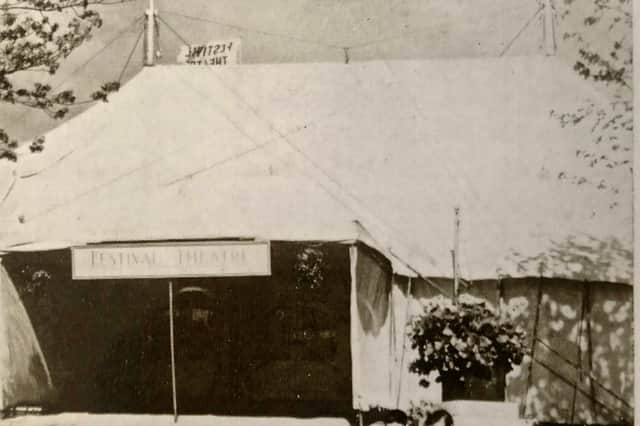

The venue was the brainchild of John Stewart, who had launched a successful theatre club in Glasgow. After “enigmatically” closing down Park Theatre in 1948, saying “Glasgow’s loss would be Scotland’s gain”, he began to make plans for a new venue in Pitlochry.
Unable to obtain building materials for a permanent structure due to post-war restrictions on building materials imposed by the Ministry of Works, Mr Stewart opted to create a tent in the centre of the town, in the grounds of his new home, Knockendarroch House.
He visited tented theatres in London and Birmingham, bought a large tent, ordered lights and managed to convince the government to allow him a small amount of steel and timber to finish the construction, before opening the new theatre in May 1951, with a production of Maxwell Anderson’s Mary of Scotland.
He called it Pitlochry Festival Theatre, after the Festival of Britain, which took place in the same year as a national, government-sponsored exhibition showcasing British achievements in arts, science, and technology to boost morale.

“John Stewart was going to create this theatre then, anyway, but he just latched on to the fact that there was the Festival of Britain, and therefore called it the Pitlochry Festival Theatre,” said Mr Liddell. “It's a funny name. I've had people in Edinburgh come up to me and say, ‘Oh, when does your festival start?”
“There was a massive move to increase culture after the war, because I think people realised that culture is what people need in times of in straightened circumstances.”
Mr Liddell began to research the theatre’s history during the 60th anniversary celebrations in 2010, not knowing his work would eventually form the basis of a book.
“I redid the archive, and I gave talks at that time, and since, about the theatre,” he says. “So the book, I suppose, in a way, came from those talks. I'd done a lot of research 15 years ago into the early days, I'd read all the minutes [of board meetings], I'd learned about John Stewart and his life as much as I could. And so I had quite a lot of stuff already.”
In the book, Mr Liddell tells the story of a note secretly placed by Mr Stewart in a road sign on the outskirts of Pitlochry during the war, close to where the current theatre, the second incarnation of the venue, now stands.

The note, which Mr Stewart retrieved after the opening of the theatre, said: “When peace is declared, I shall return to this spot to give thanks to God and to establish my Festival.”
“Every time I think about that story, it brings a tear to my eye,” said Mr Liddell, whose family has been involved with the governance of the theatre since the early days.
“Taking that note out seven years later and reading his promise to himself. The vision that he had, the determination, through really difficult circumstances - and he did it. What a man.”
Just over a year after the theatre’s opening, the tent was destroyed when a huge storm ripped the canvas, causing irreparable damage and leaving the theatre with a £5,000 loss for that year.
Mr Stewart, along with Kenneth Ireland, who had worked with Mr Stewart since his days in the Park Theatre, formed a charity and donated the belongings of the theatre, plus ownership of Knockendarroch House, before creating a more sturdy venue on the same site. Sadly, he died five years later, aged just 55.

Mr Liddell adds: “When the tent ruptured, he gave all the assets of the theatre and the house that he lived in, and everything to the charity, which still runs it. So his altruism saved the theatre, and that was more important to him than his own safety.”
In the mid-1970s, under the leadership of Mr Ireland, plans were created to rebuild the theatre on a new site. A £2 million fundraising drive was launched and the new building opened in 1981, by the then-Prince of Wales.
“The theatre's always been fleet of foot. It's always been able to switch and change,” says Mr Liddell, pointing to 2013, when Pitlochry lost £300,000 of Scottish Arts Council funding, along with St Andrews’ Byre Theatre, which closed for 18 months until it was bought by the university.
”We could have folded like the Byre Theatre, but we said, ‘darn it, no, we're going to put on more shows,” he says. “’We'll put on an autumn show, put on a Christmas show. Unfortunately, we’re going to have to employ fewer actors and we’re going to start some annual revenue schemes so we can get our supporters to become regular donors’ - and that’s how we survived.
Seven years later, when the Covid pandemic hit, then-chair Mr Liddell opted to use the time to implement phase one of an expansion plan, to create a second performance space, the Studio Theatre.
“We thought, while the theatre’s dark, instead of closing the doors to our audiences, because we’re closed anyway, get on and built the Studio Theatre, so that’s what we did during the Covid years.”
The theatre now hosts around a dozen major shows a year and has put on a total of 25 musicals. Last year, Mr Cumming was appointed as artistic director and has pushed to put Pitlochry on the map with a series of festivals and big-name performers. He also scrapped the traditional repertory structure, which allowed visitors to see multiple plays over consecutive days.

“It’s another example of the theatre being fleet of foot,” says Mr Liddell. “And saying, ‘Look, we’ve got an artistic director who’s got a direction of travel, wants to make these changes, so let’s see. It might not work, we might revert to the old style, but let’s see’.
“The old style wasn’t being massively successful.”
Mr Liddell, who first visited the venue as an eight year old in 1962, says the “theatre in the hills” is a rare resource in a rural community.
”When you think we've got 2,500 inhabitants in Pitlochry and 11,000, including children in Highland Perthshire, you think, ‘How can we have a theatre here?’” he says.
“There are so many aspects to Pitlochry that make it special and different and it just does weave magic.”
He adds: “I still pinch myself every time I go in the door, as I pinched myself as an eight year old.”
Comments
Want to join the conversation? Please or to comment on this article.