
The Alan Cumming Pitlochry stooshie and why Scotland should know how much it spends on art
Alan Cummings’ announcement has ruffled a few feathers in Pitlochry

This week Alan Cumming launched his first full programme as artistic director at Pitlochry Festival Theatre, having taken up the role earlier this year.
There's no doubt that it's an exciting line-up, including a production of musical My Fair Lady, in which Mr Cumming himself will play Henry Higgins, as well as the Scottish premiere of musical Once, with music by Glen Hansard and Markéta Irglová.
I'm already hearing that a few feathers have been ruffled among the good people of Pitlochry, who are unhappy the long-standing practice, under which a cast of actors are resident in the Perthshire town for months, performing a rotation of shows, is to be scrapped.
The system, once popular in regional theatres, has become increasingly unusual in recent times, with only a handful of theatres in the UK believed to still retain it.
Mr Cumming told me he believes from ticketing data that "very few" people actually took advantage of the rep system, where a visitor, or indeed a local, could watch multiple different plays on consecutive days.
Instead, the actor says he wants to fill the schedule with works by people he "knew and loved or admired", bringing a star-studded cast to Pitlochry and, he says, offering work to more people.
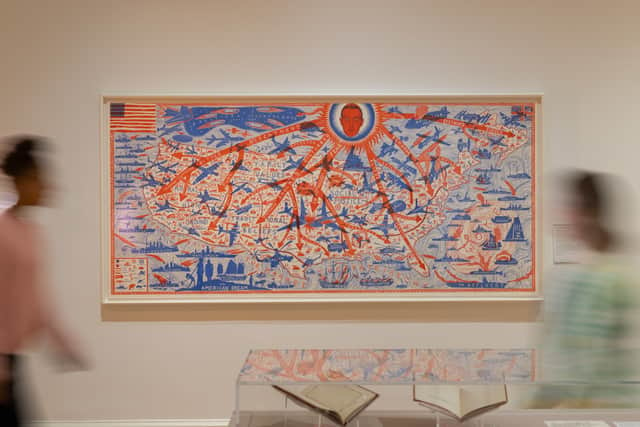

The Grayson Perry work acquired for the nation - through the nation’s joint account
Anyone who went to the smash hit Grayson Perry exhibition at the Scottish National Gallery on the Mound in Edinburgh two years ago will be delighted to hear that one of the works on display has been acquired for the nation.
The American Dream artwork, inspired by the Turner Prize winning artist's time crossing the US while filming The Great American Road Trip is described as an “epic satirical statement on our current culture wars”.
Yet the one thing that is not clear is how much the artwork is worth. If it has been acquired "for the nation", should the nation therefore not be allowed to know how much it has paid for it? That is not to say the nation would necessarily mind, just that it would be a good thing to know.
You might argue that if your partner bought you an expensive Christmas present, you wouldn't necessarily know how much it cost. But in this case, the money spent belongs to - or was raised by - the National Galleries of Scotland, a state-owned public body. So, it is perhaps more akin to the idea that your partner used your joint account to buy you the present - but still insisted on concealing the cost.
When a Barbara Hepworth's Sculpture with Oval became available to be acquired for the nation, a £3.8 million national funding drive was launched by privately owned gallery the Hepworth Wakefield. Again, three years ago, the Derby Museum and Gallery made an acquisition "for the nation" of a work by locally-born artist Joseph Wright. The gallery is run by a charitable trust, but still publicised the £2.2m funding it pulled together for the acquisition.
Yet the price of another artwork acquired for the nation by the National Galleries of Scotland (NGS), a portrait of Professor Dame Sue Black, in 2023, was also not revealed at its time of acquisition.
The potential cost of the Grayson Perry work is tricky to guess at. But for comparison, in June last year, one copy of the etching went for £32,000 at an auction held by Bonhams in London. Arguably not a huge amount in the world of art, but still a figure we should know.
I did ask NGS (repeatedly) for the price, but I never got an answer. It's time for them to be more transparent.
Comments
Want to join the conversation? Please or to comment on this article.