
Edinburgh Fringe theatre reviews: THIS IS NOT ABOUT ME. | Centre of the Universe | What ever happened to Harmony Banks? | Ego Show | Body Count
Egotism runs rampant at the Fringe this year in a flurry of shows examining the dark but sometimes funny side of narcissism. Sally Stott goes on a voyage of self-discovery
THEATRE
THIS IS NOT ABOUT ME. ★★★☆☆
Summerhall (Venue 26) until 25 August
THEATRE
Centre of the Universe ★★★☆☆
Summerhall (Venue 26) until 25 August
DANCE, PHYSICAL THEATRE AND CIRCUS
What ever happened to Harmony Banks? ★★★☆☆
Assembly @ Dance Base (Venue 22) until 10 August
MUSICALS AND OPERA
Ego Show ★★★☆☆
Greenside @ Riddles Court (Venue 16) until 09 August
THEATRE
Body Count ★★★★☆
Pleasance Courtyard (Venue 60) until 25 August
Navel gazing narcissists: at this year’s Fringe it feels like there’s almost as many of them on stage as off. No longer do you have to wait until you’re forced to “squeeze up” in a venue queue to witness a woman wearing five lanyards talk about drinks with Charli XCX with the kind urgency usually reserved for nuclear attack. Nor do you need to be relaxing in a deckchair off the Mile to hear teenage boys telling one another “We NEED to go and see some burlesque” as if it’s time-sensitive medication. No, in 2025, there’s plenty of opportunity to experience such levels of self-absorption within the shows themselves in a way that might even answer the question: why is everyone* at the festival like this?
In THIS IS NOT ABOUT ME., Grace (Amaia Naima Aguinaga), a self-absorbed writer attempts to get over the end of her friendship-turned-relationship with boyfriend Eli (Francis Nunnery). “My truth is the truth, and your truth is bullshit,” she says. Like When Harry Met Sally with a dose of 21st century psychological analysis, it explores the threat that trying to start a romantic relationship can cause to an otherwise functioning friendship. With a self-referential story by writer Hannah Caplan that’s always on the edge of eating itself, the script’s snappy and sometimes deliberately not-snappy dialogue explores how constructed conversation can feel “real” when it’s anything but.


It’s refreshing to watch a play about a female megalomaniac literary figure and her on-again-off-again male muse – a subversion of the usual gender dynamic for the writers-writing-about-writing genre. Grace is fuelled by machismo but also fear, whether it’s in relation to her work or potential partner, and in different doses these emotions help her to create or destroy. How to find a more honest language, while exploring whether this is even possible in something as dishonest as a play -- particularly one with a beautifully constructed immersive set – is what this experimental and unresolved romcom boldly attempts.
The façade continues in Centre of the Universe, where a spotlight has been solidified into the stage as part of a super stylish production design. Here, 15-year-old Mary – played by writer/performer Gaia Mondadori – embarks upon a quest for abstract fame that becomes increasingly frantic as she approaches her cut-off age of 23. Guided by a TikTok guru, called Gabriella Dios, who advocates seeking superficial success at the expense of family, friends and fellow audience members, Mary starts off intense and only gets more so, as well as increasingly funny, as her goals to “be great” and “light up a room” override any sense of a reason why.
Mondadori’s energy-consuming magnetism struggles to find sufficient variation over the course over an hour’s monologue, but the cartoonist twists and turns of a story that eventually sees her wily, wiry character scrabbling about in bins, creeping around behind closed windows and disguised as the police, offer a refreshingly surreal depiction of the search for fame.
In What ever happened to Harmony Banks? an ego is exhausted – specifically that of Tess Letham’s Lady-Gaga-Gwen-Stefani-Lana-Del-Ray-inspired pop star, who’s achieved the celebrity status but spent so much time speaking platitudes to the media that she’s forgotten how to do anything else. “Freedom of expression is what I am,” she says, dead-eyed and deflated, barely able to remain upright on a golden chaise longue to answer questions on yet another TV chat show.
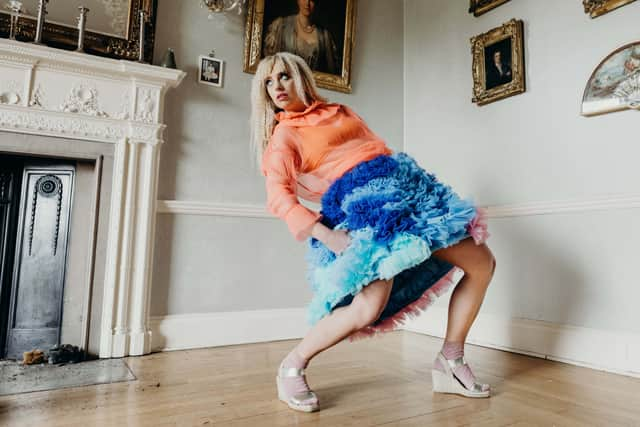
A mix of theatre, performance art and pop routines distilled into their fundamental parts, it’s unafraid to sit in its own silence between numbers. As the emptiness of fame mimics the emptiness of the stage, the piece offers a welcome break from shows in the earlier phases of egomania but, after sitting for slightly too long in the blue light and shadows, also makes you miss them when they’re gone. As this fading star’s moves are isolated, between pushing a billboard of herself about, she disintegrates and integrates into something more freeform, capturing a child-like energy before her childhood self appears in a home video at the end, still staring into the camera.
The high energy returns in Ego Show, where writer Keith White, playing both himself and his sunglasses-wearing Ego, explores how much self-love is useful, healthy and bearable by a Fringe audience or anyone else. Through different musical styles, often with a powerful 1980s vibe underpinning them – rap, musical theatre, power ballads – the piece revolves around comic character studies of individuals who either have or haven’t benefited from their egotism or lack of this.
Make sure you keep up to date with Arts and Culture news from across Scotland by signing up to our free newsletter here.
It's a great opportunity for White to demonstrate his range as an actor while playing an actor about to give up on his dreams (which clearly that hasn’t happened), a coke-addled banker, social media superstar and, particularly poignantly, a university professor forced to leave his position leading the sociology department.
With music supervision by Nicholas James Connell, it’s a fun and imaginative piece somewhat constrained by its episodic structure that asks interesting questions about whether self-obsessed individuals are something to be avoided or if their energy is a vital force upon which we can all feed.
In Body Count, a battle over a woman’s body is taking place – between her and the 1000 strangers from her OnlyFans webpage who she’s arranged to sleep with as part of her “record-breaking” Fringe show. It sounds the kind of thing that might happen in certain corners of the internet or Channel 4, then that’s because it does. But in this piece, written and performed by Issy Knowles, who plays former corporate consultant Pollie, it satirises porn by stripping away its formulaic theatricality and replacing it with her own, which is funnier, bleaker and, unlike much of the content it’s based on, fuelled by an extremely sharp script.
“Slap me, spit on me, make me yours … just don’t kill me,” she says, her steely smile and two-part naked female latex bodysuit ever unsettling. “What part of this is sexy to you?” an unseen interviewer asks at one point. But really, it’s less about sex than ownership, in particular Pollie’s cut-off determination to use her body as she wants versus the equally well-caricatured men who believe that, in doing so, her body belongs to them. It’s an arresting, provocative and uncomfortable show from a talented and brave theatre maker (behind 2018’s similar comic-horror Model Behaviour) who it’s good to see back at the Fringe. By the end, I need a drink. Thank goodness I called Charli earlier.**
*Not everyone
**Yes everyone
SALLY STOTT
Comments
Want to join the conversation? Please or to comment on this article.