
What is Maundy Thursday? History of the holy day, what Maundy means and Maundy money explained

The King and Queen will be attending a special service at Durham Cathedral to mark the day.
Today (April 17) will see Christians all over the world celebrate Maundy Thursday - part of the Easter traditions.
While most of us will be more than familiar with Good Friday and Easter Sunday, we may be less au fait with the fifth day of Holy Week.
Here’s everything you need to know.
What is the history of Maundy Thursday?
Maundy Thursday takes place in Holy Week and falls on the day before Good Friday each year.
The day commemorates the Last Supper, during which, according to the Bible, Jesus rose from the table and washed the feet of his disciples.
According to the Bible, Jesus told his disciples: “If I then, your Lord and Master, have washed your feet; ye also ought to wash one another's feet.” This is a Christian rite known as ‘Maundy’.
However, at that time, it was the lowest servant who would usually wash people's feet, so Jesus performing the Maundy showed his humility, and set an example to his disciples to always treat each other as equals.
Later that evening Judas, one of Jesus’ disciples betrayed him, which led to his arrest and crucifixion.
Where does the word ‘Maundy’ come from?
The word ‘Maundy’ is an Anglo-French word, which is derived from the Latin ‘mandatum,’ meaning ‘commandment’.
The term refers to when Jesus said to his disciples: “A new commandment I give you, that you love one another; even as I have loved you, that you also love one another,” during the last supper.
Why does the date of Maundy Thursday change so dramatically from year to year?
This year, Maundy Thursday lands on Thursday April 17, but the date changes each year, as do the other dates of the Holy Week.
The reason the dates change each year is because the Christian Church's council of Nicaea decided that Easter would be the first Sunday that came after the Pascha (or Passover) full moon - the first to appear after the Spring Equinox.
This means that Maundy Thursday can fall anytime between March 26 and April 29.
What is Maundy money?
The Monarch usually marks Maundy Thursday by giving out special commemorative coins called Maundy money - a tradition with origins dating back to medieval times.
Although the Monarchy used to give money to the poor alongside washing their feet, the foot-washing ended with King James II in the late 1600s.
The King usually offers ‘alms’ on Maundy Thursday, travelling to a church in a different UK location each year for the Royal Maundy Service.
The 2024 event was held at Worcester Cathedral, where Queen Camilla presented 75 men and women (signifying the age of King Charles) with the special coins.
This year the King and Queen will be attending a service at Durham Cathedral.
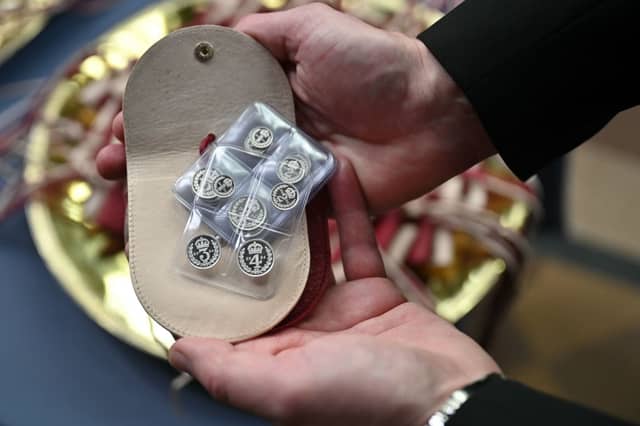
The lucky recipients receive two purses - one red and one white. The red purse contains a £5 coin and a 50p coin, and the white purse includes specially minted Maundy Money which is made up of one, two, three and four penny pieces.
With fewer than 2,000 sets struck in most years, they are highly sought-after by collectors.
Comments
Want to join the conversation? Please or to comment on this article.