
Osvaldo Golijov on setting the crucifixion story to music: ‘Straight away I said no, I’m Jewish’
Initially reluctant to get involved in reimagining the Easter Passion, Osvaldo Golijov eventually came around to the idea, with explosive results. Interview by Ken Walton
The Easter Passion sits at the pinnacle of Christian ideology and belief. For composers, from 18th century German Lutheran Johann Sebastian Bach to 21st century Roman Catholic Sir James MacMillan, it has inspired music of overwhelming personal reflection, reverential sincerity and spiritual depth.
So what happens when you ask a 21st century Latin American Jew to try his hand at setting the crucifixion story, especially one who thinks nothing of razzing up an opera (Ainadamar, which Scottish Opera dazzlingly staged in 2022) with authentically steamy Flamenco, throwing in a mambo where Bach might have settled for a pious chorale, or collaborating with iconic film director Francis Ford Coppola to write the soundtrack for the veteran director’s controversial utopian sci-fi extravaganza Megalopolis, which premiered in May at Cannes?
Initially, Osvaldo Golijov would have none of it. He’d been approached on behalf of the International Bach Academy in Stuttgart by German conductor and founder/director of the Oregon Bach Festival Helmuth Rilling. In commissioning four Passion settings, one for each of the Gospel texts and to celebrate the 250th anniversary in 2000 of Bach’s death, Rilling had identified composers who might not seem the obvious match. “Straightaway I said ‘no, I’m Jewish’,” recalls Argentine-born Golijov. The others were Wolfgang Rihm, Sofia Gubaidulina and Tan Dun.

Rilling persisted. “‘I’m not going to give you a problematic text’, he promised me. We settled on the St Mark version, a straightforward account with some beautiful images that suddenly spark, just like a good journalist’s report.” Rilling’s only diktat was: “use the text, then you can do whatever you want”.
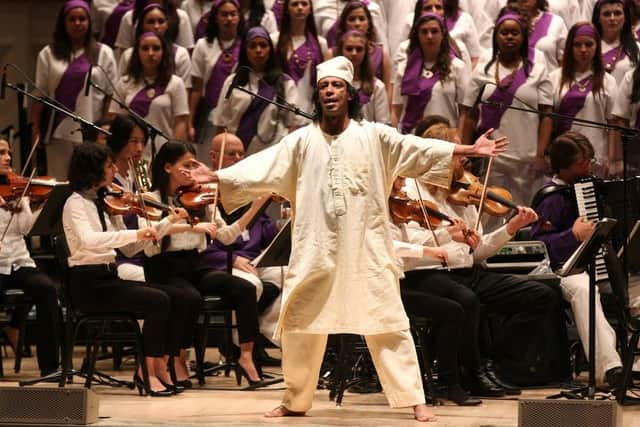
Audiences at next month’s Edinburgh International Festival performance, which opens the Usher Hall concert series, should brace themselves for just how far Golijov was prepared to go. Unlike Bach – whose St Matthew Passion is performed the following night by the Edinburgh Festival Chorus and BBC Scottish Symphony Orchestra in its 19th century Mendelssohn makeover – La Pasión según San Marcos is a polystylistic riot of costumed colour, Afro-Brazilian capoeira and dance, pulsating Latin American drumming, fiery salsa and sensuous tango, with psalm settings based on Argentine pop and a menagerie of classical references that stretch from Gregorian chant to astringent modernism.
One New York Times critic spoke of the “visceral appeal that speaks to listeners whose musical interests are not bounded by the traditions of the classical concert hall.” For Golijov, that was simply a genuine reflection on how South Americans relate to the Easter festivities. “First, I asked myself how is the Passion different in Latin America from how it is in Germany or England?” The answer, he reckoned, was the Latin American perception of it as ritualistic and transformational, especially in Brazil and Cuba, influenced also by Yoruba religious traditions imported historically from West Africa through slavery.
Rhythm is therefore key. “Rather than the kind of European recitative favoured by Bach, I was more drawn to the power of the sacred talking drums, and the type of chanting through which news was traditionally passed on in Latin America. Bach shifts gears with harmony; I shift gears with percussion.”
Underlining the cross-cultural dimension are artists that have both inspired and travelled with the piece: the dazzling stylistic versatility of the Schola Cantorum de Venezuela (also appearing separately in the Festival’s Queen’s Hall series), Cuban vocalist and dancer Reynaldo González Fernández, and Brazilian jazz vocalist Luciana Souza. In Edinburgh they’ll be joined, under Portuguese conductor Joana Carneiro, by members of the RSNO, the National Youth Choir of Scotland and Puerto Rican-American soprano Sophia Burgos.
In such a feverishly eclectic score that interweaves Spanish poetry, Latin, Hebrew and Aramaic texts, and ends with a Kaddish prayer for the dead, will Scots musicians slip easily into its multiple vibe? “The choir, once they hear the Schola Cantorum, will quickly get it,” Golijov believes. “The biggest challenge will be for the brass, but these days most players know their Latin and jazz. We bring our own percussion people.”
Is Golijov glad he caved in to Rilling’s persuasiveness? “Absolutely. This Passion is my voice. I grew up where I grew up, a Jewish guy among Latin American Christians, most of whom were Catholics. I’m simply being true to who I am.”
Osvaldo Golijov’s La Pasión según San Marcos opens the Edinburgh International Festival’s Usher Hall series on 3 August, see www.eif.co.uk