
From a nuclear tartan to 200 military bases, Scotland's Cold War secrets revealed
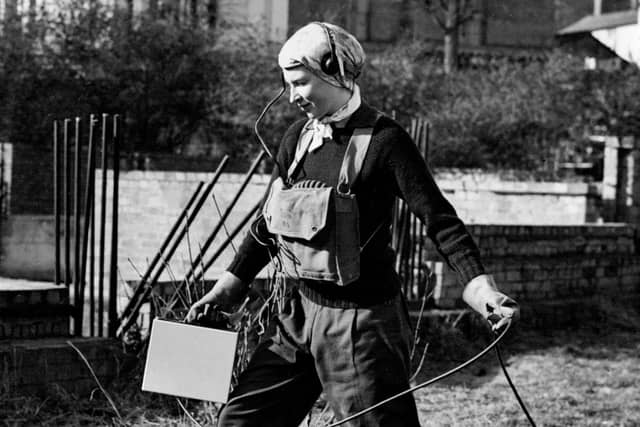

A new exhibition at the National Museum of Scotland takes a look at the impact of tensions during the postwar years of the nuclear age, writes curator Dr Sarah Harper.
A new exhibition at the National Museum of Scotland explores Scotland’s critical position on the frontline of the Cold War. Over 190 objects, many on display for the first time, are brought together in Cold War Scotland to tell the stories of the Scots at the centre of this global conflict.
The exhibition and an accompanying book are part of Materialising the Cold War, a collaborative research project between National Museums Scotland and the University of Stirling. Funded by the Arts and Humanities Research Council, the project explores how Cold War heritage is represented in museum collections and how these often unexpected stories can be told in museums now and into the future.
This excerpt is adapted from the book, also titled Cold War Scotland, which delves into the impact of the Cold War on Scotland’s social, political and technological history.

In the autumn of 1962, the world was on the brink of nuclear war, and Scotland was a potential battlefield. American bombers stationed on British air bases were loaded with nuclear weapons, with crews in a state of constant readiness. Vulcan bombers of the Royal Air Force were on what was known as ‘Quick Reaction Alert’ – able to take off within 15 minutes.
The 59 Thor nuclear missiles positioned across Britain were also on standby; and six submarines stationed at the Holy Loch – half an hour’s drive from Glasgow – were at sea, fully armed with nuclear missiles. Only 17 years after the end of the Second World War, Scots, like many others in the United Kingdom and around the world, once again feared that war was coming. This episode became known as the Cuban Missile Crisis.
Just a few years later, Alexander MacIntyre of Strone designed a tartan for the personnel of the American submarine base at the Holy Loch; it was registered as ‘Polaris Military’ after the nuclear-capable submarine-launched ballistic missile. The pattern includes navy blue to represent the naval uniform, dark green for the depths of the oceans, and the royal blue and gold overchecks represent the ‘Blue’ and ‘Gold’ crews who alternate on duty on the submarines armed with the missile.
The Polaris Military tartan embodies the cultural and physical impact of the Cold War in Scotland: the close relationship between the military and civilian life, especially in technology; the importance of Scotland’s characteristic topography; and how enmeshed the nuclear war element of the ‘imaginary war’ was in everyday life.
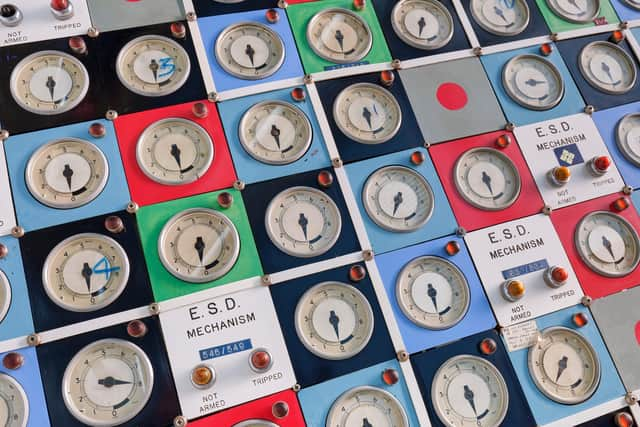
The Cold War featured in Scottish life not only in the environs of the lochs on the Scottish west coast in which the Polaris submarines were stationed, but also more widely. Scotland’s geography made it strategically critical during the four-decade nuclear stand-off between East and West. Although in Europe this Cold War never turned ‘hot’, there were profound consequences for those on the northern frontline.
Especially in the earlier decades of the conflict, Scotland’s situation overlooking the so-called ‘GIUK Gap’ (Greenland, Iceland and the United Kingdom) – through which Soviet vessels needed to travel to reach North America via the Atlantic – made it crucial for the United States and its allies. There were over 200 military bases and installations in Scotland at the height of the Cold War, including the Royal Navy and US Navy bases on the Clyde. Scotland’s physical geography was not only important for storing weapons. It also provided ideal locations for the generation of nuclear power. Scotland was – and, arguably, remains – a nuclear nation.
At the 1951 Festival of Britain – intended to shake off the post-war social and economic malaise and parade British success in the arts and sciences – there were nuclear motifs on everything from wallpaper to an atomic clock. Concentrated at the South Bank Centre in London, there were also festival events and displays across the country, including an industrial show at Kelvin Hall in Glasgow and an arts exhibition in Edinburgh at the Royal Scottish Museum (now the National Museum of Scotland).
The Festival was not the only evidence of wider optimism and a welcoming of the prospect of nuclear power. Nuclear energy became the source of hopes as well as fears. American President Dwight D. Eisenhower’s phrase ‘Atoms for Peace’ echoed throughout the 1950s on both sides of the Atlantic.
This optimism especially focused on civil nuclear reactors, which promised abundant, cheap, clean energy. The United Kingdom promised to be a world leader in their development. Those parts of the country embracing this bright future would be lifted from the economic privations of the immediate post-war. This ideal, this nuclear dawn, appeared bright and cheerful.
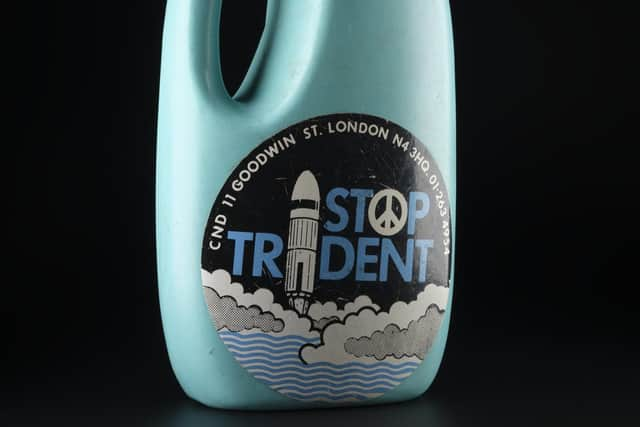
However, early atomic optimism faded as the nuclear energy revolution failed to live up to its early promise. The Scottish Campaign to Resist the Atomic Menace (SCRAM), was founded in 1976. Among SCRAM’s arguments were concerns about the disposing of nuclear waste, but this later widened to oppose nuclear power in general and in organising significant anti-nuclear demonstrations.
The realities of being a Cold War nuclear frontline became part of the Scottish lived experience in other ways too. From the decision to accommodate the American submarine base at the Holy Loch, Scotland’s extra security also clearly made it a potential target for proactive attacks or a nuclear retaliation.
This was not mere fantasy. The Soviet authorities had a detailed understanding of Scottish geography. Not only were military bases at Clydeside of interest, but so were other elements of civilian and military infrastructure. It is now known that the radar station at Saxa Vord on Unst, for example, would have been a possible target for a three-megaton bomb.

In the era of thermonuclear weapons, given the location of populations and military infrastructure, the whole Central Belt and much of Scotland’s coastline and north islands would have been targeted to devastating effect. Watchfulness, readiness and the mobilisation of Scottish society and infrastructure were all ways to manage the apprehension that such a prospect generated.
However, the United Kingdom and the United States had not based nuclear weapons in Scotland to fight a nuclear war with the Soviet Union, but rather, in principle, to prevent one. Even so, the end of the Cold War did not spell the end of nuclear weapons, nor of nuclear power in Scotland. The country was irrevocably changed; and so were its people.
Cold War Scotland is a free exhibition running at the National Museum of Scotland from Saturday until 26 January 2025. The accompanying book, Cold War Scotland by Samuel J.M.M. Alberti, Holger Nehring, Jessica Douthwaite and Sarah Harper, is published by NMS Enterprises Limited Publishing.