
Album reviews: Bon Jovi | Richard Hawley | Horse | Xan Tyler
There’s no shortage of positivity in Bon Jovi’s new collection of fist-in-the-air songs, but where’s the depth wonders Fiona Shepherd
Bon Jovi: Forever (EMI) **
Richard Hawley: In This City They Call You Love (BMG) ****
Horse: The Road Less Travelled (Randan) ****

Xan Tyler: Holding Up Half The Sky (Last Night From Glasgow) ****
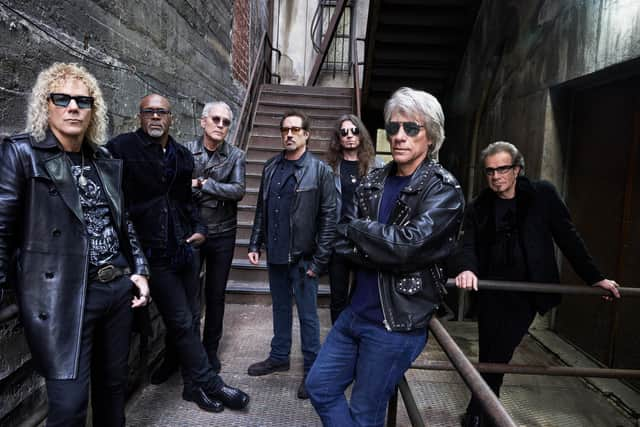
Bon Jovi hit their 40th anniversary with a feelgood optimism which presses all the standard stadium rock buttons. They open new album, Forever, with the buffed blue collar pop/rock of Legendary, which lands somewhere between Snow Patrol and Harry Styles. Then onwards, with no time to waste to We Made It Look Easy, a sepia singalong swathed in Coldplay-style pounding pianos.
You can’t deny the broad appeal of custom written fist-in-the-air arena fodder such as Walls of Jericho but where is the depth? For all the pummelling positivity, there is a shadow over Forever. Anniversary docu-series, Thank You, Goodnight details Jon Bon Jovi’s recent vocal travails, requiring reconstruction surgery and an exercise regime. Yes, he sounds vocally depleted as he overreaches on I Wrote You A Song. But if the song he had written was better, would it not highlight the vulnerabilities rather than deficiencies of his voice?
Perhaps there is an album of croaky confessionals in there biding their time. For now, Bon Jovi indulges in the father of the bride schmaltz of Kiss the Bride and the sub-Springsteen nostalgia of My First Guitar, which conjures up unwelcome comparisons with Queen’s I’m In Love With My Car. The country-flavoured pleading of Hollow Man is the flipside of that feeling of youthful invincibility but even so, Bon Jovi is sanguine about that agonising wait for inspiration to strike.

Richard Hawley, in contrast, hits the spot the moment he lays his hand on a guitar or opens his mouth to croon. Latest album In This City They Call You Love takes its title from centrepiece track People, another paean to his native Sheffield. With the exception of the Buddy Holly rockabilly rumble of Deep Space and stormy guitars of Have Love, this is ravishing ballad country, from the wistful twang of Heavy Rain and the loping Hank Williams-referencing Hear That Lonesome Whistle Blow to the intimate, sonorous well of Deep Waters and the bossa nova shuffle of Do I Really Need To Know?
Glasgow singer/songwriter Horse is another singer of distinction. Her eighth album, The Road Less Travelled, is a lushly produced affair with Horse pushing her voice to extrovert heights, whether on the triumphal pop/rock of Leaving or flexing her vocal muscles on positive soul pop number Superpower, on which she lists her attributes as “singing, dancing, loving, giving” before inviting a chorus of young voices to chime in with their superpower.
The likes of Starlight and Hungry Ghosts are reminiscent of Texas in exultant symphonic pop mode and there is much to love here for fans of hearty, commercial Scotpop. However, balladry is her strong suit. She kills softly on She Said and owns the melodramatic angst on Heaven (Something Made Me Fall). By Forever Lonely, she is hanging on by her fingertips, “breathing to stay alive” in full torch song mode before lapping waves usher in The Moon And I, her most tender moment, soundtracked by limpid piano and solo violin.
Singer/songwriter Xan Tyler is a veteran of Nineties synth pop duo Technique as well as collaborations with various dub and dance artists, from Mad Professor to Timo Maas. Holding Up Half the Sky is her first abum under her own name, with production and co-writing from Boo Hewerdine. Tyler takes her lead from the life stories of inspiring women, from her own family to Sicilian photojournalist and bane of the Mafia Leizia Battaglia, and has commissioned a piece of artwork for each song by a different female artist. As to the music, she is equally at home with the fragrant folk pop of Miniature Oceans, vaudeville swagger of Rebecca’s Desk, sunshine reggae brass blast of Ziggy and the quasi-gothic march of The Devil’s Hand.

CLASSICAL
Bach: Brandenburg Concertos – The long-forgotten 1932-34 Alois Melichar Berlin Recordings (Danachord) ***
Some will find these remastered 1930s recordings of (mainly) pre-war Berlin Philharmonic players performing Bach’s six Brandenburg Concertos quirkily antique. Others may cherish the fact they are, for their time, remarkably progressive. The man principally in charge is conductor Alois Melichar, commissioned by the orchestra to lighten aspects of its repertoire for which he often turned to Bach and interpretations that pre-echo in spirit the sprightlier early music movement that was to develop decades on. Particularly striking is the bouncing energy Melichar elicits in such dazzling moments as the Concerto No 2 with its crisp, stratospheric trumpet playing, or the oak-toned lower-string dominance of No 6. Missing from his collection is No 3, with two contrasting versions put in its place: Fürtwangler’s 1930 recording, and a hissy 1920s performance by Eugene Goosens and the Royal Albert Hall Orchestra. A mixed bag perhaps, but fascinating nonetheless. Ken Walton
FOLK
Rum Ragged: Gone Jiggin’ (LHM Records) ****
The migration of songs and tunes from old country to new and their subsequent mutation is a fascinating process, not least in this fifth album by the award-winning Rum Ragged who hail from that melting pot of cultures, Newfoundland. The opening track, The Road to Lushes Bight, is a stomping litany of island life and environment, while influences from Irish greats such as Planxty become evident in the compelling, string-driven Paddy Hyde, about a fisherman’s hard times, in the whimsical Riley, or in the jig-time narrative of Kelly’s Ghost. These are tuneful yarns and they really tell ’em. Fiddle and accordion-led sets tread the boards nimbly, as in Ray Head’s, which opens with a winsome air then steers close to a Kerry polka. And Yarrow’s dowie dens, haunted by tragic balladry, become the Dewy Dells here, although the proceedings are hardly less sanguinary than the Border original. Jim Gilchrist